Chapelle Saint Gabriel – Tarascon
Description
English
Deutsch
Dutch
Español
Italiano
Description
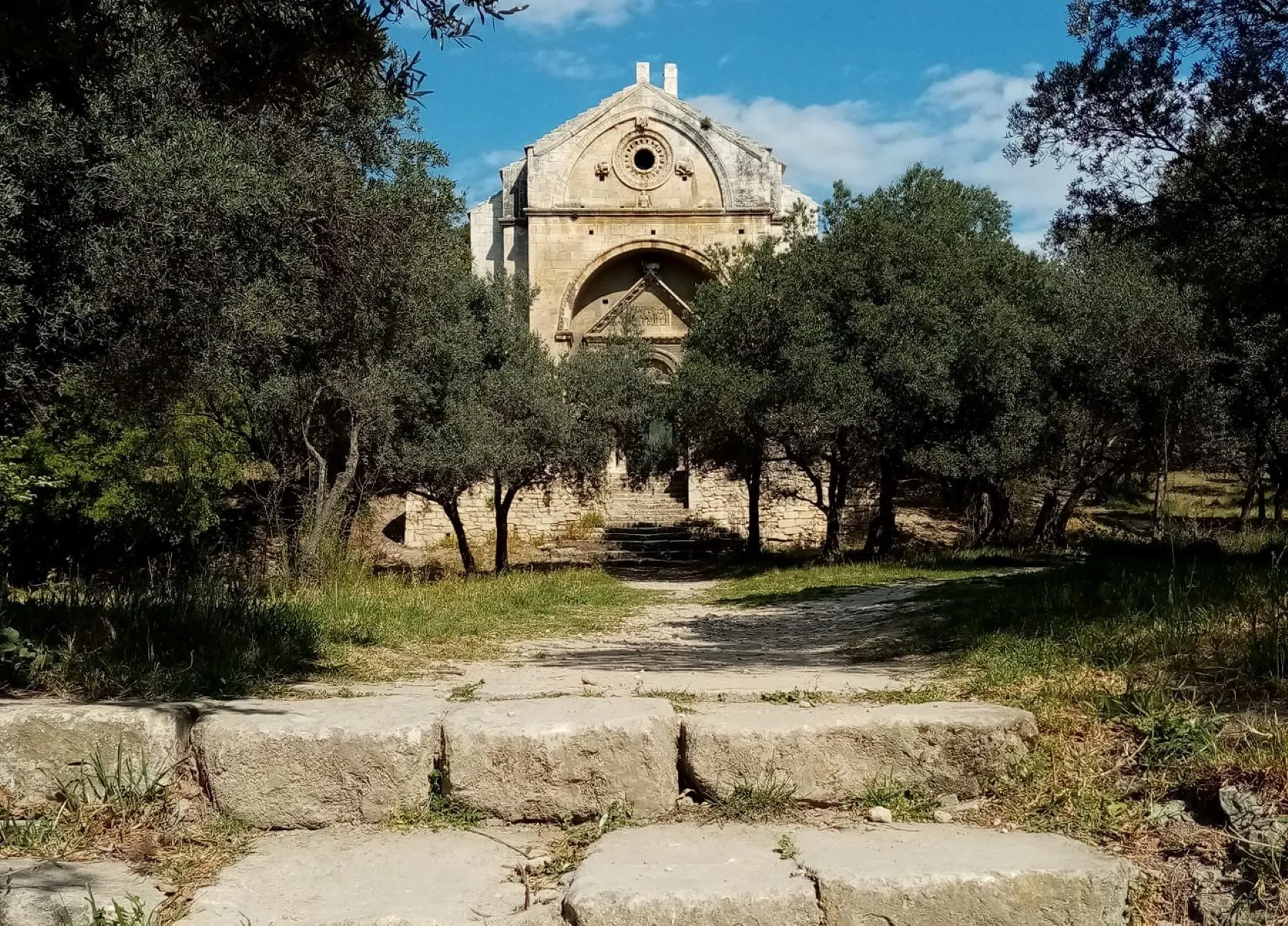
C'est quelle est bien belle notre chapelle lorsque la teinte inimitable de la pierre se détache avec la luminosité de son environnement naturel de notre massif des Alpilles !
Entourée d'oliviers, cette église dont parle Prosper Mérimée dans son ouvrage "Notes d'un voyage dans le Midi de la France" de 1835 est un chef-d’œuvre de l’art roman méridional.
La chapelle offre en effet aux visiteurs un riche décor extérieur sculpté. La façade de la chapelle Saint-Gabriel est inspirée des décorations romaines du Bas-Empire. Elle est datée de 1180 par comparaison de son oculus avec la voussure du portail occidental de la cathédrale de Saint-Paul-Trois-Châteaux.
Dans la partie supérieure, une archivolte originale entoure un oculus orné de feuilles et de masques, et flanqué des symboles des quatre évangélistes : Jean (l'aigle), Matthieu (l'homme), Luc (le taureau) et Marc (le lion), dont la disposition (avec le symbole de Jean placé en haut) est une réminiscence carolingienne.
La partie basse est un hommage à Saint Gabriel. Un grand arc abrite la porte encadrée par deux colonnes surmontées d’un fronton triangulaire sur lequel repose l’agneau pascal.
Le fronton triangulaire repose sur deux colonnes dont on admire encore aujourd’hui les chapiteaux corinthiens, ornés de deux rangées de feuilles d’acanthes.
English
How beautiful our chapel is, when the inimitable hue of the stone stands out against the luminosity of its natural surroundings in the Alpilles mountains!
Surrounded by olive trees, this church, described by Prosper Mérimée in his 1835 book "Notes d'un voyage dans le Midi de la France", is a masterpiece of Southern Romanesque art.
The chapel offers visitors a richly sculpted exterior. The façade of the Saint-Gabriel chapel is inspired by Late Roman decorations. Its oculus is dated 1180, based on a comparison with the voussure of the western portal of Saint-Paul-Trois-Châteaux cathedral.
In the upper part, an original archivolt surrounds an oculus decorated with leaves and masks, and flanked by the symbols of the four evangelists: John (the eagle), Matthew (the man), Luke (the bull) and Mark (the lion), whose layout (with John's symbol at the top) is reminiscent of the Carolingian period.
The lower part is a tribute to Saint Gabriel. A large arch houses the door, framed by two columns surmounted by a triangular pediment on which rests the Paschal Lamb.
The triangular pediment rests on two columns whose Corinthian capitals, adorned with two rows of acanthus leaves, can still be admired today.
Deutsch
Wie schön ist doch unsere Kapelle, wenn die unnachahmliche Farbe des Steins sich von der Helligkeit ihrer natürlichen Umgebung in unserem Alpilles-Massiv abhebt!
Die von Olivenbäumen umgebene Kirche, die Prosper Merimée in seinem Werk "Notes d'un voyage dans le Midi de la France" von 1835 erwähnt, ist ein Meisterwerk der südländischen Romanik.
Die Kapelle bietet den Besuchern eine reiche Ausstattung mit Skulpturen an der Außenseite. Die Fassade der Kapelle Saint-Gabriel ist von den römischen Dekorationen des späten Kaiserreichs inspiriert. Sie wird auf das Jahr 1180 datiert, indem ihr Okulus mit dem Gewölbe des Westportals der Kathedrale von Saint-Paul-Trois-Châteaux verglichen wird.
Im oberen Teil umschließt eine originelle Archivolte einen mit Blättern und Masken verzierten Okulus, der von den Symbolen der vier Evangelisten flankiert wird: Johannes (der Adler), Matthäus (der Mensch), Lukas (der Stier) und Markus (der Löwe), deren Anordnung (mit dem oben platzierten Symbol des Johannes) eine karolingische Reminiszenz ist.
Der untere Teil ist eine Hommage an den Heiligen Gabriel. Ein großer Bogen beherbergt die Tür, die von zwei Säulen eingerahmt und von einem dreieckigen Giebel überragt wird, auf dem das Osterlamm ruht.
Der dreieckige Giebel ruht auf zwei Säulen, deren korinthische Kapitelle mit zwei Reihen von Akanthusblättern noch heute zu bewundern sind.
Dutch
Hoe mooi is onze kapel, wanneer de onnavolgbare tint van de steen afsteekt tegen de helderheid van de natuurlijke omgeving in de Alpilles!
Omringd door olijfbomen is deze kerk, die door Prosper Mérimée wordt genoemd in zijn boek "Notes d'un voyage dans le Midi de la France" uit 1835, een meesterwerk van de zuidelijke Romaanse kunst.
De kapel biedt bezoekers een rijkelijk gebeeldhouwde buitenkant. De gevel van de kapel Saint-Gabriel is geïnspireerd op Romeinse decoraties uit het late keizerrijk. De oculus is gedateerd op 1180, op basis van een vergelijking met het voussoir van het westelijke portaal van de kathedraal Saint-Paul-Trois-Châteaux.
In het bovenste gedeelte omringt een originele archivolt een oculus versierd met bladeren en maskers, en geflankeerd door de symbolen van de vier evangelisten: Johannes (de adelaar), Mattheüs (de man), Lucas (de stier) en Marcus (de leeuw), waarvan de lay-out (met het symbool van Johannes bovenaan) doet denken aan de Karolingische periode.
Het onderste deel is een eerbetoon aan Sint Gabriël. Een grote boog bevat de deuropening, omlijst door twee zuilen met daarboven een driehoekig fronton waarop het paaslam rust.
Het driehoekige fronton rust op twee zuilen waarvan de Korinthische kapitelen, versierd met twee rijen acanthusbladeren, vandaag de dag nog steeds te bewonderen zijn.
Español
¡Qué bonita es nuestra capilla, cuando el tono inimitable de la piedra resalta sobre la luminosidad de su entorno natural en los montes Alpilles!
Rodeada de olivos, esta iglesia mencionada por Prosper Mérimée en su libro de 1835 "Notes d'un voyage dans le Midi de la France" es una obra maestra del arte románico meridional.
La capilla ofrece a los visitantes un exterior ricamente esculpido. La fachada de la capilla Saint-Gabriel se inspira en las decoraciones romanas del Bajo Imperio. Su óculo se ha datado en 1180, por comparación con la dovela del portal occidental de la catedral de Saint-Paul-Trois-Châteaux.
En la parte superior, una arquivolta original rodea un óculo decorado con hojas y máscaras, y flanqueado por los símbolos de los cuatro evangelistas: Juan (el águila), Mateo (el hombre), Lucas (el toro) y Marcos (el león), cuya disposición (con el símbolo de Juan colocado en la parte superior) recuerda el periodo carolingio.
La parte inferior es un homenaje a San Gabriel. Un gran arco alberga la puerta, enmarcada por dos columnas coronadas por un frontón triangular sobre el que descansa el Cordero Pascual.
El frontón triangular descansa sobre dos columnas cuyos capiteles corintios, decorados con dos hileras de hojas de acanto, aún pueden admirarse hoy en día.
Italiano
Quanto è bella la nostra cappella, quando l'inimitabile tonalità della pietra si staglia contro la luminosità dell'ambiente naturale delle Alpilles!
Circondata da ulivi, questa chiesa citata da Prosper Mérimée nel suo libro del 1835 "Notes d'un voyage dans le Midi de la France" è un capolavoro dell'arte romanica meridionale.
La cappella offre ai visitatori un esterno riccamente scolpito. La facciata della cappella di Saint-Gabriel si ispira alle decorazioni romane del tardo impero. Il suo oculo è stato datato al 1180, sulla base di un confronto con il voussoir del portale occidentale della cattedrale di Saint-Paul-Trois-Châteaux.
Nella parte superiore, un archivolto originale circonda un oculo decorato con foglie e maschere, affiancato dai simboli dei quattro evangelisti: Giovanni (l'aquila), Matteo (l'uomo), Luca (il toro) e Marco (il leone), la cui disposizione (con il simbolo di Giovanni posto in alto) ricorda il periodo carolingio.
La parte inferiore è un omaggio a San Gabriele. Un grande arco ospita il portale, incorniciato da due colonne sormontate da un frontone triangolare su cui poggia l'Agnello Pasquale.
Il frontone triangolare poggia su due colonne i cui capitelli corinzi, decorati con due file di foglie d'acanto, si possono ammirare ancora oggi.
Lieut dit "Saint Gabriel", 13150 Tarascon
Crédits: ©associationamissaintgabriel