Beffroi (ancienne Maison Commune)
Description
English
Deutsch
Dutch
Español
Italiano
Description
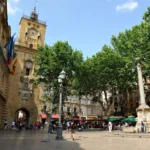
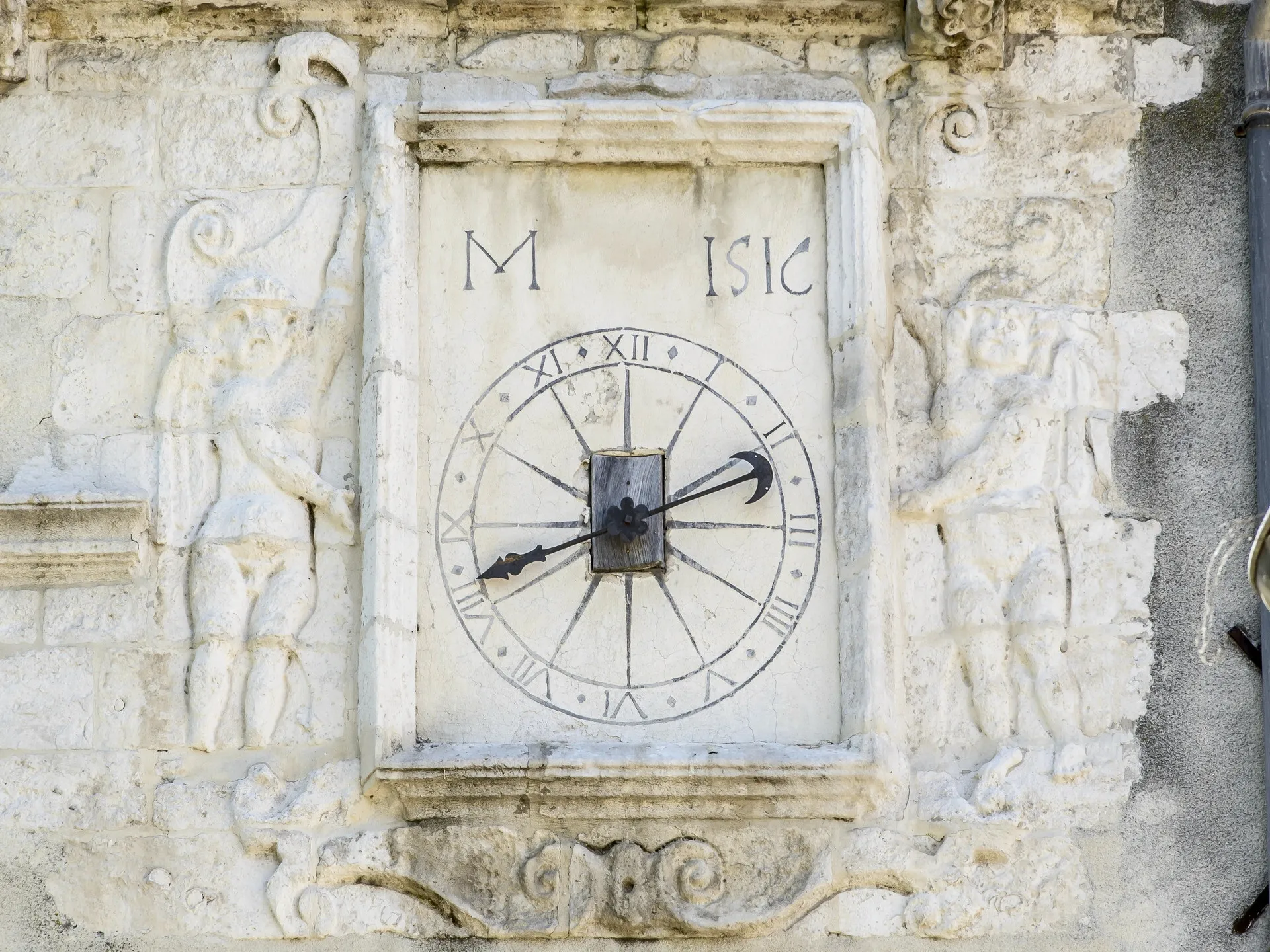
Surnommée « beffroi », l’ancienne maison commune a accueilli les assemblées de la communauté des années 1550 à la Révolution, puis a fait office de mairie jusqu’en 1892. Elle surmonte le portail donnant sur la place Camille-Desmoulins, principale entrée du bourg, dont l’existence est attestée depuis le XVe siècle. Probablement donné à la communauté en 1516, cet ancien poste de garde a fait l’objet de travaux d’aménagements documentés à partir de 1552, d’abord pour l’horloge confiée à un artisan vitrollais. Son cadran a été placé sur un relief commémorant la date de 1516 et orné de deux génies ailés sur un fond de cuir découpé, dans le plus pur style maniériste de la Renaissance. La façade et son clocheton ont été entièrement remodelés en 1643 par le maçon Jean Gaffarel, tels qu’ils se voient aujourd’hui, avec une fenêtre à croisée éclairant la salle principale, une demi-croisée indiquant le puits des poids de l’horloge, une fenêtre bâtarde sous le toit servant au cabinet des archives. Le tout est couronné de gargouilles sculptées à tête de lion. Des créneaux ont disparu, ainsi que les trois pyramidions effilés du clocheton. En 1662 une seconde horloge, côté rue Victor Hugo, est venue marquer la course du temps sur un délicat cadran probablement ciselé par le maçon Laurent Arvel. Elle a occasionné la mise en place d’un nouveau mécanisme, toujours conservé et présenté dans la salle, reliant les deux montres par un système d’engrenages et d’arbre de transmission traversant les pièces. Le monument se distingue donc par ce double dispositif horloger, dont la pièce principale datant de 1740 est toujours en action, avec une autonomie de deux jours. Elle est animée par un mouvement rotatif et alternatif, munie de deux tambours avec un poids de 7 kg pour le mouvement horaire et un de 20 kg pour le mouvement sonore. Ces poids descendent dans un puits de 12 m, en partie souterrain. La réhabilitation de ce système a duré 2 ans, de 1992 à 1994, réalisée par l’association des Amis de Marignane et de la Provence qui siégeait dans le monument depuis 1965. Restaurée entre 1986 et 1996, la maison commune révèle encore de nombreux et curieux détails comme un ensemble de gravures dans la pierre, visibles à l’intérieur comme à l’extérieur. Des visites sont organisées ponctuellement par l'association en partenariat avec l'Office de Tourisme. Toutes infos sur le site internet de l'Office de Tourisme. Source Patrick Varrot, historien d’art – Février 2021 Des visites sont organisées ponctuelllement par l'association en partenariat avec l'Office de Tourisme. Toutes infos sur le site internet de l'Office de Tourisme.
English
Nicknamed the "belfry", the old town hall hosted the community meetings from the 1550s to the Revolution, then served as the town hall until 1892. It surmounts the gateway to the Place Camille-Desmoulins, the main entrance to the town, whose existence is attested since the 15th century Probably given to the community in 1516, this former guardhouse was the subject of documented improvements from 1552, first for the clock entrusted to a craftsman vitrollais. Its dial was placed on a relief commemorating the date of 1516 and decorated with two winged genii on a cut leather background, in the purest mannerist style of the Renaissance. The facade and its bell tower were entirely remodelled in 1643 by the mason Jean Gaffarel, as they are today, with a cross window illuminating the main room, a half-cross window indicating the clock's weight well, and a bastard window under the roof used for the archives. The whole is crowned with sculpted gargoyles with lion heads. The battlements have disappeared, as well as the three tapered pyramidions of the bell tower In 1662 a second clock, on the Victor Hugo street side, came to mark the course of time on a delicate dial probably chiseled by the mason Laurent Arvel. It led to the installation of a new mechanism, still preserved and presented in the room, linking the two clocks by a system of gears and a transmission shaft running through the rooms. The monument is thus distinguished by this double watchmaking device, whose main piece dating from 1740 is still in action, with a two-day autonomy. It is driven by a rotating and alternating movement, equipped with two drums with a weight of 7 kg for the hourly movement and 20 kg for the sound movement. These weights are lowered into a 12-metre shaft, partly underground. The rehabilitation of this system lasted 2 years, from 1992 to 1994, carried out by the association of the Friends of Marignane and Provence which had been sitting in the monument since 1965 Restored between 1986 and 1996, the common house still reveals many curious details such as a set of engravings in the stone, visible inside and outside. Visits are organized from time to time by the association in partnership with the Tourist Office. All information on the website of the Tourist Office. Source Patrick Varrot, art historian – February 2021 Visits are organized from time to time by the association in partnership with the Tourist Office. All information on the website of the Tourist Office.
Deutsch
Das ehemalige Gemeindehaus, das auch als "Belfried" bezeichnet wird, war von 1550 bis zur Revolution Versammlungsort der Gemeinde und diente bis 1892 als Rathaus. Er überragt das Tor zum Place Camille-Desmoulins, dem Haupteingang des Ortes, der seit dem 15 Dieser ehemalige Wachposten, der wahrscheinlich 1516 der Gemeinde geschenkt wurde, war ab 1552 Gegenstand von dokumentierten Umbauarbeiten, zunächst für die Uhr, mit der ein Handwerker aus Vitroll beauftragt wurde. Ihr Zifferblatt wurde auf einem Relief angebracht, das an das Datum 1516 erinnert und mit zwei geflügelten Genien auf einem Hintergrund aus geschnittenem Leder im reinsten manieristischen Stil der Renaissance verziert ist. Die Fassade und ihr Glockenturm wurden 1643 von dem Maurer Jean Gaffarel vollständig umgestaltet, so wie sie heute zu sehen sind, mit einem Kreuzfenster, das den Hauptsaal beleuchtet, einem Halbkreuzfenster, das den Gewichtsschacht der Uhr anzeigt, und einem Bastardfenster unter dem Dach, das als Archivkabinett dient. Das Ganze wird von geschnitzten Wasserspeiern mit Löwenköpfen gekrönt. Die Zinnen sind verschwunden, ebenso wie die drei spitz zulaufenden Pyramiden des Glockenturms Im Jahr 1662 wurde eine zweite Uhr auf der Seite der Rue Victor Hugo installiert, die den Lauf der Zeit auf einem zarten Zifferblatt anzeigt, das wahrscheinlich vom Maurer Laurent Arvel gemeißelt wurde. Sie verursachte den Einbau eines neuen Mechanismus, der noch immer erhalten ist und im Saal gezeigt wird und die beiden Uhren durch ein System von Zahnrädern und einer durch die Räume verlaufenden Antriebswelle verbindet. Das Denkmal zeichnet sich also durch diese doppelte Uhrvorrichtung aus, deren Hauptteil aus dem Jahr 1740 noch immer in Aktion ist und eine Gangautonomie von zwei Tagen hat. Es wird von einer rotierenden und alternierenden Bewegung angetrieben und ist mit zwei Trommeln mit einem Gewicht von 7 kg für das Stundenwerk und einem von 20 kg für das Schallwerk ausgestattet. Diese Gewichte werden in einen 12 m langen, teilweise unterirdischen Schacht hinabgelassen. Die Sanierung dieses Systems dauerte 2 Jahre, von 1992 bis 1994, und wurde von der Vereinigung der Freunde von Marignane und der Provence durchgeführt, die seit 1965 in dem Denkmal saß Das zwischen 1986 und 1996 restaurierte Gemeindehaus offenbart noch immer zahlreiche kuriose Details wie eine Reihe von Gravuren im Stein, die sowohl innen als auch außen zu sehen sind. Besichtigungen werden von Zeit zu Zeit von der Vereinigung in Partnerschaft mit dem Fremdenverkehrsamt organisiert. Alle Infos auf der Website des Office de Tourisme. Quelle Patrick Varrot, Kunsthistoriker – Februar 2021 Punktuell werden vom Verein in Zusammenarbeit mit dem Fremdenverkehrsamt Besichtigungen organisiert. Alle Informationen auf der Website des Fremdenverkehrsamtes.
Dutch
Het oude huis met de bijnaam "belfort" bood onderdak aan de gemeenschapsvergaderingen van de jaren 1550 tot de Revolutie en diende daarna als gemeentehuis tot 1892. Het kijkt uit op de poort van de Place Camille-Desmoulins, de hoofdingang van de stad, waarvan het bestaan sinds de 15e eeuw bekend is Dit voormalige wachthuis werd waarschijnlijk in 1516 aan de gemeenschap geschonken en vanaf 1552 werden er gedocumenteerde verbeteringen aangebracht, in de eerste plaats aan de klok, die werd toevertrouwd aan een ambachtsman uit Vitroll. De wijzerplaat is geplaatst op een reliëf met de datum 1516 en versierd met twee gevleugelde geesten op een gesneden lederen achtergrond, in de zuiverste maniëristische stijl van de Renaissance. De gevel en de klokkentoren werden in 1643 volledig verbouwd door de metselaar Jean Gaffarel, zoals ze nu zijn, met een kruisvenster dat de hoofdzaal verlicht, een half kruisvenster dat het gewicht van de klok goed aangeeft, en een bastaardvenster onder het dak dat dient als archiefkast. Het geheel is bekroond met gebeeldhouwde waterspuwers met leeuwenkoppen. De kantelen zijn verdwenen, evenals de drie taps toelopende piramides van de klokkentoren In 1662 kwam er een tweede klok, aan de kant van de Victor Hugo straat, die het verloop van de tijd aangaf op een delicate wijzerplaat, waarschijnlijk gebeiteld door de metselaar Laurent Arvel. Het leidde tot de installatie van een nieuw mechanisme, dat nog steeds bewaard is gebleven en in de zaal wordt gepresenteerd, dat de twee klokken verbindt door een systeem van tandwielen en een transmissieas die door de zalen loopt. Het monument onderscheidt zich dus door dit dubbele uurwerk, waarvan het belangrijkste deel uit 1740 nog steeds in werking is, met een autonomie van twee dagen. Het wordt aangedreven door een roterende en heen en weer gaande beweging, uitgerust met twee trommels met een gewicht van 7 kg voor de uurbeweging en 20 kg voor de geluidsbeweging. Deze gewichten worden neergelaten in een 12 m lange schacht, gedeeltelijk ondergronds. Het herstel van dit systeem duurde 2 jaar, van 1992 tot 1994, uitgevoerd door de vereniging van de Vrienden van Marignane en de Provence die sinds 1965 in het monument gevestigd was Het tussen 1986 en 1996 gerestaureerde gemeenschappelijke huis vertoont nog vele merkwaardige details, zoals een reeks gravures in de steen, die zowel binnen als buiten zichtbaar zijn. De vereniging organiseert van tijd tot tijd bezoeken in samenwerking met de VVV. Meer informatie op de website van de VVV. Bron Patrick Varrot, kunsthistoricus – februari 2021 De vereniging organiseert van tijd tot tijd bezoeken in samenwerking met de VVV. Meer informatie op de website van de VVV.
Español
Apodado el "campanario", el antiguo ayuntamiento acogió las reuniones de la comunidad desde la década de 1550 hasta la Revolución, y luego sirvió como ayuntamiento hasta 1892. Supera la puerta de la plaza Camille-Desmoulins, la entrada principal de la ciudad, cuya existencia está atestiguada desde el siglo XV Probablemente donado a la comunidad en 1516, este antiguo cuerpo de guardia fue objeto de mejoras documentadas a partir de 1552, en primer lugar en el reloj, que fue confiado a un artesano de Vitrolles. Su esfera estaba colocada sobre un relieve que conmemoraba la fecha de 1516 y decorada con dos genios alados sobre un fondo de cuero recortado, al más puro estilo manierista del Renacimiento. La fachada y su campanario fueron completamente remodelados en 1643 por el albañil Jean Gaffarel, tal y como están hoy en día, con una ventana en cruz que ilumina la sala principal, una ventana en media cruz que indica el pozo del peso del reloj y una ventana bastarda bajo el tejado destinada a los archivos. El conjunto está coronado por gárgolas talladas con cabezas de león. Las almenas han desaparecido, al igual que las tres pirámides afiladas del campanario En 1662, un segundo reloj, en el lado de la calle Victor Hugo, vino a marcar el curso del tiempo en una delicada esfera cincelada probablemente por el albañil Laurent Arvel. Esto condujo a la instalación de un nuevo mecanismo, que aún se conserva y se presenta en la sala, que une los dos relojes mediante un sistema de engranajes y un eje de transmisión que atraviesa las salas. El monumento se distingue así por este doble dispositivo de relojería, cuya pieza principal, que data de 1740, sigue en funcionamiento, con una autonomía de dos días. Se acciona mediante un movimiento giratorio y alternativo, equipado con dos tambores con un peso de 7 kg para el movimiento horario y 20 kg para el movimiento sonoro. Estas pesas se bajan a un pozo de 12 m, en parte subterráneo. La rehabilitación de este sistema duró 2 años, de 1992 a 1994, llevada a cabo por la asociación de los Amigos de Marignane y de la Provenza, que se encontraba en el monumento desde 1965 Restaurada entre 1986 y 1996, la casa común aún revela muchos detalles curiosos, como un conjunto de grabados en la piedra, visibles tanto en el interior como en el exterior. La asociación, en colaboración con la Oficina de Turismo, organiza periódicamente visitas. Toda la información en la página web de la Oficina de Turismo. Fuente Patrick Varrot, historiador del arte – Febrero 2021 La asociación, en colaboración con la Oficina de Turismo, organiza periódicamente visitas. Toda la información en el sitio web de la Oficina de Turismo.
Italiano
Soprannominato "campanile", l'antico municipio ha ospitato le riunioni della comunità dal 1550 alla Rivoluzione, per poi fungere da municipio fino al 1892. Sormonta la porta di Place Camille-Desmoulins, l'ingresso principale della città, la cui esistenza è attestata fin dal XV secolo Probabilmente donato alla comunità nel 1516, questo antico corpo di guardia è stato oggetto di documentate migliorie a partire dal 1552, in primo luogo all'orologio, affidato a un artigiano di Vitrolles. Il suo quadrante era posto su un rilievo che ricordava la data del 1516 e decorato con due geni alati su uno sfondo di pelle ritagliata, nel più puro stile manierista del Rinascimento. La facciata e il campanile furono completamente ristrutturati nel 1643 dal muratore Jean Gaffarel, così come si presentano oggi, con una finestra a croce che illumina la sala principale, una mezza finestra a croce che indica il pozzo dei pesi dell'orologio e una finestra bastarda sotto il tetto utilizzata per gli archivi. Il tutto è coronato da doccioni scolpiti con teste di leone. I merli sono scomparsi, così come le tre piramidi affusolate del campanile Nel 1662 un secondo orologio, sul lato di via Victor Hugo, venne a segnare il corso del tempo su un delicato quadrante probabilmente cesellato dal muratore Laurent Arvel. Ciò portò all'installazione di un nuovo meccanismo, tuttora conservato e presentato nella sala, che collegava i due orologi attraverso un sistema di ingranaggi e un albero di trasmissione che attraversava le stanze. Il monumento si distingue quindi per questo doppio dispositivo di orologeria, il cui pezzo principale, risalente al 1740, è ancora in funzione, con un'autonomia di due giorni. È azionato da un movimento rotatorio e alternativo, dotato di due tamburi con un peso di 7 kg per il movimento orario e di 20 kg per il movimento sonoro. Questi pesi vengono calati in un pozzo di 12 metri, in parte sotterraneo. La riabilitazione di questo sistema è durata 2 anni, dal 1992 al 1994, ad opera dell'associazione degli Amici di Marignane e della Provenza che si era insediata nel monumento dal 1965 Restaurata tra il 1986 e il 1996, la casa comune rivela ancora molti dettagli curiosi, come una serie di incisioni nella pietra, visibili sia all'interno che all'esterno. Le visite sono organizzate di tanto in tanto dall'associazione in collaborazione con l'Ufficio del Turismo. Tutte le informazioni sul sito web dell'Ufficio del Turismo. Fonte Patrick Varrot, storico dell'arte – febbraio 2021 Le visite sono organizzate di tanto in tanto dall'associazione in collaborazione con l'Ufficio del Turismo. Tutte le informazioni sul sito dell'Ufficio del Turismo.
Renaissance
Place Camille Desmoulins, 13700 Marignane
Crédits: OT Marignane Germain Thyssen