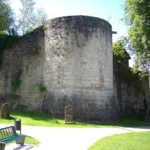
Bâtiment de l'ancien cinéma – Espace le Lorrain – Sarrebourg
Description
English
Deutsch
Dutch
Español
Italiano
Description
Ce bâtiment édifié en 1912 appartient au courant Art nouveau, mouvement international variant en fonction de chaque situation culturelle. D'innombrables noms furent donnés à ce courant : Modern style en France, Jugendstil en Allemagne, Tiffany style aux Etats-Unis. Le bâtiment appartient au Secessionstil viennois, donnant à la ligne droite et aux surfaces nues une fonction particulière malgré la prédilection de l'Art nouveau pour les lignes courbes et les éléments végétaux et floraux. Ce bâtiment est un des points du circuit historique de la ville, circuit disponible à l'Office de Tourisme.
English
This building, built in 1912, belongs to the Art Nouveau movement, an international movement that varies according to each cultural situation. Innumerable names were given to this movement: Modern style in France, Jugendstil in Germany, Tiffany style in the United States. The building belongs to the Viennese Secessionstil, giving straight lines and bare surfaces a special function despite Art Nouveau's predilection for curved lines and plant and floral elements. The building is one of the points on the city's historical tour, which is available at the Tourist Office.
Deutsch
Das 1912 errichtete Gebäude gehört zum Jugendstil, einer internationalen Bewegung, die je nach kultureller Situation variiert. Diese Strömung hat unzählige Namen erhalten: Modern style in Frankreich, Jugendstil in Deutschland, Tiffany style in den USA. Das Gebäude gehört zum Wiener Secessionstil, der der geraden Linie und den nackten Flächen eine besondere Funktion zuweist, obwohl der Jugendstil geschwungene Linien und pflanzliche und florale Elemente bevorzugt. Das Gebäude ist einer der Punkte auf dem historischen Stadtrundgang, der beim Fremdenverkehrsamt erhältlich ist.
Dutch
Dit gebouw, gebouwd in 1912, behoort tot de Art Nouveau-beweging, een internationale stroming die varieert naargelang de culturele situatie. Er zijn talloze namen gegeven aan deze beweging: Moderne stijl in Frankrijk, Jugendstil in Duitsland, Tiffany stijl in de VS. Het gebouw behoort tot de Weense Secessionstil, waardoor rechte lijnen en kale oppervlakken een bijzondere functie kregen, ondanks de voorliefde van de Art Nouveau voor gebogen lijnen en planten- en bloemenelementen. Het gebouw is een van de punten op de historische rondleiding door de stad, die verkrijgbaar is bij het VVV-kantoor.
Español
Este edificio, construido en 1912, pertenece al movimiento Art Nouveau, un movimiento internacional que varía según cada situación cultural. Se han dado innumerables nombres a este movimiento: El estilo moderno en Francia, el Jugendstil en Alemania, el estilo Tiffany en Estados Unidos. El edificio pertenece al Secessionstil vienés, que otorga a las líneas rectas y a las superficies desnudas una función especial a pesar de la predilección del Art Nouveau por las líneas curvas y los elementos vegetales y florales. El edificio es uno de los puntos del recorrido histórico de la ciudad, que se puede consultar en la Oficina de Turismo.
Italiano
Questo edificio, costruito nel 1912, appartiene al movimento Art Nouveau, un movimento internazionale che varia a seconda delle situazioni culturali. A questo movimento sono stati dati innumerevoli nomi: Lo stile moderno in Francia, lo Jugendstil in Germania, lo stile Tiffany negli Stati Uniti. L'edificio appartiene al Secessionstil viennese, che conferisce alle linee rette e alle superfici nude una funzione speciale, nonostante la predilezione dell'Art Nouveau per le linee curve e gli elementi vegetali e floreali. L'edificio è uno dei punti del tour storico della città, disponibile presso l'Ufficio del Turismo.
Art nouveau ou art déco
Clientèle: Tout public - Groupes
43 Avenue Poincaré, 57400 Sarrebourg