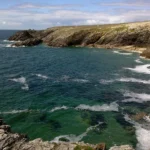
La Pointe de Conguel – Quiberon
Description
English
Deutsch
Dutch
Español
Italiano
Description
A l'extrême sud de la Presqu'île, la Pointe de Conguel, placée sous la protection du Conservatoire du Littoral, est un lieu privilégié pour la promenade. On y découvre des fours à goémons servant autrefois au brûlage du varech rejeté par la mer. Les cendres obtenues étaient traitées pour en extraire l'iode.Un sentier fait le tour de la Pointe et vous mène vers une table d'orientation.Au large, émergent deux îlots : le "petit trou" accessible à pied aux grandes marées et le "grand trou" où furent découvertes des sépultures gauloises. Plus loin se profile le phare de la Teignouse sur un banc rocheux où sombra le cuirassé France en 1922.
English
At the extreme south of the Presqu'île, the Pointe de Conguel, placed under the protection of the Conservatoire du Littoral, is a privileged place for walking. One discovers there seaweed ovens formerly used to burn the kelp rejected by the sea. The ashes obtained were treated to extract iodine. A path goes around the Pointe and leads you to an orientation table. Two islets emerge from the sea: the "small hole" accessible on foot at high tide and the "large hole" where Gallic burials were discovered. Further on, the Teignouse lighthouse stands on a rocky bank where the battleship France sank in 1922.
Deutsch
Im äußersten Süden der Halbinsel befindet sich die Pointe de Conguel, die unter dem Schutz des Conservatoire du Littoral steht und ein beliebter Ort für Spaziergänge ist. Hier kann man Tangöfen entdecken, die früher zum Verbrennen des vom Meer angespülten Tangs dienten. Ein Pfad führt um die Pointe herum zu einer Orientierungstafel.Vor der Küste tauchen zwei kleine Inseln auf: das "kleine Loch", das bei Flut zu Fuß erreichbar ist, und das "große Loch", in dem gallische Gräber entdeckt wurden. Weiter hinten ragt der Leuchtturm von La Teignouse auf einer Felsbank hervor, auf der 1922 das Schlachtschiff France unterging.
Dutch
Aan de zuidkant van het schiereiland is de Pointe de Conguel, beschermd door het Conservatoire du Littoral, een bevoorrechte plek om te wandelen. Hier kunt u de zeewierovens ontdekken die vroeger werden gebruikt om het door de zee aangespoelde kelp te verbranden. Een pad leidt rond de Punt naar een oriëntatietafel, en voor de kust duiken twee eilandjes op: het "kleine gat", te voet bereikbaar bij vloed, en het "grote gat", waar Gallische begrafenissen werden ontdekt. Verderop staat de vuurtoren van Teignouse op een rotsachtige oever waar in 1922 het slagschip France zonk.
Español
En el extremo sur de la península, la punta de Conguel, protegida por el Conservatorio del Litoral, es un lugar privilegiado para el senderismo. Aquí se pueden descubrir los hornos de algas que antiguamente se utilizaban para quemar las algas arrastradas por el mar. Un sendero conduce alrededor de la punta hasta una mesa de orientación, y dos islotes emergen mar adentro: el "petit trou", accesible a pie en marea alta, y el "grand trou", donde se descubrieron enterramientos galos. Más adelante, el faro de Teignouse se alza sobre una orilla rocosa donde se hundió el acorazado France en 1922.
Italiano
All'estremità meridionale della penisola, la Pointe de Conguel, protetta dal Conservatoire du Littoral, è un luogo privilegiato per le passeggiate. Qui si possono scoprire i forni per le alghe che un tempo venivano utilizzati per bruciare il kelp spiaggiato dal mare. Un sentiero conduce intorno alla Punta fino a un tavolo di orientamento, mentre al largo emergono due isolotti: il "buco piccolo", accessibile a piedi con l'alta marea, e il "buco grande", dove sono state scoperte sepolture galliche. Più avanti, il faro di Teignouse sorge su un banco roccioso dove nel 1922 affondò la corazzata France.