Temple de Janus – Autun
Description
English
Deutsch
Dutch
Español
Italiano
Description
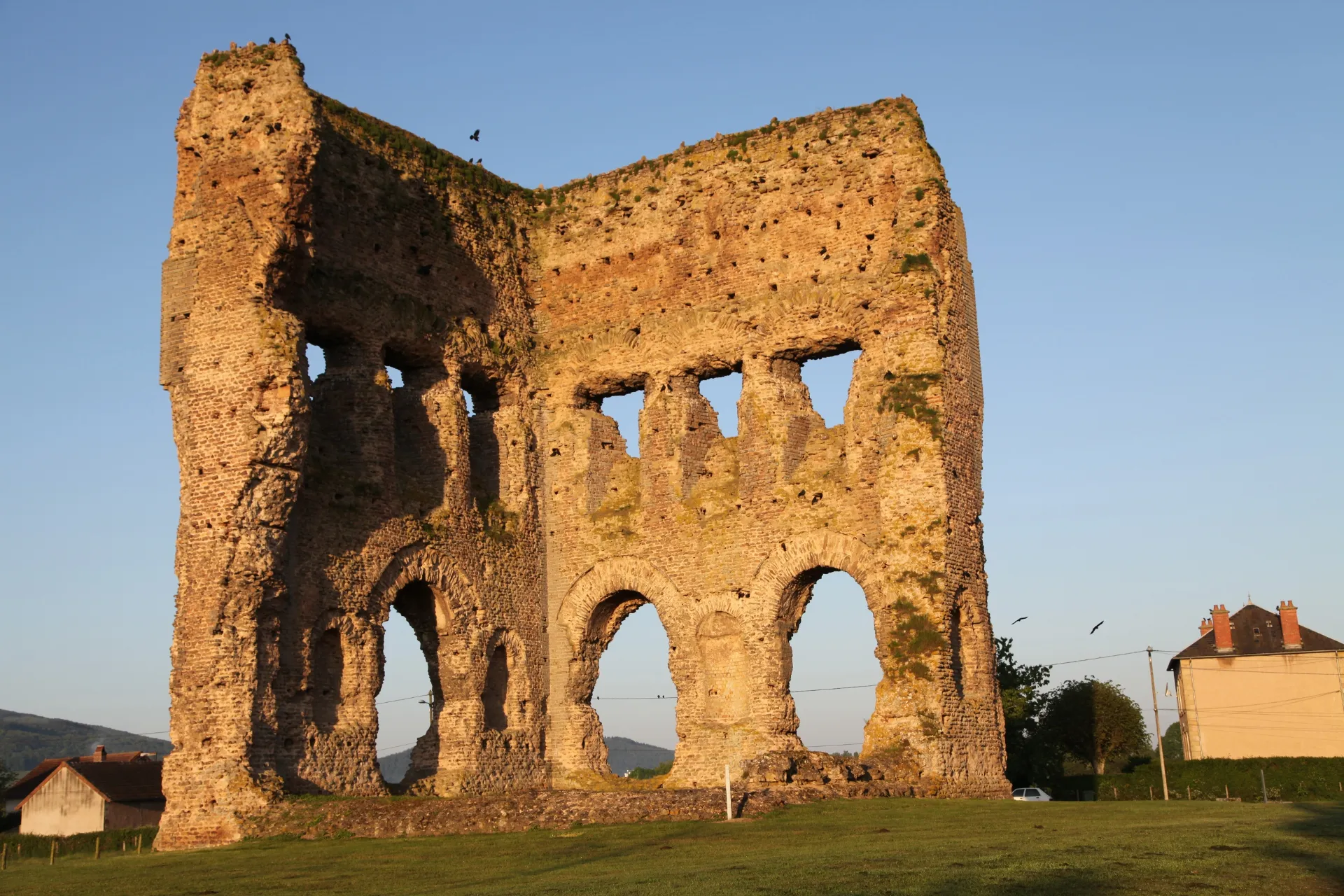
Le Temple dit de Janus encore en élévation a été fouillé entre 2013 et 2018. Son origine a pu être précisée. Elle remonte à l’époque gauloise et au IIIe siècle av. J.-C. l’ancienneté de ce sanctuaire pourrait être l’une des raisons ayant présidé au choix du site topographique pour y implanter la nouvelle capitale des Eduens, à l’époque augustéenne. L’hypothèse d’un culte à « Janus » est fausse. Elle semble issue d’une mauvaise interprétation du toponyme, « Genetoye », qui renvoie plutôt aux genêts. D’autre part, une offrande découverte en fouille à l’emplacement du temple mentionne la divinité indigène « Ienieco », qui pourrait être l’un des dieux du sanctuaire. Pour l’instant ce dieu n’est attesté qu’à Autun.
Le théâtre et les thermes du sanctuaire ont été en partie dégagés. L’édifice de spectacle de la Genetoye mesure 116 m de diamètre, il est plus petit que le théâtre urbain mais ses dimensions restent tout de même suffisamment considérables pour en faire l’un des plus grands théâtres de Gaule.
Enfin, le quartier artisanal a bénéficié de 8 années de fouilles. Les productions sont tout d’abord tournées vers la métallurgie puis s’orientent vers la confection de vaisselle céramique au IIe siècle. Plus d’une centaine de fours de potiers sont recensés. Des ateliers de figurines ont été également découverts liés au célèbre coroplaste Pistillus. Ces productions sont destinées pour certaines à l’export, pour d’autres à la consommation au sein même du sanctuaire.
English
The Temple of Janus, which is still standing, was excavated between 2013 and 2018. Its origins have been clarified. It dates back to the Gallic period and the 3rd century BC. The age of this sanctuary could be one of the reasons why the topographical site was chosen as the site for the new capital of the Eduens, in the Augustan era. The hypothesis of a cult to "Janus" is false. It seems to stem from a misinterpretation of the place name, "Genetoye", which refers to broom. On the other hand, an offering discovered during excavations on the site of the temple mentions the indigenous deity "Ienieco", who could be one of the gods of the sanctuary. So far, this god has only been documented in Autun.
The theatre and baths of the sanctuary have been partially excavated. The Genetoye theatre measures 116 m in diameter, smaller than the urban theatre but still large enough to make it one of the largest in Gaul.
Finally, the artisan quarter has benefited from 8 years of excavations. Production was initially focused on metallurgy, before turning to the manufacture of ceramic tableware in the 2nd century. More than a hundred potters' kilns have been identified. Figurine workshops have also been discovered, linked to the famous Pistillus coroplast. Some of these products were exported, while others were used within the sanctuary itself.
Deutsch
Der noch stehende sogenannte Janustempel wurde zwischen 2013 und 2018 ausgegraben. Sein Ursprung konnte geklärt werden. Er geht auf die gallische Zeit und das 3. Jahrhundert v. Chr. zurück. Das Alter dieses Heiligtums könnte einer der Gründe für die Wahl des topografischen Standorts als Standort für die neue Hauptstadt der Eduer in der augusteischen Zeit gewesen sein. Die Hypothese einer Verehrung des "Janus" ist falsch. Sie scheint auf eine Fehlinterpretation des Ortsnamens "Genetoye" zurückzuführen zu sein, der sich eher auf Ginster bezieht. Andererseits wird in einer Opfergabe, die bei Ausgrabungen an der Stelle des Tempels gefunden wurde, die einheimische Gottheit "Ienieco" erwähnt, die einer der Götter des Heiligtums sein könnte. Bisher ist dieser Gott nur in Autun belegt.
Das Theater und die Thermen des Heiligtums wurden zum Teil freigelegt. Das Veranstaltungsgebäude in La Genetoye hat einen Durchmesser von 116 m. Es ist zwar kleiner als das Stadttheater, aber seine Ausmaße sind dennoch beachtlich genug, um es zu einem der größten Theater in Gallien zu machen.
Im Handwerkerviertel schließlich wurden acht Jahre lang Ausgrabungen durchgeführt. Die Produktion war zunächst auf die Metallverarbeitung ausgerichtet und ging im 2. Jahrhundert zur Herstellung von Keramikgeschirr über. Es wurden mehr als 100 Töpferöfen gefunden. Es wurden auch Werkstätten für die Herstellung von Figuren entdeckt, die mit dem berühmten Koroplasten Pistillus in Verbindung gebracht werden. Einige dieser Produkte waren für den Export bestimmt, andere für den Verbrauch innerhalb des Heiligtums.
Dutch
De Tempel van Janus, die er nog steeds staat, werd tussen 2013 en 2018 opgegraven. De oorsprong ervan is opgehelderd. Hij dateert uit de Gallische periode en de 3e eeuw v.Chr. De ouderdom van dit heiligdom zou een van de redenen kunnen zijn waarom de topografische locatie werd gekozen als locatie voor de nieuwe hoofdstad van de Eduens, tijdens de Augusteïsche periode. De hypothese van een cultus voor "Janus" is onjuist. Het lijkt voort te komen uit een verkeerde interpretatie van de plaatsnaam "Genetoye", die verwijst naar bezem. Aan de andere kant wordt in een offer dat werd ontdekt tijdens opgravingen op de plaats van de tempel de inheemse godheid "Ienieco" genoemd, die één van de goden van het heiligdom zou kunnen zijn. Tot nu toe is deze god alleen gedocumenteerd in Autun.
Het theater en de baden van het heiligdom zijn gedeeltelijk opgegraven. Het voorstellingsgebouw van Genetoye meet 116 m in diameter, kleiner dan het stadstheater, maar nog steeds groot genoeg om het een van de grootste theaters in Gallië te maken.
De ambachtswijk ten slotte heeft geprofiteerd van 8 jaar opgravingen. De productie was aanvankelijk gericht op metallurgie, voordat in de 2e eeuw werd overgeschakeld op de productie van keramisch vaatwerk. Er zijn meer dan honderd pottenbakkersovens geïdentificeerd. Er zijn ook beeldjesateliers ontdekt, verbonden met de beroemde Pistillus coroplast. Sommige van deze stukken werden geëxporteerd, terwijl andere werden geproduceerd voor consumptie in het heiligdom zelf.
Español
El Templo de Jano, que sigue en pie, fue excavado entre 2013 y 2018. Se han aclarado sus orígenes. Se remonta a la época gala y al siglo III a. C. La antigüedad de este santuario podría ser una de las razones por las que se eligió el emplazamiento topográfico como sede de la nueva capital de los Eduardos, durante la época de Augusto. La hipótesis de un culto a "Jano" es falsa. Parece derivar de una mala interpretación del topónimo "Genetoye", que hace referencia a la retama. Por otra parte, una ofrenda descubierta durante las excavaciones en el emplazamiento del templo menciona a la deidad indígena "Ienieco", que podría ser uno de los dioses del santuario. Hasta ahora, este dios sólo se ha documentado en Autun.
El teatro y las termas del santuario han sido parcialmente excavados. El edificio de espectáculos de Genetoye mide 116 m de diámetro, menor que el teatro urbano, pero lo suficientemente grande como para convertirlo en uno de los teatros más grandes de la Galia.
Por último, el barrio de los artesanos se ha beneficiado de 8 años de excavaciones. La producción se centró inicialmente en la metalurgia, antes de orientarse hacia la fabricación de vajillas de cerámica en el siglo II. Se han identificado más de cien hornos de alfareros. También se han descubierto talleres de figurillas, vinculadas al famoso coroplasto Pistillus. Algunas de estas piezas se exportaban, mientras que otras se producían para el consumo dentro del propio santuario.
Italiano
Il Tempio di Giano, ancora in piedi, è stato scavato tra il 2013 e il 2018. Le sue origini sono state chiarite. Risale al periodo gallico e al III secolo a.C. L'età di questo santuario potrebbe essere uno dei motivi per cui il sito topografico fu scelto come sede della nuova capitale degli Eduen, durante il periodo augusteo. L'ipotesi di un culto a "Giano" è falsa. Sembra derivare da un'errata interpretazione del toponimo "Genetoye", che si riferisce alla ginestra. D'altra parte, un'offerta scoperta durante gli scavi nel sito del tempio menziona la divinità indigena "Ienieco", che potrebbe essere una delle divinità del santuario. Finora questo dio è stato documentato solo ad Autun.
Il teatro e le terme del santuario sono stati parzialmente scavati. L'edificio dello spettacolo di Genetoye misura 116 m di diametro, più piccolo del teatro urbano, ma comunque abbastanza grande da renderlo uno dei più grandi teatri della Gallia.
Infine, il quartiere degli artigiani ha beneficiato di 8 anni di scavi. La produzione si concentrava inizialmente sulla metallurgia, prima di passare alla fabbricazione di vasellame in ceramica nel II secolo. Sono stati identificati più di cento forni per vasai. Sono state scoperte anche officine di figurine, legate al famoso coroplasto Pistillus. Alcuni di questi pezzi venivano esportati, mentre altri erano prodotti per il consumo all'interno del santuario stesso.
Gallo-romain
Rue du Faubourg Saint-Andoche, 71400 Autun
Crédits: MarcJP46
CC BY-SA 3.0
CC BY-SA 3.0