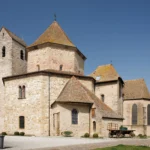
Ottmarsheim – Ottmarsheim
Description
English
Deutsch
Dutch
Español
Italiano
Description
La localité a conservé des vestiges archéologiques datant de l'époque romaine. Ottmarsheim est mentionné pour la première fois en 881. Il passe en 1648 à la couronne de France. La première moitié du XIX est marquée par une lente augmentation de la population. Mais, à partir de 1851 et jusqu'en 1941, la commune connait un déclin démographique. En effet, ce villaga agricole possèd eun sol assez ingrat, difficilement irriguable et surtout inondable. A partir de 1948, Ottmarsheim devient une localité industrielle (avec le canal d'Alsace, la centrale hydroélectrique et la zone portuaire) et voit sa population augmenter à nouveau.
English
The town has preserved archaeological remains dating back to Roman times. Ottmarsheim was first mentioned in 881, and passed to the French crown in 1648. The first half of the 19th century saw a slow increase in population. However, from 1851 until 1941, the village experienced a demographic decline. In fact, this agricultural village had rather ungrateful soil, which was difficult to irrigate and, above all, flooded. From 1948 onwards, Ottmarsheim became an industrial town (with the Alsace canal, the hydroelectric power station and the port area) and saw its population increase once again.
Deutsch
In der Ortschaft sind archäologische Funde aus der Römerzeit erhalten geblieben. Ottmarsheim wurde 881 zum ersten Mal erwähnt und ging 1648 an die französische Krone über. Die erste Hälfte des 19. Jahrhunderts war durch einen langsamen Anstieg der Bevölkerung gekennzeichnet. Ab 1851 und bis 1941 erlebte die Gemeinde jedoch einen Bevölkerungsrückgang. Das landwirtschaftlich geprägte Dorf hatte einen undankbaren Boden, der schwer zu bewässern und vor allem überschwemmungsgefährdet war. Ab 1948 entwickelte sich Ottmarsheim zu einem Industrieort (mit dem Elsasskanal, dem Wasserkraftwerk und dem Hafengebiet) und verzeichnete einen erneuten Bevölkerungszuwachs.
Dutch
In de stad zijn archeologische overblijfselen uit de Romeinse tijd bewaard gebleven. Ottmarsheim werd voor het eerst genoemd in 881 en ging in 1648 over naar de Franse kroon. In de eerste helft van de 19e eeuw nam de bevolking langzaam toe. Van 1851 tot 1941 kende het dorp echter een bevolkingsafname. Dit was te wijten aan het feit dat de grond in dit landbouwdorp vrij arm was, moeilijk te irrigeren en vooral onderhevig aan overstromingen. Vanaf 1948 werd Ottmarsheim een industriestad (met het Elzaskanaal, de waterkrachtcentrale en het havengebied) en nam de bevolking weer toe.
Español
La ciudad conserva restos arqueológicos que se remontan a la época romana. Ottmarsheim fue mencionada por primera vez en 881 y pasó a la corona francesa en 1648. En la primera mitad del siglo XIX se produjo un lento aumento de la población. Sin embargo, desde 1851 hasta 1941, el pueblo experimentó un declive demográfico. Esto se debió a que el suelo de este pueblo agrícola era bastante pobre, difícil de regar y, sobre todo, sujeto a inundaciones. A partir de 1948, Ottmarsheim se convirtió en una ciudad industrial (con el canal de Alsacia, la central hidroeléctrica y la zona portuaria) y volvió a ver aumentar su población.
Italiano
La città conserva resti archeologici risalenti all'epoca romana. Ottmarsheim fu menzionata per la prima volta nell'881 e passò alla corona francese nel 1648. La prima metà del XIX secolo vide un lento aumento della popolazione. Tuttavia, dal 1851 al 1941, il villaggio subì un calo demografico. Ciò è dovuto al fatto che il terreno di questo villaggio agricolo era piuttosto povero, difficile da irrigare e, soprattutto, soggetto a inondazioni. A partire dal 1948, Ottmarsheim divenne una città industriale (con il canale dell'Alsazia, la centrale idroelettrica e l'area portuale) e vide nuovamente aumentare la sua popolazione.
, 68490 Ottmarsheim