La Commanderie Sainte Luce
Description
English
Deutsch
Dutch
Español
Italiano
Description
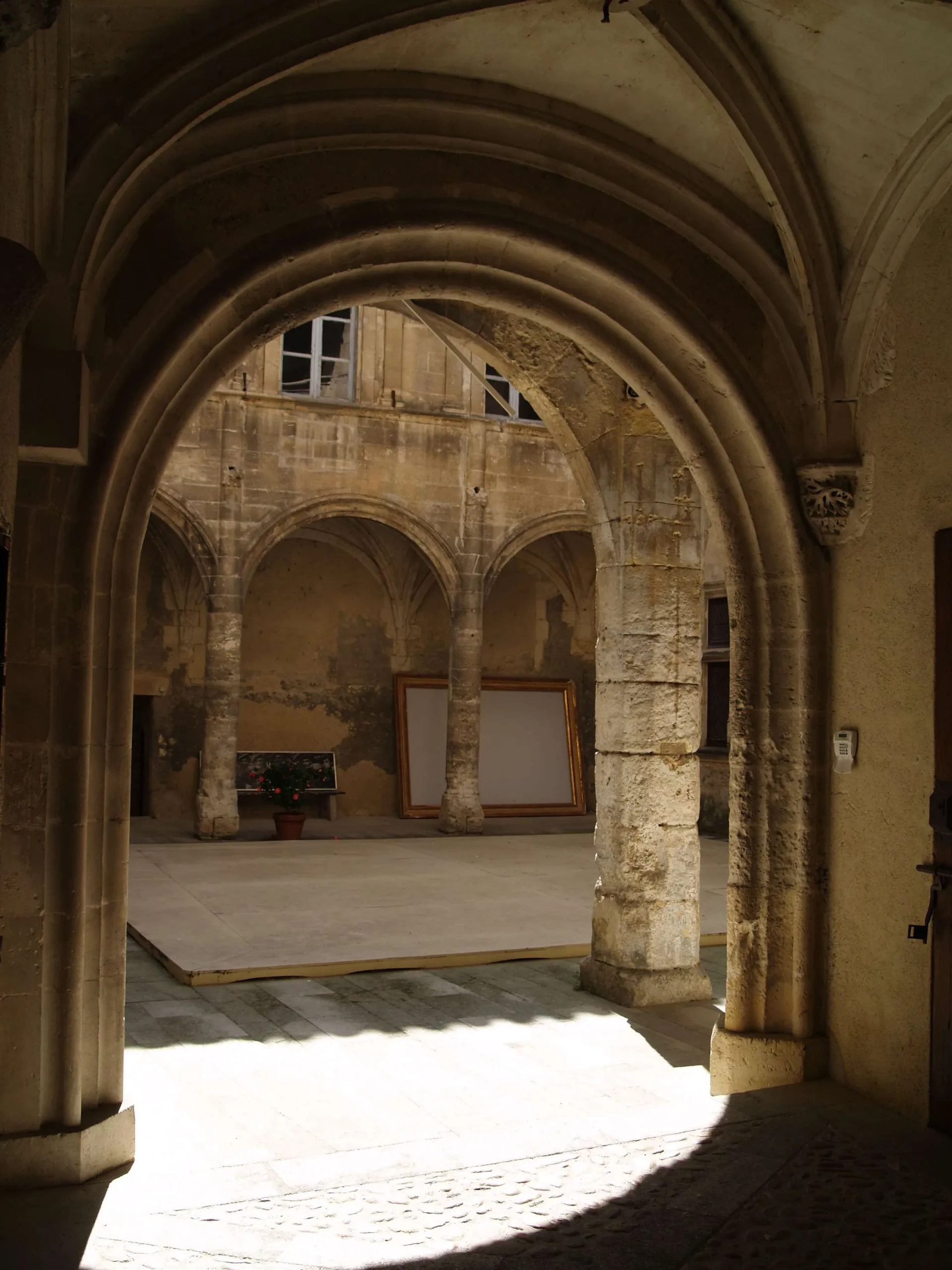
L’histoire de l’édifice est très marquée par l’histoire religieuse. Tout d’abord il abrite les templiers, puis, après l’épisode dramatique de leur suppression, celle de l’ordre de Malte. Le portail de l’édifice, entièrement restauré, a conservé son décor flamboyant de la fin XVème siècle. Le bâtiment lui-même s’organise autour d’une cour pourvue d’un puits. La façade ouest est percée de fenêtres à meneaux, surmontées d’un important décor de moulures. A l’angle de cette façade et de la façade nord, se trouve une tour hexagonale abritant un escalier à vis.
Des loggias à arcades permettent la circulation au rez-de-chaussée et aux étages.
La façade nord, bâtie en 1587, comporte un décor caractéristique de la Renaissance arlésienne. Les fenêtres à meneaux à l’origine, mais modifiées au XVIIIème siècle, sont encadrées de pilastres cannelés tout à fait antiquisants.
Le bâtiment appartint d’abord aux chevaliers du Temple (ou templiers), ordre militaire et religieux fondé en 1119, combattu et supprimé au début du XIVe siècle. Il devint ensuit la propriété des hospitaliers de Saint-Jean-de-Jérusalem, ou ordre de Malte, installés au XVIème siècle dans le Grand Prieuré voisin.Des quatre corps du bâtiment, l’un date probablement du XIIIe siècle, deux sont du XVème siècle, et un autre a été remanié au XVIème. Dans les années 1980, des travaux de restauration ont été réalisés sur l'édifice qui, bien qu'habituellement fermé au public, s'ouvre lors d'événements et de manifestations spécifiques.
English
The history of the building is very marked by religious history. Firstly it houses the Templars, and then, after the dramatic episode of their removal, of the order of Malta.The portal of the building, completely restored, has retained flamboyant late fifteenth-century décor. The building itself is organized around a courtyard with a well. The west facade was pierced by windows mullions, topped by an important decoration of mouldings. The angle of this façade and the North facade, there is a hexagonal tower with a spiral staircase.Arcaded loggias allow traffic on the ground floor and the floors.The façade North, built in 1587, has favorable Renaissance characteristic décor. Windows mullioned originally, but modified in the eighteenth century, are framed by fluted pilasters quite antiquisants.The building belonged first to the Knights of the Temple (or Templars), military and religious order founded in 1119, fought and removed at the beginning of the 14th century. He became follows the property of the Hospital of Saint John of Jerusalem, or order of Malta, installed in the sixteenth century in the nearby Grand Priory. Four bodies from the building, one probably dates from the 13th century, two are from the 15th century, and another has been redesigned in the sixteenth.The building was restored in the 1980s.
Deutsch
Die Geschichte des Gebäudes ist sehr ausgeprägt durch Religionsgeschichte. Erstens, es beherbergt der Templer, und dann, nach der dramatischen Episode der Löschung, Malteserordens.Das Portal des Gebäudes, komplett restauriert, hat extravagante späten fünfzehnten Jahrhundert Dekor bewahrt. Das Gebäude selbst ist um einen Innenhof mit einem Brunnen organisiert. Die Westfassade wurde von Windows Mittelpfosten, gekrönt durch eine wichtige Dekoration der Formteile durchbohrt. Der Winkel dieser Fassade und die Nordfassade, gibt es ein sechseckiger Turm mit einer Wendeltreppe.Arkaden Loggien erlauben Verkehr auf das Erdgeschoss und die Fußböden.Die Fassade Nord, erbaut im Jahre 1587 hat günstige charakteristische Renaissance-Dekor. Windows zweibögigen ursprünglich jedoch im achtzehnten Jahrhundert, modifiziert werden durch kannelierte Pilaster ganz Antiquisants umrahmt.Das Gebäude gehörte zunächst zum Ritter des Tempels (oder Templer), militärischen und religiösen Ordens gegründet 1119, kämpfte und am Anfang des 14. Jahrhunderts entfernt. Er wurde folgt die Eigenschaft des Hospital of Saint John of Jerusalem oder Auftrag von Malta, im sechzehnten Jahrhundert im nahe gelegenen Großpriorat installiert. Vier Stellen aus dem Gebäude, einer wahrscheinlich stammt aus dem 13. Jahrhundert, zwei sind aus dem 15. Jahrhundert und ein anderes ist neu entworfen worden, in dem sechzehnten.Das Gebäude wurde in den 1980er Jahren restauriert.
Dutch
De geschiedenis van het gebouw is sterk beïnvloed door de religieuze geschiedenis. Eerst huisvestte het de Tempeliers, daarna, na de dramatische episode van hun onderdrukking, de Orde van Malta. De toegangspoort van het gebouw, die volledig is gerestaureerd, heeft zijn laat 15e-eeuwse flamboyante decoratie behouden. Het gebouw zelf ligt rond een binnenplaats met een waterput. De westelijke gevel is voorzien van glas-in-loodramen met een uitgebreid lijstwerk. Op de hoek van deze gevel en de noordgevel staat een zeshoekige toren met daarin een wenteltrap.
Loggia's met bogen bieden toegang tot de beneden- en bovenverdieping.
De noordgevel, gebouwd in 1587, heeft een decoratie die typisch is voor de renaissance van Arles. De glas-in-loodramen, die oorspronkelijk werden gewijzigd in de 18e eeuw, worden omlijst door gecanneleerde pilasters die erg aan deze periode doen denken.
Het gebouw behoorde oorspronkelijk toe aan de Tempeliers, een militaire en religieuze orde opgericht in 1119, bevochten en onderdrukt in het begin van de 14e eeuw. Van de vier delen van het gebouw dateert er waarschijnlijk één uit de 13e eeuw, twee uit de 15e eeuw en een ander werd verbouwd in de 16e eeuw. In de jaren 1980 werd het gebouw gerestaureerd en hoewel het gewoonlijk gesloten is voor het publiek, is het open voor speciale evenementen.
Español
La historia del edificio está muy marcada por la historia religiosa.
En un principio alberga a los templarios, después, tras el episodio dramático de su supresión, a la orden de Malta.
Pórtico del edificio.
El pórtico del edificio, totalmente restaurado, ha conservado su decoración flamígera de finales del siglo XV.
El propio edificio se organiza en torno a un patio provisto de un pozo.
La fachada oeste está atravesada por ventanas con bastidores, coronada por una importante decoración de molduras.
En el ángulo de esta fachada y de la fachada norte, se encuentra una torre hexagonal que alberga una escalera de caracol.
Las logias con arcadas permiten la circulación en la planta baja y en las plantas.
La fachada norte, edificada en 1587, consta de una decoración característica del renacimiento arlesiano.
Las ventanas con bastidores en su origen, pero modificadas en el siglo XVIII, están enmarcadas con pilastras acanaladas muy antiguas.
El edificio perteneció en un principio a los caballeros del Temple (o templarios), orden militar y religiosa fundada en 1119, combatida y suprimida a principios del siglo XIV.
Después pasó a manos de los hospitalarios de Saint-Jean-de-Jérusalem, u orden de Malta, instalados en el siglo XVI en el Gran Priorato vecino. De los cuatro cuerpos del edificio, uno data probablemente del siglo XIII, dos son del siglo XV y el otro fue modificado en el siglo XVI.
El edificio fue restaurado en los años 1980.
Hoy en día alberga los servicios del museo Réattu.
Fuente de información: http://www.patrimoine.ville-arles.fr/arles/ville.cfm?action=edifice_hist…
Italiano
La commenda di Sainte-Luce presenta un complesso di edifici di grande qualità architettonica.
Riunisce le caratteristiche di una vasta dimora provenzale della fine del Medioevo.
La storia dell’edificio è molto segnata dalla storia religiosa.
Innanzitutto, ospita i Templari, poi, dopo l’episodio drammatico della loro soppressione, accoglie l’Ordine di Malta.
Portone dell’edificio:
Il portone dell’edificio, interamente restaurato, ha conservato il suo decoro flamboyant della fine del XV secolo.
L’edificio stesso si organizza attorno ad un cortile provvisto di un pozzo.
La facciata ovest presenta finestre a crociera, sormontate da un importante decoro di modanature.
All’angolo di questa facciata e della facciata nord, si trova una torre esagonale che ospita una scala a chiocciola.
Logge ad arcate consentono la circolazione al pianterreno e ai piani.
La facciata nord, costruita nel 1587, comporta un decoro caratteristico del Rinascimento arlesiano.
Le finestre a crociera d’origine, ma modificate nel corso del XVIII secolo, sono incorniciate da pilastri scanalati completamente antichizzanti.
L’edificio appartenne, prima, ai cavalieri del Tempio (o Templari), ordine militare e religioso fondato nel 1119, combattuto e soppresso all’inizio del XIV secolo.
In seguito, divenne la proprietà degli Ospitalieri di San Giovanni in Gerusalemme, oppure Ordine di Malta, insediatisi nel XVI secolo nel Gran Priorato vicino. Dei quattro corpi dell’edificio, uno risale probabilmente al XIII secolo, due sono del XV secolo, e un altro è stato rimaneggiato nel XVI secolo.
L’edificio è stato restaurato negli anni ‘80.
Oggi ospita gli uffici del museo Réattu.
Fonte info : http://www.patrimoine.ville-arles.fr/arles/ville.cfm?action=edifice_hist…
En ville
Rue Du Grand Prieuré, 13200 Arles
Crédits: awn, Musée Réattu