Hangars Boussiron
Description
English
Deutsch
Dutch
Español
Italiano
Description
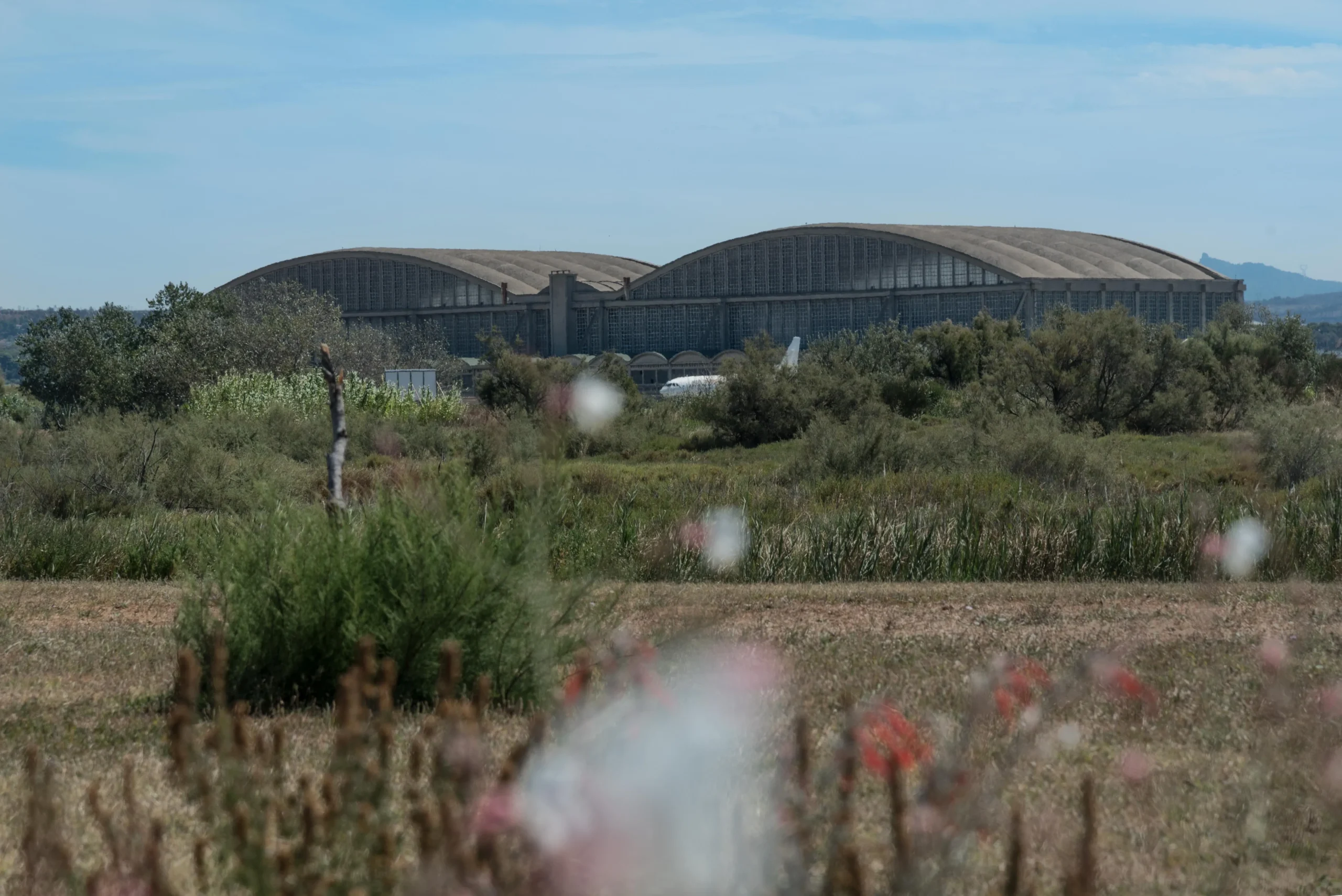
Bâti à proximité de l’étang de Berre entre 1950 et 1953, ce bâtiment de 2 hectares est parfois appelé « hangar double de Marignane ». Il appartient au complexe aéroportuaire implanté dès 1920, détruit à la Libération, et précède l’aérogare élevée sur les plans de Fernand Pouillon en 1961. Il était à l’origine destiné à abriter la construction des hydravions et a fait l’objet d’un concours initié par la Chambre de commerce de Marseille en 1943, interrompu et repris en 1949. La conception des hangars a alors été confiée aux architectes Auguste et Gustave Perret, connus pour la reconstruction intégrale du Havre, associés aux ingénieurs Nicolas Esquillan et Eugène Freyssinet. C’est toutefois Simon Boussiron, collaborateur de Gustave Eiffel et fondateur de la première entreprise de béton armé, qui a donné son nom à l’œuvre architecturale. Elle se distingue en effet par sa couverture constituée de six fines voiles de béton armé de 6 cm d’épaisseur à peine, formant une onde à double courbure sur chaque nef, offrant 101 mètres de portée chacune. Elles ont été fabriquées au sol, en béton précontraint et armature en métal déployé, puis hissées sur vérins à 19 mètres de hauteur, alors que les parois étaient élevées en sous-œuvre au fur et à mesure. Un film relatant ce chantier épique a été confié par Auguste Perret lui-même au photographe Fred Delvert, témoin de l’élaboration de ce qui est longtemps resté enregistré comme un record. Il ne se visite pas et est situé sur l’emprise de l’aéroport. On le voit très bien à partir de la route qui va au Jaï Source Patrick Varrot, historien d’art – Février 2021
English
Built near the Etang de Berre between 1950 and 1953, this 2 hectare building is sometimes called the "Marignane double hangar" It belongs to the airport complex established in 1920, destroyed at the Liberation, and precedes the terminal built on the plans of Fernand Pouillon in 1961 It was originally intended to house the construction of seaplanes and was the subject of a competition initiated by the Chamber of Commerce of Marseille in 1943, interrupted and resumed in 1949 The design of the hangars was then entrusted to the architects Auguste and Gustave Perret, known for the complete reconstruction of Le Havre, associated with the engineers Nicolas Esquillan and Eugène Freyssinet However, it was Simon Boussiron, Gustave Eiffel's collaborator and founder of the first reinforced concrete company, who gave his name to the architectural work It is distinguished by its roof, which is made up of six thin reinforced concrete walls, each just 6 cm thick, forming a double-curved wave over each nave, each with a span of 101 metres. They were made on the ground, in pre-stressed concrete and expanded metal reinforcement, then hoisted on jacks to a height of 19 metres, while the walls were raised underneath as they were built. A film recounting this epic construction site was entrusted by Auguste Perret himself to the photographer Fred Delvert, who witnessed the construction of what has long been recorded as a record. It cannot be visited and is located on the airport's right of way. It can be seen very well from the road that goes to the Jaï Source Patrick Varrot, art historian – February 2021
Deutsch
Das zwischen 1950 und 1953 in der Nähe des Étang de Berre errichtete, zwei Hektar große Gebäude wird manchmal auch als "Doppelhangar von Marignane" bezeichnet Er gehört zu dem 1920 errichteten Flughafenkomplex, der bei der Befreiung zerstört wurde, und geht dem 1961 nach Plänen von Fernand Pouillon errichteten Terminal voraus Er war ursprünglich für den Bau von Wasserflugzeugen gedacht und war Gegenstand eines Wettbewerbs, der 1943 von der Handelskammer Marseille initiiert, unterbrochen und 1949 wieder aufgenommen wurde Mit der Planung der Hangars wurden damals die Architekten Auguste und Gustave Perret, die für den vollständigen Wiederaufbau von Le Havre bekannt waren, zusammen mit den Ingenieuren Nicolas Esquillan und Eugène Freyssinet beauftragt Es war jedoch Simon Boussiron, ein Mitarbeiter von Gustave Eiffel und Gründer des ersten Stahlbetonunternehmens, der dem architektonischen Werk seinen Namen gab Das Dach der Kirche besteht aus sechs dünnen, nur 6 cm dicken Stahlbetonsegeln, die eine doppelt gekrümmte Welle über jedem Kirchenschiff bilden und jeweils eine Spannweite von 101 Metern haben. Sie wurden am Boden aus Spannbeton und Streckmetallbewehrung hergestellt und dann mit Hilfe von Hebern auf 19 Meter Höhe gehoben, während die Wände nach und nach in Unterarbeit hochgezogen wurden. Ein Film über diese epische Baustelle wurde von Auguste Perret selbst dem Fotografen Fred Delvert anvertraut, der die Entstehung dieses lange Zeit als Rekord verzeichneten Projekts miterlebte. Das Gebäude kann nicht besichtigt werden und befindet sich auf dem Gelände des Flughafens. Man kann es sehr gut von der Straße aus sehen, die zum Jaï Quelle Patrick Varrot, Kunsthistoriker – Februar 2021
Dutch
Dit gebouw van 2 hectare, dat tussen 1950 en 1953 bij de Etang de Berre is gebouwd, wordt ook wel de "dubbele hangar van Marignane" genoemd Het maakt deel uit van het luchthavencomplex dat in 1920 werd aangelegd en bij de bevrijding werd verwoest, en gaat vooraf aan de terminal die in 1961 volgens de plannen van Fernand Pouillon werd gebouwd Het was oorspronkelijk bedoeld voor de bouw van watervliegtuigen en was het onderwerp van een wedstrijd die in 1943 door de Kamer van Koophandel van Marseille werd uitgeschreven, werd onderbroken en in 1949 hervat Het ontwerp van de hangars werd toevertrouwd aan de architecten Auguste en Gustave Perret, bekend van de volledige reconstructie van Le Havre, geassocieerd met de ingenieurs Nicolas Esquillan en Eugène Freyssinet Het was echter Simon Boussiron, de medewerker van Gustave Eiffel en oprichter van het eerste bedrijf in gewapend beton, die zijn naam gaf aan het architectonische werk Het onderscheidt zich door zijn dak, dat bestaat uit zes dunne wanden van gewapend beton, slechts 6 cm dik, die een dubbele gebogen golf vormen over elk schip, elk met een overspanning van 101 meter. Ze werden gemaakt op de grond, in voorgespannen beton en strekmetalen wapening, en vervolgens op vijzels gehesen tot een hoogte van 19 meter, terwijl de muren eronder werden opgetrokken. Een film over deze epische bouwplaats werd door Auguste Perret zelf toevertrouwd aan de fotograaf Fred Delvert, die getuige was van de bouw van wat al lang is vastgelegd. Het is niet te bezoeken en ligt op de doorgangsweg van de luchthaven. Het is heel goed te zien vanaf de weg naar Jaï Bron Patrick Varrot, kunsthistoricus – februari 2021
Español
Construido cerca del Etang de Berre entre 1950 y 1953, este edificio de 2 hectáreas se llama a veces el "doble hangar de Marignane" Pertenece al complejo aeroportuario creado en 1920, destruido en la Liberación, y precede a la terminal construida según los planos de Fernand Pouillon en 1961 Originalmente estaba destinado a albergar la construcción de hidroaviones y fue objeto de un concurso iniciado por la Cámara de Comercio de Marsella en 1943, interrumpido y reanudado en 1949 El diseño de los hangares se encargó a los arquitectos Auguste y Gustave Perret, conocidos por la reconstrucción completa de Le Havre, asociados a los ingenieros Nicolas Esquillan y Eugène Freyssinet Sin embargo, fue Simon Boussiron, colega de Gustave Eiffel y fundador de la primera empresa de hormigón armado, quien dio su nombre a la obra arquitectónica El edificio se distingue por su tejado, que consiste en seis finos muros de hormigón armado de apenas 6 cm de grosor, que forman una onda de doble curvatura sobre cada nave, cada una de ellas con una luz de 101 metros. Se hicieron en el suelo, con hormigón pretensado y armadura metálica expandida, y luego se izaron sobre gatos hasta una altura de 19 metros, mientras los muros se elevaban por debajo a medida que se construían. El propio Auguste Perret confió al fotógrafo Fred Delvert una película que relata esta obra épica y que fue testigo de la construcción de lo que desde hace tiempo ha quedado registrado como un récord. No se puede visitar y se encuentra en el derecho de paso del aeropuerto. Se puede ver muy bien desde la carretera que lleva al Jaï Fuente Patrick Varrot, historiador del arte – Febrero 2021
Italiano
Costruito vicino all'Etang de Berre tra il 1950 e il 1953, questo edificio di 2 ettari è talvolta chiamato "doppio hangar di Marignane" Appartiene al complesso aeroportuale fondato nel 1920, distrutto alla Liberazione, e precede il terminal costruito su progetto di Fernand Pouillon nel 1961 Originariamente destinato alla costruzione di idrovolanti, fu oggetto di un concorso indetto dalla Camera di Commercio di Marsiglia nel 1943, interrotto e ripreso nel 1949 La progettazione degli hangar fu affidata agli architetti Auguste e Gustave Perret, noti per la completa ricostruzione di Le Havre, associati agli ingegneri Nicolas Esquillan e Eugène Freyssinet Tuttavia, fu Simon Boussiron, collega di Gustave Eiffel e fondatore della prima azienda di cemento armato, a dare il suo nome all'opera architettonica L'edificio si distingue per la sua copertura, costituita da sei sottili pareti in cemento armato spesse appena 6 cm, che formano un'onda a doppia curvatura su ogni navata, ciascuna con una luce di 101 metri. Sono stati realizzati a terra, in calcestruzzo precompresso e armatura metallica stirata, e poi issati su martinetti fino a 19 metri di altezza, mentre le pareti venivano sollevate sotto di loro durante la costruzione. Un filmato che racconta questo epico cantiere è stato affidato dallo stesso Auguste Perret al fotografo Fred Delvert, che ha assistito alla costruzione di quello che è stato a lungo ricordato come un record. Non è visitabile e si trova sul diritto di passaggio dell'aeroporto. Si vede molto bene dalla strada che porta al Jaï Fonte Patrick Varrot, storico dell'arte – febbraio 2021
Xxe siècle
Aeroport Marseille Provence, 13700 Marignane
Crédits: OT Marignane Sandrine Massel