Hameau de Lustrac – Trentels
Description
English
Deutsch
Dutch
Español
Italiano
Description
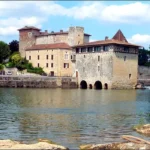
Le hameau de Lustrac se compose d'un moulin, indissociable du château édifié vers 1296 par Foulques de Lustrac, seigneur du lieu. L'actuel bâtiment, construit sur la rive droite du Lot à la fin du XIIIème et au début du XIVème siècle servit à la mouture des grains jusqu'à sa conversion en 1930, en centrale hydroélectrique. Transformé en habitation. Base Mérimée.
English
The hamlet of Lustrac consists of a mill, inseparable from the castle built around 1296 by Foulques de Lustrac, lord of the place. The current building, built on the right bank of the Lot at the end of the 13th and beginning of the 14th century, was used for grinding grain until its conversion in 1930 into a hydroelectric power station. Transformed into a dwelling. Mérimée base.
Deutsch
Der Weiler Lustrac besteht aus einer Mühle, die untrennbar mit dem Schloss verbunden ist, das um 1296 von Foulques de Lustrac, dem Herrn des Ortes, errichtet wurde. Das heutige Gebäude, das am rechten Ufer des Lot Ende des 13. und Anfang des 14. Jahrhunderts errichtet wurde, diente bis zu seiner Umwandlung in ein Wasserkraftwerk im Jahr 1930 zum Mahlen von Getreide. Wurde in ein Wohnhaus umgewandelt. Mérimée-Datenbank.
Dutch
Het gehucht Lustrac bestaat uit een molen, onlosmakelijk verbonden met het kasteel dat rond 1296 werd gebouwd door Foulques de Lustrac, heer van de plaats. Het huidige gebouw, gebouwd op de rechteroever van de Lot aan het einde van de 13e en het begin van de 14e eeuw, werd gebruikt om graan te malen totdat het in 1930 werd omgebouwd tot waterkrachtcentrale. Veranderd in een woning. Mérimée database.
Español
La aldea de Lustrac consta de un molino, inseparable del castillo construido hacia 1296 por Foulques de Lustrac, señor del lugar. El edificio actual, construido en la orilla derecha del Lot a finales del siglo XIII y principios del XIV, se utilizaba para moler el grano hasta que se convirtió en una central hidroeléctrica en 1930. Transformado en una vivienda. Base de datos Mérimée.
Italiano
La frazione di Lustrac è costituita da un mulino, inseparabile dal castello costruito intorno al 1296 da Foulques de Lustrac, signore del luogo. L'edificio attuale, costruito sulla riva destra del Lot tra la fine del XIII e l'inizio del XIV secolo, è stato utilizzato per la macinazione del grano fino alla conversione in centrale idroelettrica nel 1930. Trasformato in abitazione. Banca dati Mérimée.