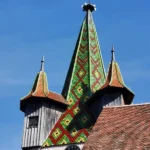
ÉGLISE SAINT-PIERRE – Châtenois
Description
English
Deutsch
Dutch
Español
Italiano
Description
L'église prieurale romane (représentée sur un des vitraux) a été démolie pour faire place à l'église actuelle Saint-Pierre de type Grillot (1843).
Elle a été rénovée à l'intérieure et à l'extérieur en 1993. Elle fait suite à une très vieille église romane datant de la fondation du Prieuré (1069). L'attention peut être portée sur les points suivants : Statues de Saint-Antoine aux Ardents, de l'éducation de la Vierge, de Saint Jean-Baptiste datant du XVIème siècle.
Les gros chapelets pourraient représenter une confrérie du Rosaire fondée en 1535 à La Neuveville-sous-Châtenois.
Fragment d'un retable sur lequel les personnages devaient être peints.
English
The Romanesque priory church (represented on one of the stained glass windows) was demolished to make way for the present Saint-Pierre church of the Grillot type (1843).
It was renovated inside and out in 1993. It follows a very old Romanesque church dating from the foundation of the Priory (1069). Attention can be drawn to the following points: Statues of St. Anthony of the Ardents, of the education of the Virgin, of St. John the Baptist dating from the 16th century
The large rosaries could represent a brotherhood of the Rosary founded in 1535 in La Neuveville-sous-Châtenois
Fragment of an altarpiece on which the figures were to be painted.
Deutsch
Die romanische Prioratskirche (auf einem der Buntglasfenster abgebildet) wurde abgerissen, um Platz für die heutige Kirche Saint-Pierre vom Typ Grillot (1843) zu schaffen.
Sie wurde 1993 innen und außen renoviert. Sie folgt auf eine sehr alte romanische Kirche aus der Zeit der Gründung des Priorats (1069). Die Aufmerksamkeit kann auf folgende Punkte gelenkt werden: Statuen des Heiligen Antonius mit den Brennenden, der Erziehung der Jungfrau Maria und des Heiligen Johannes des Täufers aus dem 16
Die großen Rosenkränze könnten eine Rosenkranzbruderschaft darstellen, die 1535 in La Neuveville-sous-Châtenois gegründet wurde
Fragment eines Altaraufsatzes, auf dem die Figuren vermutlich gemalt waren.
Dutch
De Romaanse priorijkerk (te zien op een van de gebrandschilderde ramen) werd afgebroken om plaats te maken voor de huidige kerk van Sint-Pieter in Grillot-stijl (1843).
Het werd in 1993 van binnen en van buiten gerenoveerd. Het volgt een zeer oude Romaanse kerk die dateert van de stichting van de Priorij (1069). De aandacht kan worden gevestigd op de volgende punten: Beelden van St. Antonius van de Vuren, de Opvoeding van de Maagd, St. Johannes de Doper uit de 16e eeuw
De grote rozenkransen zouden een in 1535 in La Neuveville-sous-Châtenois opgerichte rozenkransbroederschap kunnen voorstellen
Fragment van een altaarstuk waarop de figuren geschilderd moeten zijn.
Español
La iglesia prioral románica (que aparece en una de las vidrieras) fue demolida para dar paso a la actual iglesia de San Pedro, de estilo grillot (1843).
Fue renovado por dentro y por fuera en 1993. Sigue una iglesia románica muy antigua que data de la fundación del Priorato (1069). Cabe destacar los siguientes puntos: Estatuas de San Antonio de los Fuegos, la Educación de la Virgen, San Juan Bautista que datan del siglo XVI
Los grandes rosarios podrían representar una cofradía del Rosario fundada en 1535 en La Neuveville-sous-Châtenois
Fragmento de un retablo en el que las figuras debían estar pintadas.
Italiano
La chiesa priorale romanica (raffigurata in una delle vetrate) fu demolita per far posto all'attuale chiesa di San Pietro in stile Grillot (1843).
È stato ristrutturato all'interno e all'esterno nel 1993. Segue un'antichissima chiesa romanica risalente alla fondazione del Priorato (1069). È possibile richiamare l'attenzione sui seguenti punti: Statue di Sant'Antonio dei Fuochi, dell'Educazione della Vergine, di San Giovanni Battista risalenti al XVI secolo
I grandi rosari potrebbero rappresentare una confraternita del Rosario fondata nel 1535 a La Neuveville-sous-Châtenois
Frammento di pala d'altare su cui dovevano essere state dipinte le figure.
Clientèle: Tout public - Groupes
Rue du Paradis, 88170 Châtenois