Eglise Saint Martin de Pontenx les Forges – Pontenx-les-Forges
Description
English
Deutsch
Dutch
Español
Italiano
Description
A l'origine, cette église dédiée à St Martin, comprenait une seule nef. Elle a fait l'objet de remaniement avec l'adjonction au XIXème siècle de la nef latérale sud et plus tard d'un avant porche.
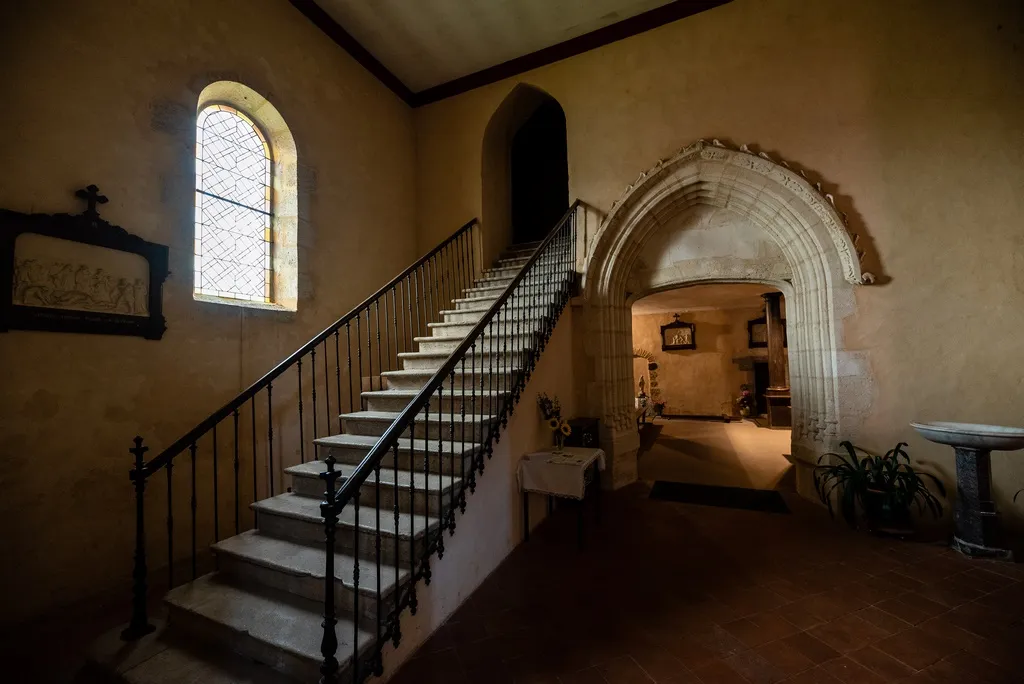
Elle porte l'empreinte du XV°s avec sa tour de garde et se compose de 2 nefs. Au pied du clocher s'ouvre une ancienne porte intérieure dont l'archivolte est décorée de palmettes adossées figurant des feuilles de chêne, qui pourrait se rapporter à un style gothique tardif. Au clocher, on remarquera sur la façade nord une ouverture carrée qui semble avoir été un poste d'observation. Sur le côté sud de la tour, on notera une ouverture à 4 lobes, ayant servi pour la surveillance. A l'intérieur se trouve une vierge debout du XVII°s en bois doré, elle tient l'enfant Jésus sur son bras dormant alors qu'habituellement il est éveillé.
English
Originally, this church, dedicated to St Martin, had a single nave. It was redesigned in the 19th century with the addition of the south side nave and later a front porch.
It bears the imprint of the 15th c. with its watchtower and is composed of 2 naves. At the foot of the bell tower is an old interior doorway whose archivolt is decorated with leaning palmettes featuring oak leaves, which could be related to a late Gothic style. On the north façade of the bell tower there is a square opening that seems to have been an observation post. On the south side of the tower, there is a four-lobed opening that was used for surveillance. Inside there is a 17th century standing virgin made of gilded wood, she holds the baby Jesus on her sleeping arm while he is usually awake.
Deutsch
Ursprünglich bestand die dem Heiligen Martin geweihte Kirche aus einem einzigen Schiff. Sie wurde im 19. Jahrhundert umgebaut, indem das südliche Seitenschiff und später eine Vorhalle hinzugefügt wurden.
Sie trägt mit ihrem Wachturm die Spuren des 15. Jahrhunderts und besteht aus zwei Schiffen. Am Fuße des Glockenturms öffnet sich eine alte Innentür, deren Archivolte mit angelehnten Palmetten verziert ist, die Eichenblätter darstellen, was auf einen spätgotischen Stil hindeuten könnte. Am Glockenturm ist an der Nordseite eine quadratische Öffnung zu erkennen, die offenbar ein Beobachtungsposten war. An der Südseite des Turms ist eine vierlappige Öffnung zu beachten, die zur Überwachung gedient haben soll. Im Inneren befindet sich eine stehende Jungfrau aus dem 17. Jahrhundert aus vergoldetem Holz.
Dutch
Oorspronkelijk had deze kerk, gewijd aan Sint Maarten, één schip. Het werd in de 19e eeuw heringericht met de toevoeging van het schip aan de zuidkant en later een voorportaal.
Het draagt de stempel van de 15e eeuw met zijn wachttoren en bestaat uit twee schepen. Aan de voet van de klokkentoren gaat een oude binnendeur open, waarvan de archivolt versierd is met leunende palmetten met eikenbladeren, die laatgotisch zouden kunnen zijn. In de klokkentoren lijkt een vierkante opening aan de noordzijde een uitkijkpost te zijn geweest. Aan de zuidkant van de toren is een vierlobbige opening die werd gebruikt voor bewaking. Binnen is een 17e eeuwse staande vergulde Maria die het kindje Jezus op haar slapende arm houdt, terwijl hij gewoonlijk wakker is.
Español
Originalmente, esta iglesia, dedicada a San Martín, tenía una sola nave. Fue rediseñada en el siglo XIX con la adición de la nave del lado sur y, posteriormente, de un porche delantero.
Lleva la impronta del siglo XV con su torre de vigilancia y consta de dos naves. A los pies del campanario se abre una antigua puerta interior cuya arquivolta está decorada con palmetas inclinadas que representan hojas de roble y que podrían ser del gótico tardío. En el lado norte del campanario hay una abertura cuadrada que parece haber sido un puesto de vigilancia. En el lado sur de la torre hay una abertura de cuatro lóbulos que se utilizaba para la vigilancia. En el interior, hay una Virgen María dorada de pie del siglo XVII que sostiene al niño Jesús en su brazo dormido cuando normalmente está despierto.
Italiano
In origine questa chiesa, dedicata a San Martino, era a navata unica. Fu ridisegnata nel XIX secolo con l'aggiunta della navata laterale sud e successivamente di un portico anteriore.
Porta l'impronta del XV secolo con la sua torre di guardia ed è composta da due navate. Ai piedi del campanile si apre un'antica porta interna, il cui archivolto è decorato con palmette addossate raffiguranti foglie di quercia, che potrebbero essere tardogotiche. Sul lato nord del campanile si trova un'apertura quadrata che sembra essere stata una postazione di vedetta. Sul lato sud della torre si trova un'apertura quadrilobata che serviva per la sorveglianza. All'interno, si trova una Madonna dorata in piedi del XVII secolo che tiene in braccio Gesù bambino che dorme, mentre di solito è sveglio.
Histoire - En ville - Art sacré - Pèlerinage de Saint-Jacques de Compostelle
Avenue de Mimizan, 40200 Pontenx-les-Forges
Crédits: Yohan Espiaube / OIT Mimizan
Licence
Licence