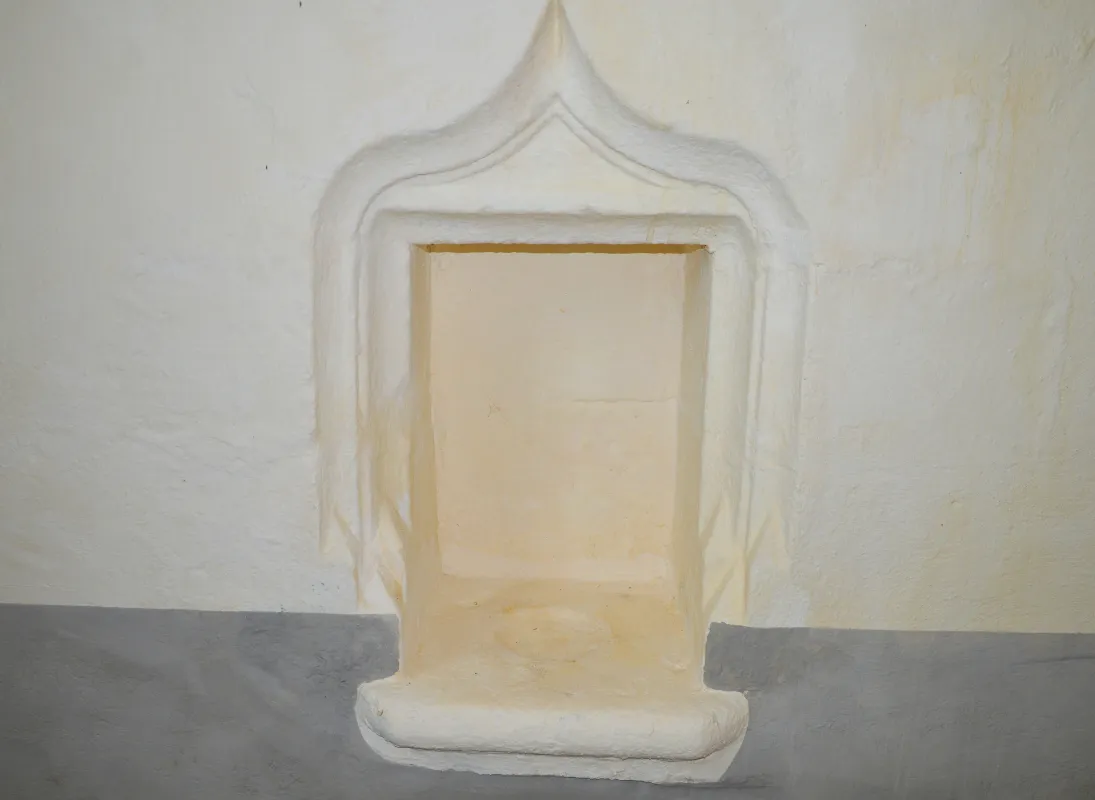
Église Saint-Étienne de Lageyrat – Châlus
Description
English
Deutsch
Dutch
Español
Italiano
Description
Comme en témoignent les vestiges, notamment des mosaïques et des tessons découverts au milieu du 19e siècle, l’église de Lageyrat est très probablement bâtie sur l’emplacement d’une villa gallo-romaine, dont le lieu tire sans doute son nom (Lageyrat ou Lageyrac, le suffixe -ac signifiant « domaine » à l’époque gallo-romaine). L’église, dédiée au protomartyr Etienne, fut sans doute fondée très précocement, peut-être dès l’époque mérovingienne. Si l’édifice recèle quelques parties, notamment au niveau de la nef ou la porte d’entrée, pouvant dater du 11e siècle, il se présente aujourd’hui surtout sous un aspect gothique en raison de la reconstruction au 15e siècle du chœur, du transept et du clocher carré surmontant la croix du transept. Ces dernières parties sont voutées, mais seul le bras nord du transept a conservé son voûtement d’origine.
English
As evidenced by the remains of mosaics and potsherds discovered in the mid-19th century, the church at Lageyrat was most likely built on the site of a Gallo-Roman villa, from which the area undoubtedly derives its name (Lageyrat or Lageyrac, the suffix -ac meaning "estate" in Gallo-Roman times). The church, dedicated to the protomartyr Etienne, was probably founded very early, perhaps as early as the Merovingian period. Although some parts of the building, such as the nave and entrance door, may date from the 11th century, it is now mainly Gothic in appearance, thanks to the 15th-century reconstruction of the choir, transept and square bell tower surmounting the transept cross. The latter parts are vaulted, but only the north arm of the transept has retained its original vaulting.
Deutsch
Jahrhunderts gefundenen Mosaiken und Scherben belegen, dass die Kirche von Lageyrat höchstwahrscheinlich auf dem Gelände einer gallorömischen Villa errichtet wurde, nach der der Ort wahrscheinlich benannt ist (Lageyrat oder Lageyrac, wobei das Suffix -ac in der gallorömischen Epoche "Landgut" bedeutete). Die Kirche, die dem Protomartyr Stephanus geweiht ist, wurde wahrscheinlich sehr früh gegründet, vielleicht schon in der Merowingerzeit. Jahrhundert stammen, ist sie heute vor allem gotisch, da im 15. Jahrhundert der Chor, das Querschiff und der quadratische Glockenturm über dem Kreuz des Querschiffs wiederaufgebaut wurden. Letztere sind gewölbt, aber nur der nördliche Arm des Querschiffs hat seine ursprüngliche Gewölbedecke bewahrt.
Dutch
Zoals blijkt uit de overblijfselen, met name mozaïeken en scherven die halverwege de 19e eeuw zijn ontdekt, is de kerk van Lageyrat zeer waarschijnlijk gebouwd op de plaats van een Gallo-Romeinse villa, waaraan de plaats waarschijnlijk zijn naam ontleent (Lageyrat of Lageyrac, waarbij het achtervoegsel -ac in de Gallo-Romeinse tijd "landgoed" betekende). De kerk, gewijd aan de protomartyr Etienne, werd waarschijnlijk zeer vroeg gesticht, misschien al in de Merovingische periode. Hoewel sommige delen van het gebouw, met name het schip en de toegangsdeur, uit de 11e eeuw dateren, ziet het er vandaag de dag vooral gotisch uit door de 15e-eeuwse reconstructie van het koor, het dwarsschip en de vierkante klokkentoren boven het dwarskruis. De laatste delen zijn gewelfd, maar alleen de noordelijke arm van het transept heeft zijn oorspronkelijke gewelf behouden.
Español
Como demuestran los vestigios, en particular mosaicos y fragmentos descubiertos a mediados del siglo XIX, es muy probable que la iglesia de Lageyrat se construyera en el emplazamiento de una villa galo-romana, de la que probablemente toma su nombre el lugar (Lageyrat o Lageyrac, el sufijo -ac significaba "finca" en época galo-romana). La iglesia, dedicada al protomártir Etienne, fue fundada probablemente muy pronto, quizá ya en época merovingia. Aunque algunas partes del edificio, sobre todo en la nave y la puerta de entrada, pueden datar del siglo XI, su aspecto actual es principalmente gótico, debido a la reconstrucción en el siglo XV del coro, el crucero y el campanario cuadrado que corona la cruz del crucero. Estas últimas partes están abovedadas, pero sólo el brazo norte del crucero conserva su bóveda original.
Italiano
Come testimoniano i resti, in particolare i mosaici e i cocci rinvenuti a metà del XIX secolo, la chiesa di Lageyrat è stata molto probabilmente costruita sul sito di una villa gallo-romana, da cui probabilmente la località prende il nome (Lageyrat o Lageyrac, il cui suffisso -ac significa "tenuta" in epoca gallo-romana). La chiesa, dedicata al protomartire Etienne, fu probabilmente fondata molto presto, forse già in epoca merovingia. Sebbene alcune parti dell'edificio, in particolare la navata e la porta d'ingresso, possano risalire all'XI secolo, oggi l'edificio ha un aspetto prevalentemente gotico grazie alla ricostruzione del coro, del transetto e del campanile quadrato che sormonta la croce del transetto, avvenuta nel XV secolo. Queste ultime parti sono coperte da volte, ma solo il braccio nord del transetto ha conservato la volta originale.