Eglise Saint-Barthélémy – Marcillac-la-Croisille
Description
English
Deutsch
Dutch
Español
Italiano
Description
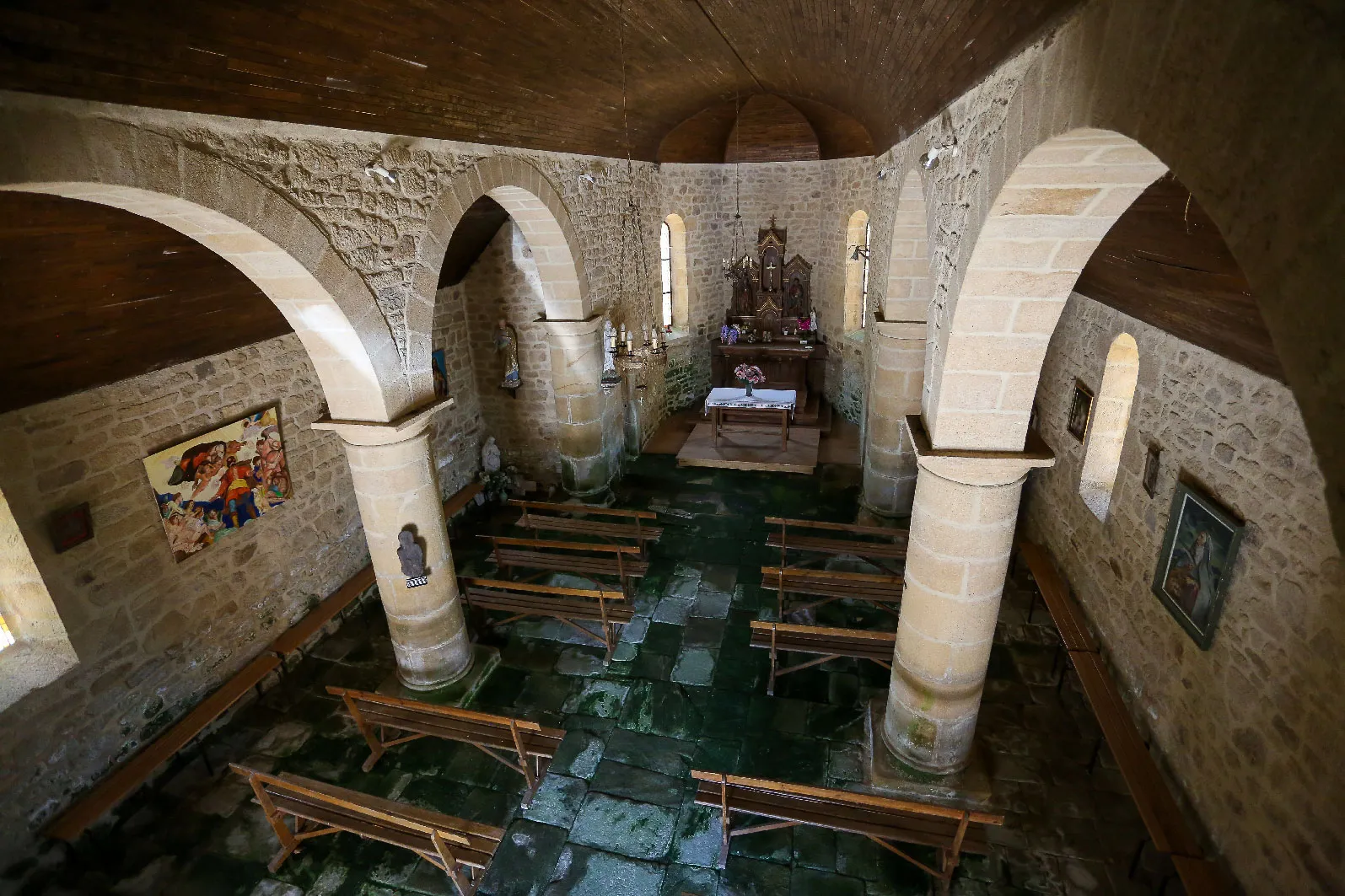
L’église actuelle fut reconstruite en 1860 et rappelle, par la forme de son vaisseau, une grange à trois travées. L’inclinaison de son toit permet une couverture en lauze, son portail de type limousin possède un curieux linteau de dalle de verre, ses fenêtres calibrées, en plein-cintre (cinq au nord et cinq au sud), sont ornées de beaux vitraux en dalles de verre, son chevet plat est percé de deux autres baies elles aussi néo-romanes. Le clocher porche, de plan carré au premier niveau, devient octogonal dans sa partie haute. Il est surmonté d’une flèche couverte d’ardoises.
English
The present church was rebuilt in 1860, and its vessel shape is reminiscent of a three-bay barn. Its sloping roof allows for a lauze roof, its Limousin-style portal features a curious glass slab lintel, its calibrated round-headed windows (five to the north and five to the south) are adorned with beautiful stained glass slabs, and its flat chevet is pierced by two other bays, also neo-Romanesque. The porch bell tower, square on the first level, becomes octagonal at the top. It is topped by a slate-covered spire.
Deutsch
Die heutige Kirche wurde 1860 wieder aufgebaut und erinnert aufgrund der Form ihres Schiffes an eine Scheune mit drei Spannweiten. Die Neigung des Daches ermöglicht eine Eindeckung mit Schiefer, das Portal im Limousin-Stil hat einen kuriosen Sturz aus Glasplatten, die Rundbogenfenster (fünf im Norden und fünf im Süden) sind mit schönen Glasplattenfenstern verziert, und das flache Dach wird von zwei weiteren, ebenfalls neoromanischen Buchten durchbrochen. Der Glockenturm hat einen quadratischen Grundriss auf der ersten Ebene und wird im oberen Teil achteckig. Er wird von einer schiefergedeckten Spitze gekrönt.
Dutch
De huidige kerk werd herbouwd in 1860 en doet qua vorm van het schip denken aan een schuur met drie traveeën. Het schuine dak is bedekt met gaas, de deuropening in Limousin-stijl heeft een merkwaardige bovendorpel met glaspanelen, de gekalibreerde ramen met ronde koppen (vijf aan de noordkant en vijf aan de zuidkant) zijn versierd met prachtige glas-in-loodramen en het platte chevet wordt doorboord door twee andere traveeën, ook neoromaans. De klokkentoren, vierkant op de begane grond, wordt achthoekig aan de bovenkant. Hij wordt bekroond door een met leisteen bedekte spits.
Español
La iglesia actual fue reconstruida en 1860 y, por la forma de su nave, recuerda a un granero de tres naves. Su tejado inclinado permite revestirla de lauze, su portada de estilo lemosín presenta un curioso dintel acristalado, sus ventanas calibradas de medio punto (cinco al norte y cinco al sur) están adornadas con hermosas vidrieras acristaladas, y su cabecera plana está perforada por otras dos crujías, también neorrománicas. El campanario del pórtico, cuadrado en la planta baja, se convierte en octogonal en la parte superior. Está rematado por una aguja cubierta de pizarra.
Italiano
L'attuale chiesa fu ricostruita nel 1860 e, nella forma della navata, ricorda un fienile a tre campate. La pendenza del tetto consente di realizzare una copertura in ardesia, il portale in stile limosino ha un curioso architrave in lastre di vetro, le finestre calibrate a tutto sesto (cinque a nord e cinque a sud) sono ornate da belle lastre di vetro colorato, e il suo chevet piatto è trafitto da altre due campate, anch'esse neoromaniche. Il campanile del portico, quadrato al piano terra, diventa ottagonale alla sommità. È sormontato da una guglia rivestita di ardesia.