Eglise Saint Barthélémy – Chénérailles
Description
English
Deutsch
Dutch
Español
Italiano
Description
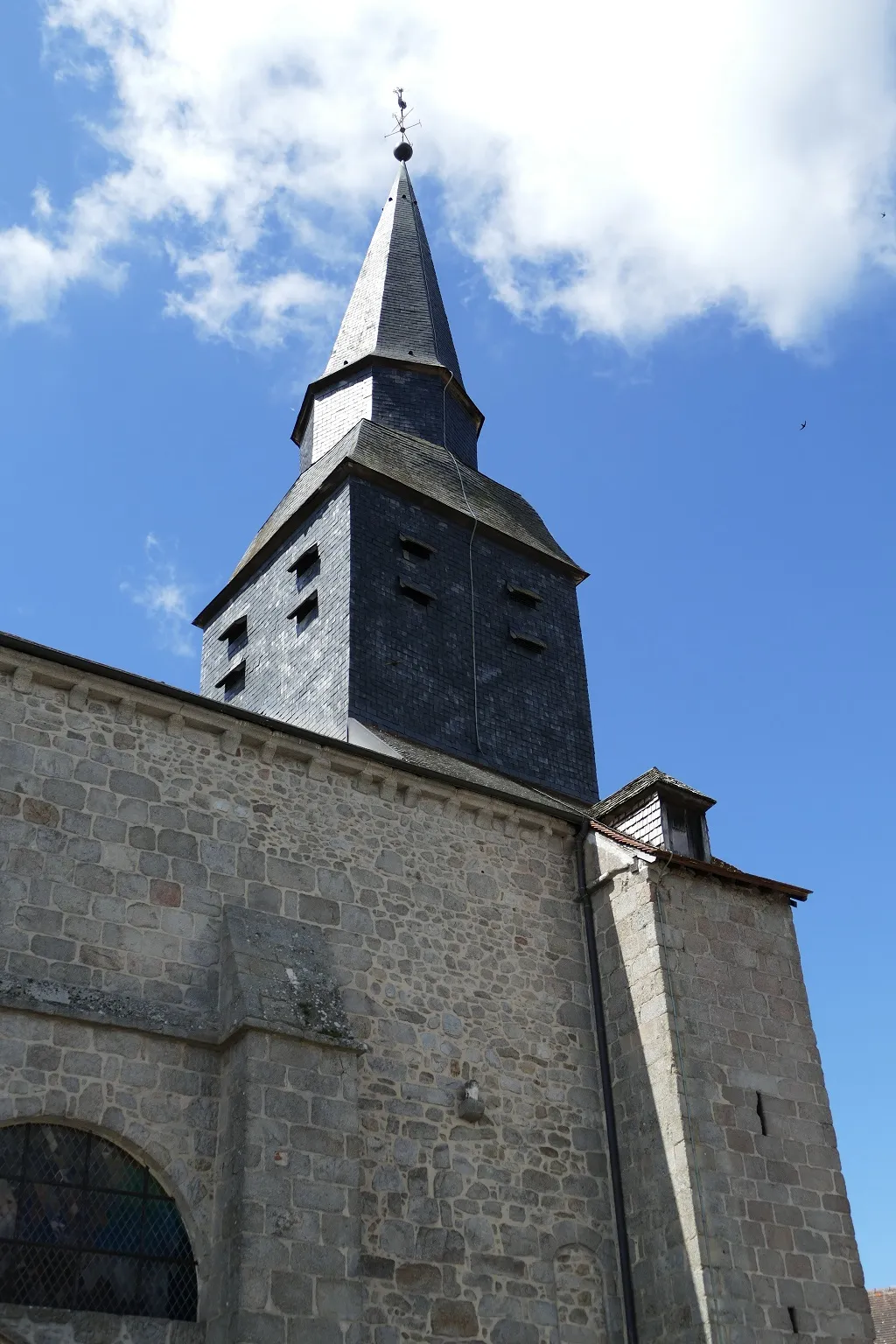
L'église dépendait de l'abbaye de Bénévent. Elle est formée d'un vaisseau divisé en quatre travées, celle de l'est formant le choeur à chevet plat. Au 14e siècle a été ajoutée la chapelle seigneuriale. La voûte du choeur a ses quatre compartiments ornés de peintures modernes représentant l'Annonciation, la Nativité, la Résurrection et la Transfiguration. A l'extérieur, les deux portails sont en arc brisé. Celui du nord est à voussures moulurées de boudins retombant sur des colonnettes garnissant les ressauts des piedroits, par l'intermédiaire de chapiteaux faisant frise avec retour sur le mur. Un cordon en larmier formant archivolte au-dessus de l'arc, surmonte l'ensemble. Le portail ouest est plus simple. Son arc est mouluré d'un boudin reçu sur des colonnettes par l'intermédiaire d'un chapiteau sculpté.
English
The exterior of the church of Saint Barthélémy is classical, but it is inside that (where) the interest of the visit lies. A seigniorial chapel dedicated to the Etangsannes family (whose chateau you can still visit) was added to the nave in the 14th century. The furnishings of this religious building are particularly noteworthy for the presence of a 14th-century limestone funeral plaque representing the funeral of Barthélémy de la Place, who died in 1300 and is considered the founder of the church of Chénérailles. Also noteworthy is the preservation in good condition of part of the stalls and the painted ceiling of the choir.
Deutsch
Die Kirche Saint Barthélémy weist ein klassisches Äußeres auf, doch im Inneren liegt das Hauptinteresse der Besichtigung. Eine herrschaftliche Kapelle, die der Familie d'Étangsannes gewidmet war (deren Schloss man noch heute besichtigen kann), wurde im 14. Jahrhundert an das Kirchenschiff angebaut. Das Mobiliar dieses religiösen Gebäudes zeichnet sich insbesondere durch das Vorhandensein einer Grabplatte aus Kalkstein aus dem 14. Jahrhundert aus, die die Beerdigung von Barthélémy de la Place darstellt, der 1300 starb und als Gründer der Kirche von Chénérailles gilt. Bemerkenswert sind auch die gute Erhaltung eines Teils des Chorgestühls und die bemalte Decke des Chors.
Dutch
De kerk Saint-Barthélémy heeft een klassieke buitenkant, maar het is het interieur dat het bezoek zo interessant maakt. Een heerlijkheidskapel gewijd aan de familie d'Étangsannes (waarvan het kasteel nog steeds kan worden bezocht) werd in de 14e eeuw aan het schip toegevoegd. De inrichting van dit religieuze gebouw valt vooral op door een kalkstenen grafsteen uit de 14e eeuw die de begrafenis voorstelt van Barthélémy de la Place, die in 1300 stierf en beschouwd wordt als de stichter van de kerk van Chénérailles. Sommige koorbanken en het beschilderde koorplafond zijn ook goed bewaard gebleven.
Español
La iglesia de San Bartolomé tiene un exterior clásico, pero es su interior lo que hace que la visita sea aún más interesante. En el siglo XIV se añadió a la nave una capilla señorial dedicada a la familia Étangsannes, cuyo castillo aún puede visitarse. En el mobiliario de este edificio religioso destaca una lápida de piedra caliza del siglo XIV que representa los funerales de Bartolomé de la Place, fallecido en 1300 y considerado el fundador de la iglesia de Chénérailles. También se conservan en buen estado la sillería y el techo pintado del coro.
Italiano
La chiesa apparteneva all'abbazia di Bénévent. È composta da una navata divisa in quattro campate, di cui quella orientale forma il coro con un chevet piatto. La cappella signorile fu aggiunta nel XIV secolo. La volta del coro presenta quattro scomparti decorati con dipinti moderni che rappresentano l'Annunciazione, la Natività, la Resurrezione e la Trasfigurazione. All'esterno, i due portali sono a sesto acuto. Il portale nord presenta dei voussoir modanati con pennacchi che ricadono su colonnine che rivestono gli stipiti, attraverso capitelli che formano un fregio con un ritorno sulla parete. Una modanatura a goccia che forma un archivolto sopra l'arco sormonta il tutto. Il portale occidentale è più semplice. Il suo arco è modellato con un'asta accolta da colonne tramite un capitello scolpito.
Dans le village
Classement: Monument Historique
Rue de l'église, 23130 Chénérailles
Crédits: ©MCA
Licence
Licence
Publications similaires :
 Circuit de randonnée : Les mille visages de Chénérailles – Chénérailles
  Chénérailles (Place du Champ de Foire) : Aire de jeux et toilettes publiques – Chénérailles
  Saint-Barthélémy-d'Agenais, dans les coteaux de Guyenne – Saint-Barthélemy-d'Agenais Saint-Barthélémy, vers les Bois de Péfranc et de Verteuil – Saint-Barthélemy-d'Agenais