Eglise protestante – Eglise des Récollets – Sélestat
Description
English
Deutsch
Dutch
Español
Italiano
Description
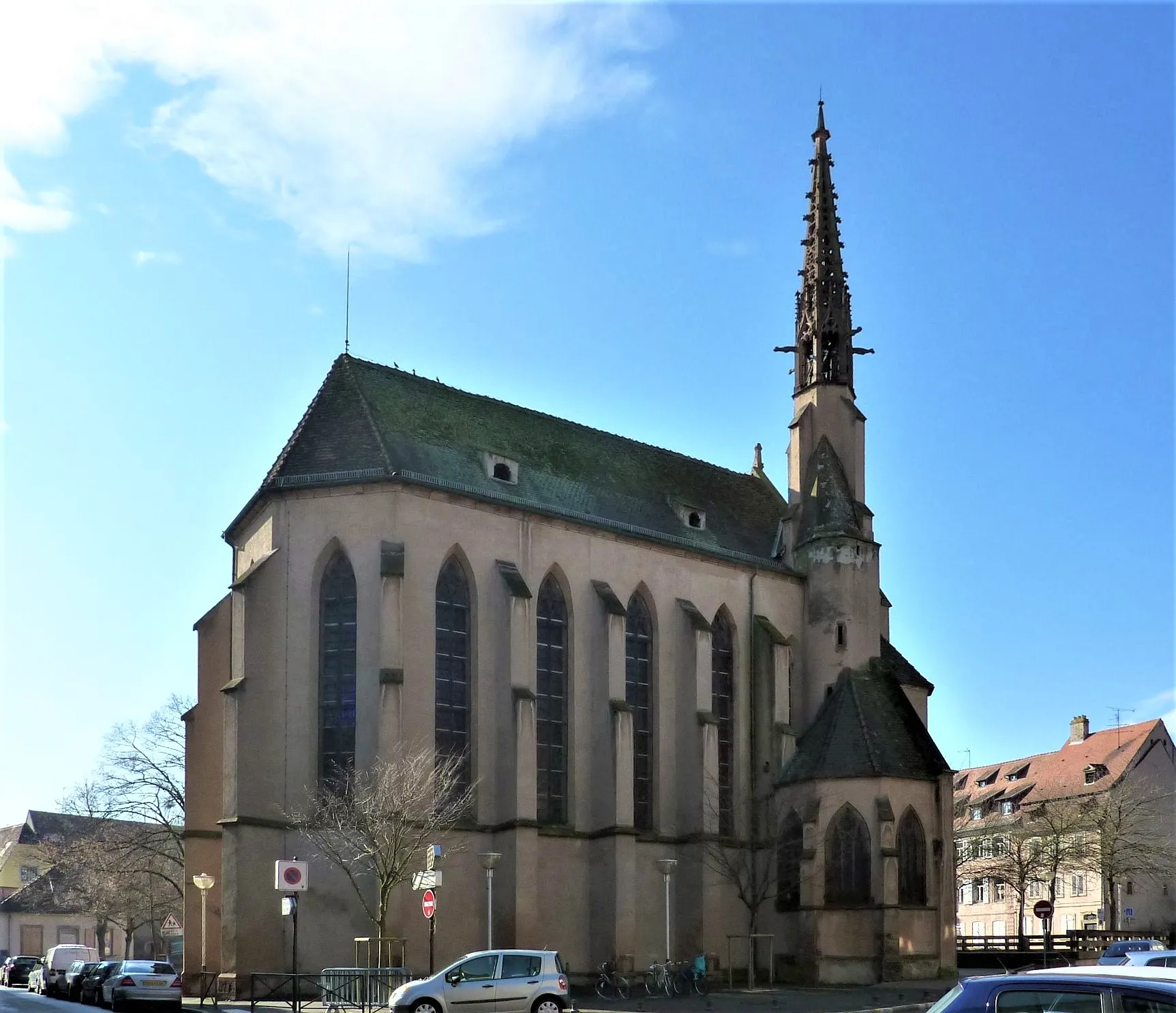
L'actuelle église protestante occupe le choeur de l'ancienne église du couvent des Franciscains de Sélestat. L'ordre s'installe à Sélestat au 13ème siècle et érige ce choeur en 1280 à côté des bâtiments conventuels.
Abandonnée, puis reprise par l'ordre des Récollets, sécularisée pendant la Révolution, c'est en 1878 que le Conseil Municipal de Sélestat autorise la jeune communauté protestante à en faire son lieu de culte. Avant l'inauguration officielle en 1881, on procède à la démolition de la nef et à d'importants travaux de rénovation. L'orgue a été construit par Rinckenbach.
Les vitraux datent d'après la seconde guerre mondiale, ceux du choeur représentent Moïse et le Christ (centre) et les 4 évangélistes (à droite et à gauche). Source : www.martinbucer.org
English
The present Protestant church occupies the choir of the former Franciscan convent church in Selestat. The order settled in Selestat in the 13th century and built this choir in 1280 next to the conventual buildings.
Abandoned, then taken over by the Récollet order, secularized during the Revolution, it was in 1878 that the Sélestat City Council authorized the young Protestant community to use it as a place of worship. Before the official inauguration in 1881, the nave was demolished and major renovation work was carried out. The organ was built by Rinckenbach.
The stained glass windows date from after the Second World War, those in the choir represent Moses and Christ (center) and the 4 evangelists (right and left). Source : www.martinbucer.org
Deutsch
Die heutige protestantische Kirche nimmt den Chor der ehemaligen Kirche des Franziskanerklosters von Sélestat ein. Der Orden ließ sich im 13. Jahrhundert in Sélestat nieder und errichtete diesen Chor 1280 neben den Klostergebäuden.
Nach der Aufgabe und Übernahme durch den Orden der Rekollekten und der Säkularisierung während der Revolution genehmigte der Gemeinderat von Sélestat 1878 der jungen protestantischen Gemeinde, den Chor als Gotteshaus zu nutzen. Vor der offiziellen Einweihung im Jahr 1881 wurden das Kirchenschiff abgerissen und umfangreiche Renovierungsarbeiten durchgeführt. Die Orgel wurde von Rinckenbach gebaut.
Die Kirchenfenster stammen aus der Zeit nach dem Zweiten Weltkrieg. Die Fenster im Chor zeigen Moses und Christus (Mitte) und die vier Evangelisten (rechts und links). Quelle: www.martinbucer.org
Dutch
De huidige protestantse kerk bezet het koor van de voormalige Franciscaner kloosterkerk in Selestat. De orde vestigde zich in de 13e eeuw in Sélestat en bouwde dit koor in 1280 naast de kloostergebouwen.
Verlaten, vervolgens overgenomen door de orde van Récollet, geseculariseerd tijdens de Revolutie, gaf de gemeenteraad van Sélestat in 1878 toestemming aan de jonge protestantse gemeenschap om het als bedehuis te gebruiken. Vóór de officiële inwijding in 1881 werd het schip afgebroken en werden grote renovatiewerkzaamheden uitgevoerd. Het orgel werd gebouwd door Rinckenbach.
De gebrandschilderde ramen dateren van na de Tweede Wereldoorlog, die in het koor stellen Mozes en Christus voor (midden) en de vier evangelisten (rechts en links). Bron: www.martinbucer.org
Español
La actual iglesia protestante ocupa el coro de la antigua iglesia del convento franciscano de Selestat. La orden se instaló en Sélestat en el siglo XIII y construyó este coro en 1280 junto a los edificios conventuales.
Abandonado, luego tomado por la orden de los Récollet, secularizado durante la Revolución, fue en 1878 cuando el ayuntamiento de Sélestat autorizó a la joven comunidad protestante a utilizarlo como lugar de culto. Antes de la inauguración oficial, en 1881, se demolió la nave y se llevaron a cabo importantes obras de renovación. El órgano fue construido por Rinckenbach.
Las vidrieras datan de después de la Segunda Guerra Mundial, las del coro representan a Moisés y Cristo (centro) y a los cuatro evangelistas (derecha e izquierda). Fuente: www.martinbucer.org
Italiano
L'attuale chiesa protestante occupa il coro dell'ex convento francescano di Selestat. L'ordine si stabilì a Sélestat nel XIII secolo e costruì questo coro nel 1280 accanto agli edifici conventuali.
Abbandonato, poi rilevato dall'ordine dei Récollet, secolarizzato durante la Rivoluzione, fu nel 1878 che il consiglio comunale di Sélestat autorizzò la giovane comunità protestante a utilizzarlo come luogo di culto. Prima dell'inaugurazione ufficiale, nel 1881, la navata centrale fu demolita e furono eseguiti importanti lavori di ristrutturazione. L'organo è stato costruito da Rinckenbach.
Le vetrate risalgono al secondo dopoguerra; quelle del coro raffigurano Mosè e Cristo (al centro) e i quattro evangelisti (a destra e a sinistra). Fonte: www.martinbucer.org
Place du Marché aux Pots, 67600 Sélestat
Crédits: ©SHKT