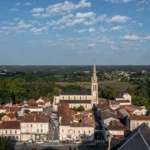
Eglise Notre Dame de l'Assomption La Roche-Chalais – La Roche-Chalais
My Tourisme > Sites Culturels > Eglise Notre Dame de l'Assomption La Roche-Chalais – La Roche-Chalais
Description
English
Deutsch
Dutch
Español
Italiano
Description
Jean Hérier-Fonclaire, maire de la commune de 1860 à 1870 fait raser l'ancienne église en bois, délabrée, et reconstruire de 1868 à 1871 l'église actuelle, de style néogothique.
En 1883, le clocher accueille une deuxième cloche (la première fut fondue en 1813) ; le comte de Saint-Saud commande au renommé Joseph Merklin l'orgue qui restera sa propriété jusqu'en 1951. Sous le mandat municipal de Fernand Lapeyre, une horloge à trois cadrans est adjointe au clocher en 1898.
Si l'église n'est pas inscrite à l'inventaire des monuments historiques, le lutrin est classé au titre d'objet historique depuis 1975 ; le pupitre comprend deux aigles affrontés à têtes croisées (aigles de Saint-Jean et de Saint-Luc avec angelots et feuilles d'acanthe) ; il date du XVIIe siècle, la base et le pied du XIXe.
English
Jean Hérier-Fonclaire, mayor of the commune from 1860 to 1870, had the old, dilapidated wooden church razed to the ground and rebuilt from 1868 to 1871 the present church in neo-gothic style.
In 1883, a second bell was added to the bell tower (the first was cast in 1813); the Count of Saint-Saud ordered the organ from the renowned Joseph Merklin, who remained his property until 1951. Under the municipal mandate of Fernand Lapeyre, a clock with three dials was added to the bell tower in 1898.
Although the church is not listed in the inventory of historical monuments, the lectern has been classified as a historical object since 1975; the lectern includes two eagles with crossed heads (eagles of Saint John and Saint Luke with cherubs and acanthus leaves); it dates from the 17th century, the base and foot from the 19th century.
Deutsch
Jean Hérier-Fonclaire, der von 1860 bis 1870 Bürgermeister der Gemeinde war, ließ die alte, baufällige Holzkirche abreißen und von 1868 bis 1871 die heutige Kirche im neugotischen Stil wieder aufbauen.
Im Jahr 1883 erhielt der Glockenturm eine zweite Glocke (die erste wurde 1813 gegossen); der Graf von Saint-Saud bestellte bei dem renommierten Joseph Merklin die Orgel, die bis 1951 in seinem Besitz blieb. Unter der Amtszeit von Fernand Lapeyre wurde 1898 eine Uhr mit drei Zifferblättern an den Glockenturm angebaut.
Die Kirche steht zwar nicht im Inventar der historischen Denkmäler, aber das Pult ist seit 1975 als historisches Objekt klassifiziert; der Notenständer besteht aus zwei Adlern mit gekreuzten Köpfen (Adler des Heiligen Johannes und des Heiligen Lukas mit Engeln und Akanthusblättern); er stammt aus dem 17.
Dutch
Jean Hérier-Fonclaire, burgemeester van de gemeente van 1860 tot 1870, liet de oude, vervallen houten kerk met de grond gelijk maken en de huidige neogotische kerk van 1868 tot 1871 herbouwen.
In 1883 werd een tweede klok aan de klokkentoren toegevoegd (de eerste werd in 1813 gegoten); de graaf van Saint-Saud gaf de vermaarde Joseph Merklin de opdracht het orgel te bouwen, dat tot 1951 zijn eigendom bleef. Onder gemeentelijk mandaat van Fernand Lapeyre werd in 1898 een klok met drie wijzerplaten aan de klokkentoren toegevoegd.
Hoewel de kerk niet als historisch monument is opgenomen, staat de lessenaar sinds 1975 op de monumentenlijst; de lessenaar bestaat uit twee tegenover elkaar staande adelaars met gekruiste koppen (adelaars van Sint Jan en Sint Lucas met cherubijnen en acanthusbladeren); hij dateert uit de 17e eeuw, de voet en de voet uit de 19e eeuw.
Español
Jean Hérier-Fonclaire, alcalde de la comuna de 1860 a 1870, mandó arrasar la vieja y ruinosa iglesia de madera y reconstruir la actual iglesia neogótica de 1868 a 1871.
En 1883, se añadió una segunda campana al campanario (la primera se fundió en 1813); el conde de Saint-Saud encargó al célebre Joseph Merklin la construcción del órgano, que siguió siendo de su propiedad hasta 1951. Bajo el mandato municipal de Fernand Lapeyre, en 1898 se añadió al campanario un reloj de tres esferas.
Aunque la iglesia no está catalogada como monumento histórico, el facistol está catalogado como objeto histórico desde 1975; el facistol consta de dos águilas enfrentadas con cabezas cruzadas (águilas de San Juan y San Lucas con querubines y hojas de acanto); data del siglo XVII, la base y el pie del siglo XIX.
Italiano
Jean Hérier-Fonclaire, sindaco del comune dal 1860 al 1870, fece radere al suolo la vecchia e fatiscente chiesa di legno e ricostruì l'attuale chiesa neogotica tra il 1868 e il 1871.
Nel 1883 fu aggiunta una seconda campana al campanile (la prima era stata fusa nel 1813); il conte di Saint-Saud commissionò al famoso Joseph Merklin la costruzione dell'organo, che rimase di sua proprietà fino al 1951. Nel 1898, su mandato del municipio di Fernand Lapeyre, fu aggiunto al campanile un orologio a tre quadranti.
Sebbene la chiesa non sia iscritta nell'elenco dei monumenti storici, il leggio è iscritto nell'elenco degli oggetti storici dal 1975; il leggio è composto da due aquile contrapposte con teste incrociate (aquile di San Giovanni e San Luca con cherubini e foglie d'acanto); risale al XVII secolo, la base e il piede al XIX secolo.