Eglise de Pompignac – Pompignac
Description
English
Deutsch
Dutch
Español
Italiano
Description
L'église est de fondation romane (XIIe siècle) et a été construite sur un site gallo-roman. À l'origine, elle constituait une cure indépendante dont les premières mentions écrites apparaissent au XIVe siècle. Elle est inscrite[1] à l'Inventaire général du patrimoine culturel.
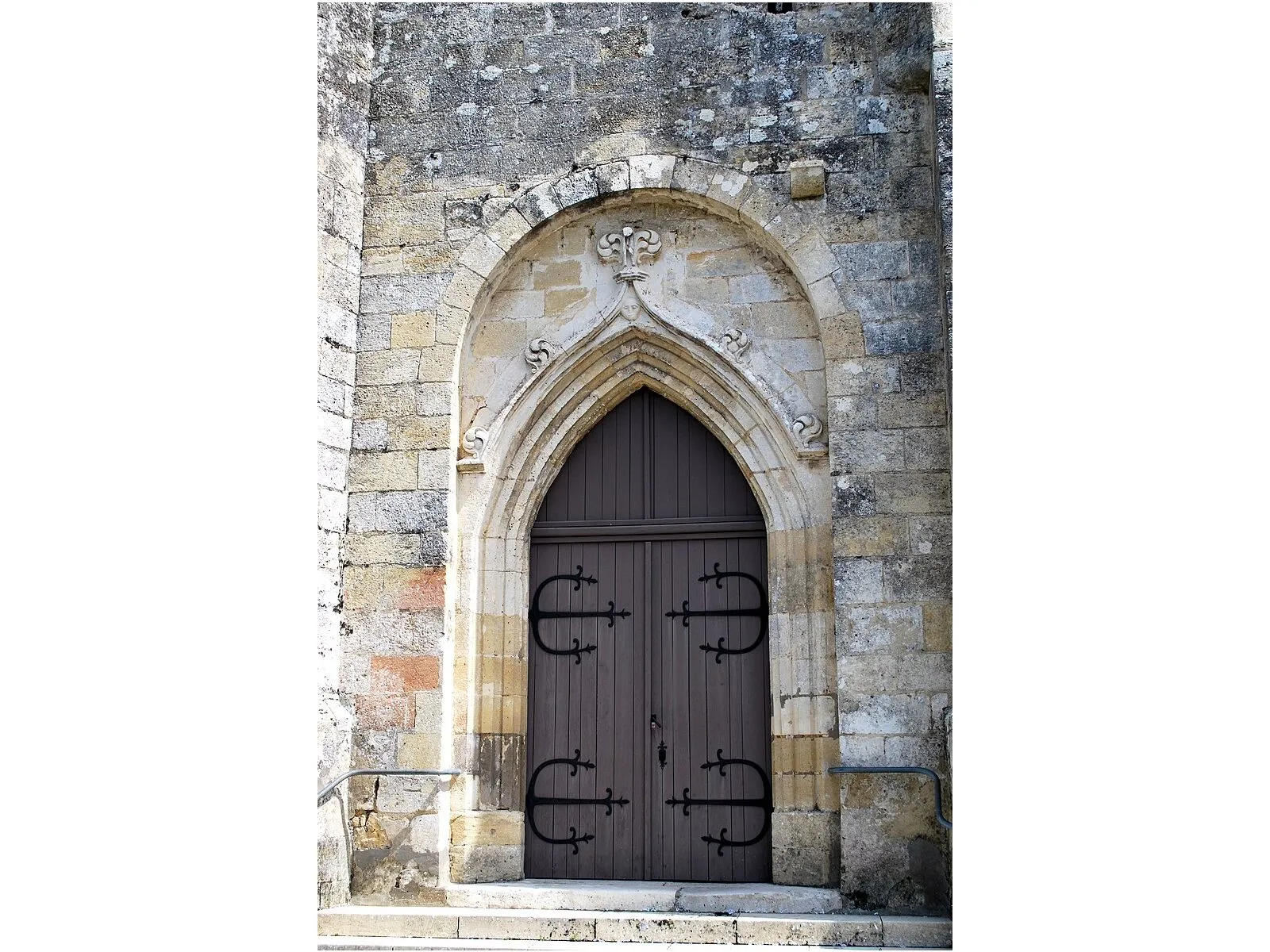
À la fin du XVe, ou au début du XVIe siècle, l'église fut dotée d'un clocher-porche qui a préservé le portail roman. Le clocher est percé de baies en plein cintre au niveau du campanile. Sa porte, inscrite dans une grande arcade également en plein cintre, est surmontée d’un arc gothique en accolade, orné de choux frisés et d’une tête humaine.
Un oculus est percé dans le mur ouest, tandis que le flanc sud présente encore une fenêtre romane.
Une reconstruction partielle a été faite au XVIIIe siècle par l'architecte bordelais Étienne Laclotte.
English
The church has a Romanesque foundation (12th century) and was built on a Gallo-Romanesque site. It was originally an independent parish church, first mentioned in writing in the 14th century. It is listed[1] on the Inventaire Général du Patrimoine Culturel (General Inventory of Cultural Heritage).
At the end of the 15th or beginning of the 16th century, the church was given a bell tower-porch, which preserves the Romanesque portal. The bell tower is pierced by round-headed bays at the level of the campanile. The door, set in a large semicircular archway, is surmounted by a Gothic bracketed arch, decorated with curly cabbages and a human head.
An oculus is pierced in the west wall, while the south flank still features a Romanesque window.
A partial reconstruction was carried out in the 18th century by Bordeaux architect Étienne Laclotte.
Deutsch
Die Kirche ist eine romanische Gründung (12. Jahrhundert) und wurde auf einer galloromanischen Stätte errichtet. Ursprünglich bildete sie eine eigenständige Pfarrei, die im 14. Jahrhundert erstmals schriftlich erwähnt wurde. Sie wurde in das Inventaire général du patrimoine culturel aufgenommen[1].
Ende des 15. bzw. Anfang des 16. Jahrhunderts wurde die Kirche mit einem Glockenturm versehen, der das romanische Portal bewahrt hat. Der Glockenturm hat Rundbogenöffnungen auf der Höhe des Glockenturms. Die Tür, die in einen großen Rundbogen eingelassen ist, wird von einem gotischen Klammerbogen überragt, der mit Krauskohl und einem menschlichen Kopf verziert ist.
In der Westmauer befindet sich ein Okulus, während die Südseite noch ein romanisches Fenster aufweist.
Jahrhundert von dem Architekten Étienne Laclotte aus Bordeaux teilweise wieder aufgebaut.
Dutch
De kerk heeft een Romaanse fundering (12e eeuw) en is gebouwd op een Gallo-Romaanse plek. Oorspronkelijk was het een onafhankelijke parochiekerk, voor het eerst schriftelijk vermeld in de 14e eeuw. Ze is opgenomen[1] in de Algemene Inventaris van het Cultureel Erfgoed.
Aan het eind van de 15e of het begin van de 16e eeuw kreeg de kerk een klokkentoren-poort, waardoor het romaanse portaal bewaard is gebleven. De klokkentoren wordt doorboord door halfronde traveeën in de klokkentoren. De deuropening, in een grote arcade die ook rond is, wordt bekroond door een gotische boog in de vorm van een beugel, versierd met gekrulde kolen en een menselijk hoofd.
In de westelijke muur is een oculus doorboord, terwijl de zuidkant nog een Romaans raam heeft.
Een gedeeltelijke reconstructie werd in de 18e eeuw uitgevoerd door de architect Étienne Laclotte uit Bordeaux.
Español
La iglesia tiene una fundación románica (siglo XII) y fue construida en un emplazamiento galo-románico. Originalmente, era una iglesia parroquial independiente, mencionada por primera vez por escrito en el siglo XIV. Está inscrita[1] en el Inventario General del Patrimonio Cultural.
A finales del siglo XV o principios del XVI, la iglesia recibió un campanario-porche, que conserva la portada románica. El campanario está perforado por vanos semicirculares en la espadaña. Su portada, situada en una gran arcada también de medio punto, está rematada por un arco gótico en forma de ménsula, decorado con coles rizadas y una cabeza humana.
En el muro oeste hay perforado un óculo, mientras que el lado sur conserva una ventana románica.
En el siglo XVIII, el arquitecto bordelés Étienne Laclotte llevó a cabo una reconstrucción parcial.
Italiano
La chiesa ha una fondazione romanica (XII secolo) ed è stata costruita su un sito gallo-romanico. In origine era una chiesa parrocchiale indipendente, citata per la prima volta per iscritto nel XIV secolo. È iscritta[1] nell'Inventario generale dei beni culturali.
Alla fine del XV o all'inizio del XVI secolo, la chiesa fu dotata di un campanile-portico, che conserva il portale romanico. Il campanile è traforato da campate semicircolari nella torre campanaria. Il portale, inserito in un ampio porticato anch'esso a tutto sesto, è sormontato da un arco gotico a forma di mensola, decorato con cavoli ricci e una testa umana.
Un oculo è trafitto nella parete ovest, mentre il lato sud conserva ancora una finestra romanica.
Una parziale ricostruzione è stata realizzata nel XVIII secolo dall'architetto bordolese Étienne Laclotte.