ÉGLISE DE BARTRES
Description
English
Deutsch
Dutch
Español
Italiano
Description
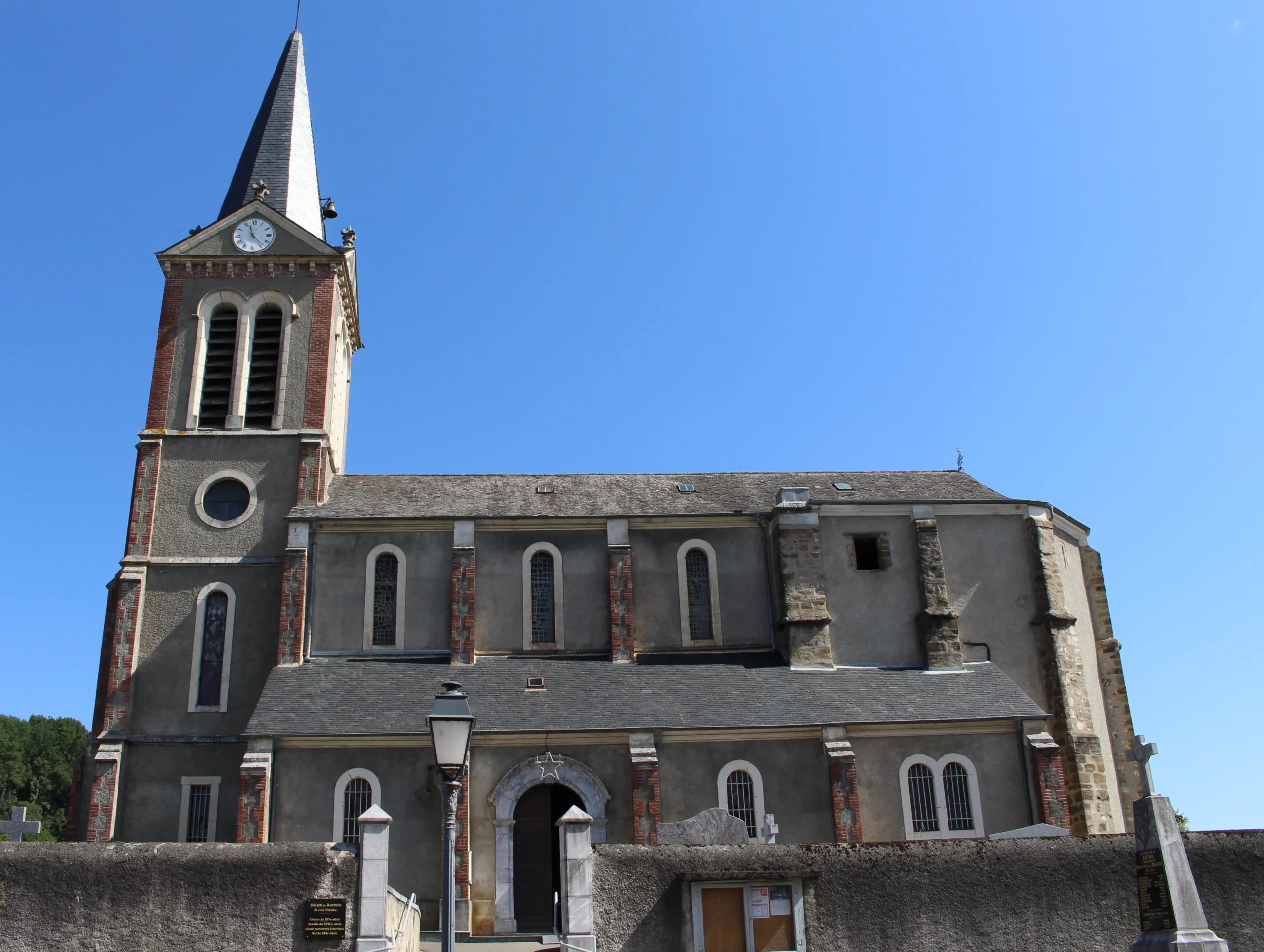
L’église a été restaurée et reconstruite en partie, au XIXe siècle (1855-1887). L’ancienne église du XIVe siècle, qui était fortifiée à l’origine, s’affaissait dangereusement. L’intérieur est plus beau que ne le laisse supposer l’extérieur. Chœur du XIVe siècle, derrière lequel se trouve un très beau retable du début XVIIIe consacré à saint Jean-Baptiste ; il est classé Monument historique. Au centre, le baptême du Christ par le saint, sur le panneau de bois sculpté doré de droite, la décollation du saint et sur celui de gauche, sainte Catherine. L’armoire baptismale semi-circulaire, typique des réalisations des ébénistes lourdais, date de 1707. Confessional baroque.
English
The church was partially restored and rebuilt in the 19th century (1855-1887). The old 14th century church, which was originally fortified, was sinking dangerously. The interior is more beautiful than the exterior suggests. 14th century choir, behind which is a beautiful altarpiece from the early 18th century dedicated to Saint John the Baptist; it is classified as a Historic Monument. In the centre, the baptism of Christ by the saint, on the gilded carved wooden panel on the right, the decollation of the saint and on the left, Saint Catherine. The semicircular baptismal cupboard, typical of the work of cabinetmakers from the region of lourdais, dates from 1707. Baroque confessional.
Deutsch
Jahrhundert (1855-1887) wurde die Kirche restauriert und teilweise wiederaufgebaut. Die alte Kirche aus dem 14. Jahrhundert, die ursprünglich befestigt war, senkte sich gefährlich ab. Das Innere ist schöner, als es das Äußere vermuten lässt. Chor aus dem 14. Jahrhundert, dahinter ein sehr schönes Altarbild aus dem frühen 18. Jahrhundert, das Johannes dem Täufer gewidmet ist; es ist als historisches Monument klassifiziert. In der Mitte ist die Taufe Christi durch den Heiligen dargestellt, auf der rechten vergoldeten geschnitzten Holztafel die Enthauptung des Heiligen und auf der linken die heilige Katharina. Der halbrunde Taufschrank, der typisch für die Arbeiten der Kunsttischler aus Louvre ist, stammt aus dem Jahr 1707. Barocker Beichtstuhl.
Dutch
De kerk werd gerestaureerd en gedeeltelijk herbouwd in de 19e eeuw (1855-1887). De oude 14e-eeuwse kerk, die oorspronkelijk versterkt was, was gevaarlijk aan het verzakken. Het interieur is mooier dan de buitenkant doet vermoeden. Het 14e-eeuwse koor, waarachter een prachtig vroeg 18e-eeuws altaarstuk gewijd aan Johannes de Doper, is een beschermd monument. In het midden de doop van Christus door de heilige, op het vergulde houten paneel rechts de onthoofding van de heilige en links de heilige Catharina. De halfronde doopkast, typisch voor het werk van de Leuvense meubelmakers, dateert uit 1707. Barokke biechtstoel.
Español
La iglesia fue restaurada y parcialmente reconstruida en el siglo XIX (1855-1887). La antigua iglesia del siglo XIV, originalmente fortificada, se estaba derrumbando peligrosamente. El interior es más bonito de lo que sugiere el exterior. El coro del siglo XIV, detrás del cual hay un hermoso retablo de principios del siglo XVIII dedicado a San Juan Bautista, es un edificio protegido. En el centro, el bautismo de Cristo por el santo, en el panel de madera tallada de la derecha, la decapitación del santo y en el panel de la izquierda, Santa Catalina. El armario bautismal semicircular, típico de los ebanistas de Lovaina, data de 1707. El confesionario barroco.
Italiano
La chiesa fu restaurata e in parte ricostruita nel XIX secolo (1855-1887). L'antica chiesa del XIV secolo, originariamente fortificata, stava pericolosamente crollando. L'interno è più bello di quanto suggerisca l'esterno. Il coro del XIV secolo, dietro il quale si trova una bella pala d'altare dei primi del XVIII secolo dedicata a San Giovanni Battista, è un edificio classificato. Al centro, il battesimo di Cristo da parte della santa, sul pannello ligneo intagliato di destra la decapitazione della santa e su quello di sinistra Santa Caterina. L'armadio battesimale semicircolare, tipico dei lavori degli ebanisti di Lovanio, risale al 1707. Confessionale barocco.
, 65100 Bartrès
Crédits: Sotos