Découvrez le Pont de Grand-Fuel – Sainte-Juliette-sur-Viaur
Description
English
Deutsch
Dutch
Español
Italiano
Description
Grâce à l'intervention du juge des montagnes et des 4 châtellenies, les habitants de Rodez et de Cassagnes-Bégonhès furent exemptés du péage qu'imposait le seigneur de Salmiech : Arnal de Landorre.
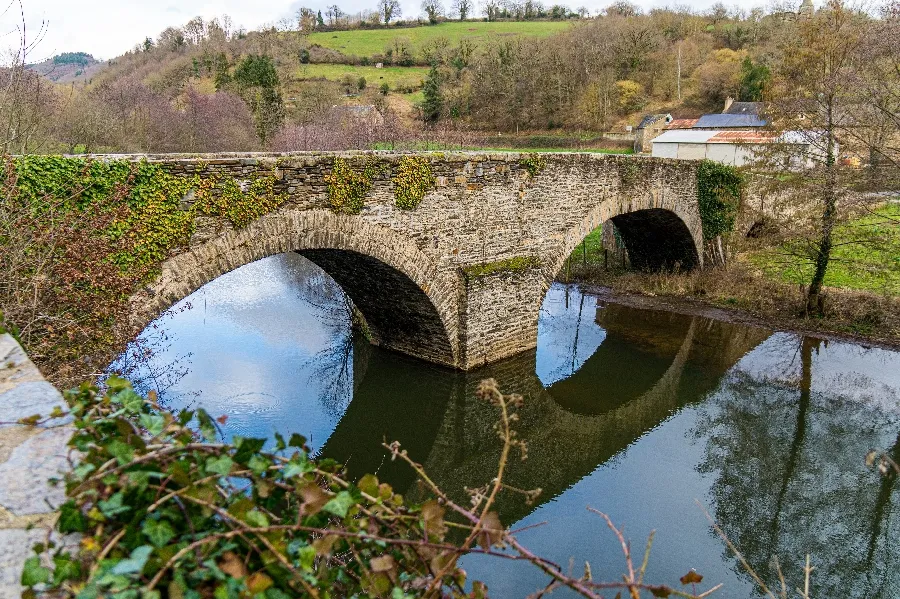
Bénéficiant aujourd'hui d'une route goudronnée, ce pont de 55m environ est construit en schiste et en grès. Son existence est évoquée dès 1302-1305 (sûrement en bois avant cette date).
Plusieurs fois partiellement reconstruit en 1382-1383, au cours du XVIIIe siècle et en 1789, la plus grande partie de ce pont peut être attribuée au XIVe siècle. D'un point de vue technique, ce pont en léger dos d'âne est constitué de 2 arches latérales en plein cintre et d'une arche médiane en segment de cercle.
Eléments architecturaux notables : la pile de droite dotée d'un avant-bec légèrement arrondi et d'un talon rectangulaire à peine marqué ainsi que les piles avec avant-becs triangulaires et chaperons mi-pyramidaux (XVIIe siècle).
Le pont a bénéficié d'une restauration dans les années 80 et d'une nouvelle très récente car il a été partiellement détruit avec une importante crue du Viaur.
Stationnement : en bord de route, de préférence sur la portion entre le pont et la D902.
English
Thanks to the intervention of the mountain judge and the 4 châtellenies, the inhabitants of Rodez and Cassagnes-Bégonhès were exempted from the toll imposed by the lord of Salmiech: Arnal de Landorre.
The 55-meter-long bridge is built of schist and sandstone, and now has a paved road. Its existence is mentioned as early as 1302-1305 (it must have been made of wood before then).
Partially rebuilt several times in 1382-1383, during the 18th century and in 1789, most of the bridge can be attributed to the 14th century. From a technical point of view, this slightly humpbacked bridge is made up of 2 semi-circular side arches and a segmental middle arch.
Notable architectural features include the right-hand pier, with its slightly rounded forebay and barely defined rectangular heel, and the piers with triangular forebays and semi-pyramidal copings (17th century).
The bridge was restored in the 1980s and again very recently, as it was partially destroyed by a major flood on the Viaur.
Parking: by the roadside, preferably on the stretch between the bridge and the D902.
Deutsch
Dank der Intervention des Bergrichters und der vier Kastlaneien wurden die Einwohner von Rodez und Cassagnes-Bégonhès von der Maut befreit, die der Herr von Salmiech: Arnal de Landorre, erhoben hatte.
Die Brücke, die heute über eine asphaltierte Straße verfügt, ist etwa 55 m lang und aus Schiefer und Sandstein gebaut. Ihre Existenz wird bereits 1302-1305 erwähnt (davor sicher aus Holz).
Mehrmals wurde sie 1382-1383, im Laufe des 18. Jahrhunderts und 1789 teilweise umgebaut, doch der größte Teil der Brücke lässt sich dem 14. Aus technischer Sicht besteht die leicht hügelförmige Brücke aus zwei seitlichen Rundbögen und einem mittleren Bogen in Kreissegmentform.
Bemerkenswerte architektonische Elemente: der rechte Pfeiler mit einem leicht abgerundeten Vorbau und einem kaum ausgeprägten rechteckigen Absatz sowie die Pfeiler mit dreieckigen Vorbauten und halb pyramidenförmigen Kappen (17. Jh.).
Die Brücke wurde in den 1980er Jahren restauriert und erst kürzlich wieder aufgebaut, da sie bei einer großen Überschwemmung des Viaur teilweise zerstört wurde.
Parken: Am Straßenrand, vorzugsweise auf dem Abschnitt zwischen der Brücke und der D902.
Dutch
Dankzij de tussenkomst van de bergrechter en de 4 kasteleins werden de inwoners van Rodez en Cassagnes-Bégonhès vrijgesteld van de tol die werd geheven door de heer van Salmiech, Arnal de Landorre.
De brug, die nu een geasfalteerde weg heeft, is ongeveer 55 meter lang en is gemaakt van schist en zandsteen. Het bestaan van de brug wordt al vermeld in 1302-1305 (voor die tijd was hij waarschijnlijk van hout).
De brug is meerdere keren gedeeltelijk herbouwd in 1382-1383, in de 18e eeuw en in 1789, maar het grootste deel kan worden toegeschreven aan de 14e eeuw. Technisch gezien bestaat deze brug met een lichte bochel uit 2 halfronde zijbogen en een segmentboog in het midden.
Opvallende architecturale kenmerken zijn de rechterpijler met een licht afgerond voorplein en een nauwelijks gedefinieerde rechthoekige hiel, en de pijlers met driehoekige voorpleinen en half piramidale boordstenen (17e eeuw).
De brug werd gerestaureerd in de jaren 1980 en opnieuw zeer recent, omdat hij gedeeltelijk werd verwoest door een grote overstroming van de Viaur.
Parkeren: langs de weg, bij voorkeur op het stuk tussen de brug en de D902.
Español
Gracias a la intervención del juez de montaña y de las 4 castellanías, los habitantes de Rodez y Cassagnes-Bégonhès quedaron exentos del peaje impuesto por el señor de Salmiech, Arnal de Landorre.
El puente, actualmente asfaltado, tiene unos 55 metros de longitud y está construido en esquisto y arenisca. Su existencia se menciona ya en 1302-1305 (probablemente era de madera antes de esta fecha).
Reconstruido parcialmente varias veces en 1382-1383, durante el siglo XVIII y en 1789, la mayor parte del puente puede atribuirse al siglo XIV. Desde un punto de vista técnico, este puente ligeramente jorobado está formado por 2 arcos laterales semicirculares y un arco escarzano en el centro.
Desde el punto de vista arquitectónico, destaca la pila derecha, con un antepecho ligeramente redondeado y un talón rectangular poco definido, y las pilas con antepechos triangulares y albardillas semipiramidales (siglo XVII).
El puente fue restaurado en los años 80 y muy recientemente, ya que quedó parcialmente destruido por una gran inundación del Viaur.
Aparcamiento: al borde de la carretera, preferentemente en el tramo entre el puente y la D902.
Italiano
Grazie all'intervento del giudice di montagna e delle 4 castellanie, gli abitanti di Rodez e Cassagnes-Bégonhès furono esentati dal pedaggio imposto dal signore di Salmiech, Arnal de Landorre.
Il ponte, oggi asfaltato, è lungo circa 55 metri ed è realizzato in scisto e arenaria. La sua esistenza è menzionata già nel 1302-1305 (probabilmente era in legno prima di questa data).
Parzialmente ricostruito più volte nel 1382-1383, nel XVIII secolo e nel 1789, la maggior parte del ponte può essere attribuita al XIV secolo. Dal punto di vista tecnico, questo ponte leggermente gibboso è costituito da 2 archi laterali semicircolari e da un arco segmentale al centro.
Tra le caratteristiche architettoniche degne di nota vi sono il pilastro destro con avancorpo leggermente arrotondato e tallone rettangolare appena definito, e i pilastri con avancorpi triangolari e copriferro semi-piramidale (XVII secolo).
Il ponte è stato restaurato negli anni '80 e di recente, poiché è stato parzialmente distrutto da una grande inondazione del Viaur.
Parcheggio: a bordo strada, preferibilmente nel tratto tra il ponte e la D902.
Pont de Grandfuel, 12120 Sainte-Juliette-sur-Viaur
Crédits: OFFICE DE TOURISME PAYS SEGALI