Collégiale Saint-Étienne – Hombourg-Haut
Description
English
Deutsch
Dutch
Español
Italiano
Description
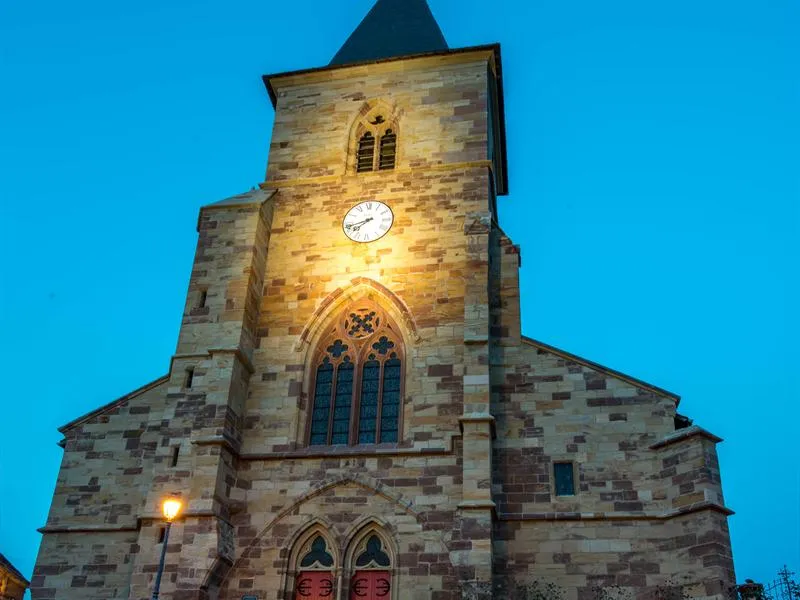
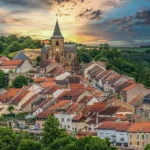
Après avoir fortifié, vers 1245, le sommet de la colline de Hombourg avec un imposant château-fort, l'évêque de Metz Jacques de Lorraine fonda en ce lieu, en 1254, un chapitre de chanoines, pour lequel il ordonna la construction d'une grande et belle église dédiée à Saint-Etienne et à la Vierge. L'église occupe une position dominante au sommet du promontoire rocheux, d'où elle est visible de presque tous les côtés. Sensiblement orientée Est-Ouest, elle se situe dans le prolongement du bourg qui s'est développé à ses pieds. D'un style gothique des 13ème et 14ème siècles (elle fut commencée à la fin du XIIIe siècle et achevée vers 1400), l'église offre un aspect assez massif et trapu. L'édifice est construit en pierres de grès rose-ocre d'un bel appareil régulier, sauf au transept Nord recouvert d'un enduit. Elle brûla en 1632 mais échappa aux ravages de la guerre de Trente ans et de la Révolution de 1789.
Symbole de la ville, l’église fut classée Monument historique en 1930.
English
After having fortified, around 1245, the top of the hill of Hombourg with an imposing fortified castle, the Bishop of Metz Jacques de Lorraine founded a chapter of canons in this place in 1254, for which he ordered the construction of a large and beautiful church dedicated to Saint-Etienne and the Virgin. The church occupies a dominant position at the top of the rocky promontory, from where it is visible from almost all sides. Sensibly oriented East-West, it is situated in the extension of the village that developed at its feet. The church, built in the Gothic style of the 13th and 14th centuries (it was begun at the end of the 13th century and completed around 1400), has a rather massive and stocky appearance. The edifice is built in pinkish ochre sandstone with a beautiful regular structure, except for the north transept which is covered with a plaster. It burnt down in 1632 but escaped the ravages of the Thirty Years' War and the Revolution of 1789.
Symbol of the city, the church was classified as a Historic Monument in 1930.
Deutsch
Nachdem er um 1245 den Gipfel des Hügels von Hombourg mit einer imposanten Burg befestigt hatte, gründete der Bischof von Metz, Jacques de Lorraine, 1254 an diesem Ort ein Kapitel von Kanonikern, für das er den Bau einer großen und schönen Kirche anordnete, die dem Heiligen Stephanus und der Jungfrau Maria geweiht ist. Die Kirche nimmt eine beherrschende Stellung auf dem Gipfel des felsigen Vorgebirges ein, von wo aus sie von fast allen Seiten zu sehen ist. Sie ist spürbar in Ost-West-Richtung ausgerichtet und befindet sich in der Verlängerung des Dorfes, das sich zu ihren Füßen entwickelt hat. Die Kirche wurde im gotischen Stil des 13. und 14. Jahrhunderts erbaut (sie wurde Ende des 13. Jahrhunderts begonnen und um 1400 fertiggestellt) und wirkt recht massiv und gedrungen. Das Gebäude wurde aus rosa-ockerfarbenen Sandsteinen in einem schönen, regelmäßigen Verband errichtet, mit Ausnahme des nördlichen Querschiffs, das verputzt ist. Die Kirche brannte 1632 nieder, entging jedoch den Verwüstungen des Dreißigjährigen Krieges und der Revolution von 1789.
Als Symbol der Stadt wurde die Kirche 1930 zum historischen Monument erklärt.
Dutch
Nadat hij rond 1245 de top van de heuvel van Hombourg had versterkt met een imposant kasteel, stichtte bisschop Jacques de Lorraine van Metz hier in 1254 een kapittel van kanunniken, waarvoor hij een grote en mooie kerk liet bouwen, gewijd aan Sint Stefanus en de Maagd. De kerk neemt een dominante positie in op de top van het rotsachtige voorgebergte, vanwaar zij van bijna alle kanten zichtbaar is. Het is oost-west gericht en ligt in het verlengde van het dorp dat zich aan zijn voeten heeft ontwikkeld. De kerk, gebouwd in gotische stijl in de 13e en 14e eeuw (begonnen aan het eind van de 13e eeuw en voltooid rond 1400), ziet er nogal massief en gedrongen uit. Het gebouw is opgetrokken uit roze-oker zandsteen in een mooi regelmatig patroon, behalve het noordertransept dat met pleisterwerk is bedekt. Het brandde af in 1632, maar ontsnapte aan de verwoestingen van de Dertigjarige Oorlog en de Revolutie van 1789.
Als symbool van de stad werd de kerk in 1930 geklasseerd als historisch monument.
Español
Después de fortificar la cima de la colina de Hombourg con un imponente castillo hacia 1245, el obispo Jacques de Lorraine de Metz fundó aquí un capítulo de canónigos en 1254, para lo cual ordenó la construcción de una gran y hermosa iglesia dedicada a San Esteban y a la Virgen. La iglesia ocupa una posición dominante en la cima del promontorio rocoso, desde donde es visible desde casi todos los lados. Orientada hacia el este-oeste, está situada en la extensión del pueblo que se ha desarrollado a sus pies. Construida en estilo gótico en los siglos XIII y XIV (se empezó a construir a finales del siglo XIII y se terminó hacia 1400), la iglesia tiene un aspecto bastante macizo y achaparrado. El edificio está construido en piedra arenisca de color rosa-ocre con un hermoso diseño regular, excepto el crucero norte, que está cubierto de yeso. Se quemó en 1632, pero escapó a los estragos de la Guerra de los Treinta Años y de la Revolución de 1789.
Símbolo de la ciudad, la iglesia fue clasificada como monumento histórico en 1930.
Italiano
Dopo aver fortificato la cima della collina di Hombourg con un imponente castello intorno al 1245, il vescovo di Metz Jacques de Lorraine vi fondò un capitolo di canonici nel 1254, per il quale ordinò la costruzione di una grande e bella chiesa dedicata a Santo Stefano e alla Vergine. La chiesa occupa una posizione dominante in cima al promontorio roccioso, da cui è visibile da quasi tutti i lati. Rivolta a est-ovest, è situata nell'estensione del villaggio che si è sviluppato ai suoi piedi. Costruita in stile gotico nel XIII e XIV secolo (fu iniziata alla fine del XIII secolo e completata intorno al 1400), la chiesa ha un aspetto piuttosto massiccio e tozzo. L'edificio è costruito in arenaria rosa-ocra con un bel disegno regolare, ad eccezione del transetto nord che è ricoperto di intonaco. Bruciò nel 1632, ma sfuggì alle devastazioni della Guerra dei Trent'anni e della Rivoluzione del 1789.
Simbolo della città, la chiesa è stata classificata come monumento storico nel 1930.
Médiéval
Langues: Deutsch
Clientèle: Tout public - Groupes
rue de l'église, 57470 Hombourg-Haut