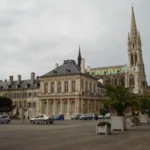
CHÂTEAU DE BAS DE CHAMPIGNEULLES – Champigneulles
Description
English
Deutsch
Dutch
Español
Italiano
Description
Au début du XVIIIe siècle, Christophe LE PRUD'HOMME, comte de Fontenoy, fait construire en bordure du chemin de la Papeterie un important château entouré d'un parc et de jardins à la française. L’édifice renferme notamment en son cœur un remarquable escalier courbe à double volée sous un haut plafond ovale peint en trompe-l’œil, pièce maîtresse toujours visible aujourd’hui. Cette œuvre baroque, très proche de celle de l’hôtel Ferraris à Nancy, est attribuée à Giacomo BARILLI, collaborateur du célèbre décorateur italien Francesco BIBIENA, venu en Lorraine sur appel du duc Léopold 1er, afin d’y construire son opéra. Les pierres des vestiges de l'ancien hameau de Saint-Barthélemy ont servi à la construction. Si nous n'avons pas de détails intéressants sur la construction du château en tant que telle, il subsiste néanmoins quelques notes sur son aspect : "Le château de Monsieur de Fontenoy est fort bien bâti, les jardins magnifiques et il y a de fort belles eaux." Le site devient alors un lieu de rendez-vous régulier du duc Léopold 1er de Lorraine qui s'y rend avec sa cour pour y déguster notamment le vin de Champigneulles. Un cépage de Champagne fut en effet commandé par le comte, la vigne subsistera longtemps sous le nom de Plante de Reims. Autour de son château, qui entraîne un regain d’activité important pour la localité, le domaine foisonne d’activités. L’on fabrique à Champigneulles du papier, des tuiles, des briques ou encore des faïences. C’est d’ailleurs ici que débute l’histoire de la célèbre faïencerie de Lunéville. Dès 1711, Jacques Chambrette, maître faïencier de Dijon, y crée ses premières pièces pour le comte de Fontenoy, avant que son fils n’établisse la manufacture bien connue à Lunéville, onze ans plus tard. En 1758, l’imposant édifice et ses jardins auraient séduits Voltaire, cherchant à revenir en Lorraine et plus particulièrement à la cour de Lunéville, autour du duc Stanislas. Mais ce dernier n’y donna pas une suite favorable, sur prescription de son gendre le roi Louis XV qui ne souhaite pas voir l’écrivain des Lumières se rapprocher de Paris, à la suite du contentieux lié à l’article « Genève » de l’Encyclopédie. Le château connaîtra ensuite différents propriétaires durant le XVIIIème et le XIXème siècle. C’est en 1888 que l’industriel Victor HINZELIN, qui deviendra dix ans plus tard le cofondateur de la Brasserie de Champigneulles, produisant « la grande blonde de Champigneulles, Reine des bières », devient propriétaire du site. Durant la seconde guerre mondiale, le château sera occupé par l’Allemagne nazie avant d’être vendu à la Libération par la famille HINZELIN. Devenue propriété de la Ville en 1951, s’y installent une école jusqu’en 2017, ainsi que la restauration scolaire, l’école municipale de musique et divers locaux associatifs. Au fil des années, le parc du château a également subi de nombreuses transformations, passant d’un aménagement à la française à un jardin à l’anglaise. Afin d’éviter qu’il ne se transforme en lotissement, la Ville a engagé des procédures de protection dès 1955. Le parc est aujourd’hui classé au titre des monuments et des sites. Composé d’un bâtiment central, abritant l’escalier monumental, et de deux grandes ailes, le château totalise environ 3000 m2 sur trois niveaux et dispose d’une cour d’honneur centrale et d’un accès direct sur son parc. La requalification totale du château de bas constitue le cœur du nouveau plan patrimoine de la ville de Champigneulles. L’opération consiste à optimiser l’utilisation des surfaces disponibles, à réhabiliter les espaces intérieurs, à préserver et valoriser les éléments patrimoniaux remarquables et à reconquérir les espaces extérieurs. Trois grandes orientations ont été dégagées à la suite d’une étude préalable et d’une concertation des habitants de sorte à ce que la population se réapproprie le site par la nécessité d’y développer du service public, tout en faisant un lien d’accueil d’exception. Un aménagement est envisagé par aile, en fonction des vocations : une aile petite enfance, une aile vie culturelle et associative et le bâtiment central avec un pôle évènementiel, économique et touristique. Aujourd’hui, dans le cadre du plan patrimoine, pour le mandat 2020-2026, devant permettre une réorganisation et une gestion plus efficace du bâti communal, le château est redevenu une école pour une durée de 2 ans, afin d’agrandir l’école Jean Moulin et y intégrer les activités liées à cette école présentes dans le château, à savoir la restauration scolaire, le RASED, le périscolaire.
English
At the beginning of the 18th century, Christophe LE PRUD'HOMME, Count of Fontenoy, built an important castle on the edge of the Papeterie road, surrounded by a park and French gardens At the heart of the building is a remarkable curved staircase with a double flight under a high oval ceiling painted in trompe l??il, a masterpiece still visible today. This baroque work, very similar to that of the Hotel Ferraris in Nancy, is attributed to Giacomo BARILLI, collaborator of the famous Italian decorator Francesco BIBIENA, who came to Lorraine at the request of Duke Leopold I to build his opera house Stones from the remains of the old hamlet of Saint-Barthélemy were used for the construction. Although we do not have any interesting details about the construction of the castle as such, there are nevertheless a few notes about its appearance: "The castle of Monsieur de Fontenoy is very well built, the gardens are magnificent and there are very beautiful waters The site became a regular meeting place for Duke Leopold I of Lorraine, who went there with his court to taste the wine of Champigneulles. A Champagne grape variety was indeed ordered by the count, the vine will remain for a long time under the name of Plante de Reims. Around its castle, which brings an important revival of activity for the locality, the domain abounds in activities. Paper, tiles, bricks and earthenware are manufactured in Champigneulles. This is where the history of the famous Lunéville earthenware factory began. As early as 1711, Jacques Chambrette, a master potter from Dijon, created his first pieces for the Count of Fontenoy, before his son established the well-known factory in Lunéville, eleven years later. In 1758, the imposing building and its gardens would have seduced Voltaire, seeking to return to Lorraine and more particularly to the court of Lunéville, around Duke Stanislas. But the latter did not respond favorably to the request of his son-in-law, King Louis XV, who did not want to see the writer of the Enlightenment move closer to Paris, following the dispute over the article "Geneva" in the Encyclopedia. The castle will know then different owners during the XVIIIth and the XIXth century. In 1888, the industrialist Victor HINZELIN, who ten years later became the co-founder of the Champigneulles Brewery, producing "the great blonde of Champigneulles, Queen of beers", became the owner of the site. During the Second World War, the castle was occupied by Nazi Germany before being sold at the Liberation by the HINZELIN family. It became the property of the city in 1951, where a school was installed until 2017, as well as the school canteen, the municipal music school and various association premises. Over the years, the park of the castle has also undergone numerous transformations, from a French-style layout to an English-style garden. In order to prevent the park from becoming a housing estate, the city initiated protection procedures in 1955. Today, the park is listed as a monument and site. Composed of a central building, housing the monumental staircase, and two large wings, the castle totals about 3000 m2 on three levels and has a central courtyard and a direct access to its park. The total requalification of the lower castle is the heart of the new heritage plan of the city of Champigneulles. The operation consists of optimizing the use of the available surfaces, rehabilitating the interior spaces, preserving and enhancing the remarkable heritage elements and reclaiming the exterior spaces. Three main orientations have been identified following a preliminary study and consultation with the inhabitants so that the population can reappropriate the site through the need to develop public services, while at the same time creating a link of exceptional welcome. A development is envisaged by wing, according to the vocations: a wing for young children, a wing for cultural and associative life and the central building with an event, economic and tourist pole. Today, as part of the heritage plan for the 2020-2026 term of office, which should allow for a more efficient reorganization and management of the communal buildings, the castle has become a school again for a period of 2 years, in order to enlarge the Jean Moulin school and to integrate the activities linked to this school present in the castle, i.e. the school canteen, the RASED, the after-school care service.
Deutsch
Jahrhunderts ließ Christophe LE PRUD'HOMME, Graf von Fontenoy, am Rande des Chemin de la Papeterie ein bedeutendes Schloss errichten, das von einem Park und französischen Gärten umgeben war Das Gebäude beherbergt in seinem Inneren eine bemerkenswerte, geschwungene, doppelläufige Treppe unter einer hohen, ovalen Decke mit Trompe-l'oeil-Malerei, die noch heute zu sehen ist. Dieses barocke Werk, das dem des Hôtel Ferraris in Nancy sehr ähnlich ist, wird Giacomo BARILLI zugeschrieben, einem Mitarbeiter des berühmten italienischen Dekorateurs Francesco BIBIENA, der auf Wunsch von Herzog Leopold I. nach Lothringen kam, um dort seine Oper zu bauen Für den Bau wurden Steine von den Überresten des alten Weilers Saint-Barthélemy verwendet. Obwohl wir keine interessanten Details über den Bau des Schlosses an sich haben, gibt es dennoch einige Notizen über sein Aussehen: "Le château de Monsieur de Fontenoy est fort bien bâti, les jardins magnifiques et il y a de fort belles eaux." (Das Schloss des Herrn von Fontenoy ist sehr gut gebaut, die Gärten sind wunderschön und es gibt sehr schöne Gewässer Die Anlage wurde zu einem regelmäßigen Treffpunkt des Herzogs Leopold I. von Lothringen, der mit seinem Hofstaat dorthin reiste, um insbesondere den Wein von Champigneulles zu probieren. Eine Rebsorte aus der Champagne wurde tatsächlich vom Grafen bestellt, die Rebe sollte lange Zeit unter dem Namen Plante de Reims bestehen bleiben. Rund um das Schloss, das dem Ort einen bedeutenden Aufschwung bescherte, wimmelt es in der Gegend von Aktivitäten. In Champigneulles werden Papier, Dachziegel, Backsteine und Fayencen hergestellt. Hier beginnt auch die Geschichte der berühmten Fayencefabrik von Lunéville. Bereits 1711 fertigte Jacques Chambrette, ein Fayencemeister aus Dijon, hier seine ersten Stücke für den Grafen von Fontenoy an, bevor sein Sohn elf Jahre später die bekannte Manufaktur in Lunéville gründete. Im Jahr 1758 soll das imposante Gebäude und seine Gärten Voltaire gefallen haben, der nach Lothringen und insbesondere an den Hof von Lunéville um Herzog Stanislas zurückkehren wollte. König Ludwig XV. wollte nicht, dass der Schriftsteller der Aufklärung in die Nähe von Paris zog, da es wegen des Artikels "Genf" in der Enzyklopädie zu Streitigkeiten kam. Das Schloss hatte während des 18. und 19. Jahrhunderts verschiedene Besitzer. Jahrhundert. 1888 wurde der Industrielle Victor HINZELIN, der zehn Jahre später zum Mitbegründer der Brasserie de Champigneulles wurde, die "das große blonde Champigneulles, Königin der Biere" herstellte, Eigentümer des Ortes. Während des Zweiten Weltkriegs wurde das Schloss von Nazi-Deutschland besetzt, bevor es nach der Befreiung von der Familie HINZELIN verkauft wurde. Seit 1951 ist das Schloss im Besitz der Stadt und beherbergt bis 2017 eine Schule, die Schulspeisung, die städtische Musikschule und verschiedene Vereinsräume. Im Laufe der Jahre wurde auch der Schlosspark mehrfach umgestaltet, von einem französischen zu einem englischen Garten. Um zu verhindern, dass sich der Park in eine Wohnsiedlung verwandelt, leitete die Stadt bereits 1955 ein Schutzverfahren ein. Der Park steht heute unter Denkmalschutz. Das Schloss besteht aus einem zentralen Gebäude, in dem sich die monumentale Treppe befindet, und zwei großen Flügeln. Es hat eine Gesamtfläche von ca. 3000 m2 auf drei Ebenen, einen zentralen Ehrenhof und einen direkten Zugang zum Park. Die vollständige Sanierung des unteren Schlosses ist das Herzstück des neuen Kulturerbeplans der Stadt Champigneulles. Die Operation besteht darin, die Nutzung der verfügbaren Flächen zu optimieren, die Innenräume zu sanieren, die bemerkenswerten Elemente des Kulturerbes zu erhalten und aufzuwerten und die Außenbereiche neu zu gestalten. Nach einer Vorstudie und einer Abstimmung mit den Bewohnern wurden drei große Orientierungen herausgearbeitet, damit die Bevölkerung sich den Ort durch die Notwendigkeit, dort öffentliche Dienstleistungen zu entwickeln, wieder aneignet und gleichzeitig eine außergewöhnliche Verbindung zum Empfang herstellt. Die Einrichtung soll nach Flügeln gegliedert werden: ein Kindergartenflügel, ein Flügel für das Kultur- und Vereinsleben und das zentrale Gebäude mit einem Veranstaltungs-, Wirtschafts- und Tourismuszentrum. Im Rahmen des Kulturerbeplans für die Amtszeit 2020-2026, der eine Neuorganisation und effizientere Verwaltung der kommunalen Gebäude ermöglichen soll, wird das Schloss nun für zwei Jahre wieder als Schule genutzt, um die Jean-Moulin-Schule zu vergrößern und die mit dieser Schule verbundenen Aktivitäten, die im Schloss untergebracht sind, zu integrieren, d. h. die Schulspeisung, das RASED und die außerschulische Betreuung.
Dutch
Aan het begin van de 18e eeuw liet Christophe LE PRUD'HOMME, graaf van Fontenoy, een groot kasteel bouwen aan de rand van de Papeterie, omgeven door een park en Franse tuinen In het hart van het gebouw bevindt zich een opmerkelijke gebogen trap met een dubbele vlucht onder een hoog ovaal, in trompe l??il geschilderd plafond, waarvan het middelpunt nog steeds zichtbaar is. Dit barokke werk, dat erg lijkt op dat van het Hotel Ferraris in Nancy, wordt toegeschreven aan Giacomo BARILLI, een medewerker van de beroemde Italiaanse decorateur Francesco BIBIENA, die naar Lotharingen kwam op verzoek van hertog Leopold I om zijn operagebouw te bouwen Voor de bouw werden stenen uit de resten van het oude gehucht Saint-Barthélemy gebruikt. Hoewel we geen interessante details hebben over de bouw van het kasteel als zodanig, zijn er toch enkele aantekeningen over het uiterlijk ervan: "Het kasteel van Monsieur de Fontenoy is zeer goed gebouwd, de tuinen zijn prachtig en er zijn enkele zeer mooie wateren De plaats werd vervolgens een vaste ontmoetingsplaats voor hertog Leopold I van Lotharingen, die er met zijn hofhouding naartoe ging om vooral Champigneulles-wijn te proeven. Een Champagne druivenras werd namelijk besteld door de graaf, en de wijnstok zou lange tijd overleven onder de naam Plante de Reims. Rond zijn kasteel, dat een belangrijke opleving van de activiteit voor de plaats met zich meebrengt, biedt het domein een overvloed aan activiteiten. Papier, tegels, bakstenen en aardewerk worden in Champigneulles geproduceerd. Hier begon de geschiedenis van de beroemde aardewerkfabriek van Lunéville. Al in 1711 maakte Jacques Chambrette, een meester-pottenbakker uit Dijon, zijn eerste stukken voor de graaf van Fontenoy, voordat zijn zoon elf jaar later de bekende fabriek in Lunéville oprichtte. In 1758 zouden het imposante gebouw en de tuinen Voltaire hebben verleid om terug te keren naar Lotharingen en meer bepaald naar het hof van Lunéville, rond hertog Stanislas. Deze reageerde echter niet positief op het verzoek van zijn schoonzoon, koning Lodewijk XV, die niet wilde dat de verlichtingsschrijver dichter bij Parijs kwam wonen, naar aanleiding van het geschil over het artikel "Genève" in de Encyclopedie. Het kasteel had vervolgens verschillende eigenaren in de 18e en 19e eeuw. In 1888 werd de industrieel Victor HINZELIN, die tien jaar later medeoprichter werd van de Brouwerij Champigneulles, die "het grote blond van Champigneulles, Koningin der bieren" produceerde, eigenaar van het terrein. Tijdens de Tweede Wereldoorlog werd het kasteel bezet door Nazi-Duitsland voordat het bij de bevrijding werd verkocht door de familie HINZELIN. In 1951 werd het eigendom van de stad, waar tot 2017 een school was gevestigd, evenals de schoolkantine, de gemeentelijke muziekschool en diverse verenigingslokalen. In de loop der jaren heeft ook het kasteelpark talrijke transformaties ondergaan, van een inrichting in Franse stijl tot een tuin in Engelse stijl. Om te voorkomen dat het park een woonwijk zou worden, startte de stad in 1955 beschermingsprocedures. Tegenwoordig staat het park op de monumentenlijst. Het kasteel, dat bestaat uit een centraal gebouw met de monumentale trap en twee grote vleugels, beslaat in totaal ongeveer 3000 m2 op drie niveaus en heeft een centrale binnenplaats en directe toegang tot het park. De totale herkwalificatie van het Château de Bas vormt de kern van het nieuwe erfgoedplan van de stad Champigneulles. De operatie bestaat uit het optimaliseren van het gebruik van de beschikbare oppervlakken, het herstel van de binnenruimten, het behoud en de opwaardering van de opmerkelijke erfgoedelementen en het terugwinnen van de buitenruimten. Na een voorstudie en overleg met de bewoners werden drie hoofdoriëntaties vastgesteld, zodat de bevolking zich het terrein opnieuw kan toe-eigenen door de noodzaak om openbare diensten te ontwikkelen en er tegelijkertijd een uitzonderlijke ontvangstruimte van te maken. Voor elke vleugel is een ontwikkeling gepland naar gelang van haar functie: een kindervleugel, een culturele en gemeenschapsvleugel en het centrale gebouw met een evenementen-, economisch en toeristisch centrum. Vandaag, in het kader van het erfgoedplan voor de legislatuur 2020-2026, dat een efficiëntere reorganisatie en een efficiënter beheer van de gemeentelijke gebouwen mogelijk moet maken, is het kasteel voor een periode van 2 jaar teruggegeven aan de status van school, om de Jean Moulin-school uit te breiden en de met deze school verbonden activiteiten die in het kasteel aanwezig zijn te integreren, namelijk de schoolkantine, de RASED en de naschoolse activiteiten.
Español
A principios del siglo XVIII, Christophe LE PRUD'HOMME, conde de Fontenoy, hizo construir un gran castillo al borde de la carretera de Papeterie, rodeado de un parque y jardines franceses En el corazón del edificio destaca una escalera curva de doble tramo bajo un alto techo oval pintado en trampantojo, cuya pieza central aún puede verse hoy en día. Esta obra barroca, muy similar a la del Hotel Ferraris de Nancy, se atribuye a Giacomo BARILLI, colaborador del famoso decorador italiano Francesco BIBIENA, que llegó a Lorena a petición del duque Leopoldo I para construir su teatro de la ópera Para la construcción se utilizaron piedras de los restos de la antigua aldea de Saint-Barthélemy. Aunque no disponemos de detalles interesantes sobre la construcción del castillo como tal, hay sin embargo algunas notas sobre su aspecto: "El castillo de Monsieur de Fontenoy está muy bien construido, los jardines son magníficos y hay unas aguas muy bonitas El lugar se convirtió entonces en un punto de encuentro habitual del duque Leopoldo I de Lorena, que acudía allí con su corte para degustar, en particular, el vino de Champigneulles. De hecho, el conde encargó la creación de una variedad de uva de Champaña que sobreviviría durante mucho tiempo con el nombre de Plante de Reims. Alrededor de su castillo, que supone un importante revulsivo para la localidad, el dominio abunda en actividades. En Champigneulles se fabrica papel, tejas, ladrillos y loza. Aquí comenzó la historia de la famosa fábrica de loza de Lunéville. Ya en 1711, Jacques Chambrette, maestro alfarero de Dijon, creó sus primeras piezas para el conde de Fontenoy, antes de que su hijo estableciera la conocida fábrica de Lunéville once años más tarde. En 1758, el imponente edificio y sus jardines habrían seducido a Voltaire, que buscaba volver a Lorena y más concretamente a la corte de Lunéville, en torno al duque Stanislas. Sin embargo, éste no respondió favorablemente a la petición de su yerno, el rey Luis XV, que no quería que el escritor ilustrado se trasladara más cerca de París, a raíz de la disputa sobre el artículo "Ginebra" de la Enciclopedia. El castillo tuvo varios propietarios durante los siglos XVIII y XIX. En 1888, el industrial Victor HINZELIN, cofundador diez años más tarde de la cervecería Champigneulles, productora de "la gran rubia de Champigneulles, reina de las cervezas", se convierte en propietario del lugar. Durante la Segunda Guerra Mundial, el castillo fue ocupado por la Alemania nazi antes de ser vendido en la Liberación por la familia HINZELIN. Pasó a ser propiedad del municipio en 1951, donde se instaló una escuela hasta 2017, así como el comedor escolar, la escuela municipal de música y diversos locales de asociaciones. A lo largo de los años, el parque del castillo también ha sufrido numerosas transformaciones, pasando de un trazado de estilo francés a un jardín de estilo inglés. Para evitar que el parque se convirtiera en una urbanización, la ciudad inició procedimientos de protección en 1955. En la actualidad, el parque está catalogado como monumento y sitio. Compuesto por un edificio central, que alberga la escalera monumental, y dos grandes alas, el castillo ocupa en total unos 3000 m2 en tres niveles y cuenta con un patio central principal y acceso directo a su parque. La recalificación total del castillo de Bas constituye el núcleo del nuevo plan patrimonial de la ciudad de Champigneulles. La operación consiste en optimizar el uso de las superficies disponibles, rehabilitar los espacios interiores, conservar y valorizar los elementos patrimoniales notables y recuperar los espacios exteriores. Tras un estudio preliminar y una consulta con los habitantes, se identificaron tres orientaciones principales para que la población se reapropiara del lugar a través de la necesidad de desarrollar servicios públicos, convirtiéndolo al mismo tiempo en una zona de acogida excepcional. Se prevé un desarrollo para cada ala, según su función: un ala infantil, un ala cultural y comunitaria y el edificio central con un centro de eventos, económico y turístico. En la actualidad, en el marco del plan de patrimonio para el mandato 2020-2026, que debería permitir una reorganización y una gestión más eficaces de los edificios municipales, el castillo ha recuperado el estatus de escuela por un periodo de 2 años, con el fin de ampliar la escuela Jean Moulin e integrar las actividades vinculadas a esta escuela, que actualmente se alojan en el castillo, es decir, el comedor escolar, el RASED (servicio de educación especial) y el centro de atención extraescolar.
Italiano
All'inizio del XVIII secolo, Christophe LE PRUD'HOMME, conte di Fontenoy, fece costruire un grande castello ai margini della strada della Papeterie, circondato da un parco e da giardini alla francese Il cuore dell'edificio è costituito da una straordinaria scala curva a doppia rampa sotto un alto soffitto ovale dipinto a trompe l'il, il cui fulcro è ancora oggi visibile. Quest'opera barocca, molto simile a quella dell'Hotel Ferraris di Nancy, è attribuita a Giacomo BARILLI, collaboratore del famoso decoratore italiano Francesco BIBIENA, giunto in Lorena su richiesta del duca Leopoldo I per costruire il suo teatro dell'opera Per la costruzione sono state utilizzate pietre provenienti dai resti dell'antico borgo di Saint-Barthélemy. Anche se non abbiamo dettagli interessanti sulla costruzione del castello in quanto tale, ci sono comunque alcune note sul suo aspetto: "Il castello di Monsieur de Fontenoy è molto ben costruito, i giardini sono magnifici e ci sono delle acque molto belle Il sito divenne quindi un luogo di incontro regolare per il duca Leopoldo I di Lorena, che vi si recava con la sua corte per degustare in particolare il vino di Champigneulles. Il conte ordinò infatti un vitigno per la Champagne, che sarebbe sopravvissuto a lungo con il nome di Plante de Reims. Intorno al suo castello, che rappresenta un importante rilancio dell'attività per la località, il dominio abbonda di attività. A Champigneulles si producono carta, piastrelle, mattoni e terracotta. Qui è iniziata la storia della famosa fabbrica di terracotta di Lunéville. Già nel 1711 Jacques Chambrette, maestro vasaio di Digione, creò i suoi primi pezzi per il conte di Fontenoy, prima che il figlio fondasse la nota fabbrica di Lunéville undici anni dopo. Nel 1758, l'imponente edificio e i suoi giardini avrebbero sedotto Voltaire, desideroso di ritornare in Lorena e più in particolare alla corte di Lunéville, intorno al duca Stanislas. Tuttavia, quest'ultimo non rispose favorevolmente alla richiesta del genero, il re Luigi XV, che non voleva che l'illuminista si trasferisse più vicino a Parigi, in seguito alla disputa sull'articolo "Ginevra" dell'Enciclopedia. Il castello ebbe poi diversi proprietari nel corso del XVIII e XIX secolo. Nel 1888, l'industriale Victor HINZELIN, che dieci anni dopo diventerà il cofondatore del birrificio di Champigneulles, che produce "la grande bionda di Champigneulles, regina delle birre", diventa proprietario del sito. Durante la Seconda Guerra Mondiale, il castello fu occupato dalla Germania nazista prima di essere venduto alla Liberazione dalla famiglia HINZELIN. Divenne proprietà della città nel 1951, dove è stata allestita una scuola fino al 2017, oltre alla mensa scolastica, alla scuola di musica comunale e a varie sedi di associazioni. Nel corso degli anni, anche il parco del castello ha subito numerose trasformazioni, passando da una disposizione alla francese a un giardino all'inglese. Per evitare che il parco si trasformasse in un complesso residenziale, nel 1955 la città ha avviato le procedure di tutela. Oggi il parco è classificato come monumento e sito. Composto da un edificio centrale, che ospita lo scalone monumentale, e da due grandi ali, il castello si estende per un totale di circa 3000 m2 su tre livelli e dispone di un cortile principale centrale e di un accesso diretto al parco. La riqualificazione totale dello château de bas costituisce il cuore del nuovo piano del patrimonio della città di Champigneulles. L'operazione consiste nell'ottimizzare l'uso delle superfici disponibili, nel riabilitare gli spazi interni, nel conservare e valorizzare gli elementi notevoli del patrimonio e nel recuperare gli spazi esterni. A seguito di uno studio preliminare e di una consultazione con gli abitanti, sono stati individuati tre orientamenti principali per far sì che la popolazione si riappropriasse del sito attraverso la necessità di sviluppare i servizi pubblici, rendendolo allo stesso tempo un'area di accoglienza eccezionale. Per ogni ala è previsto uno sviluppo in base alla sua funzione: un'ala per i bambini, un'ala culturale e comunitaria e l'edificio centrale con un centro eventi, economico e turistico. Oggi, nell'ambito del piano del patrimonio per il mandato 2020-2026, che dovrebbe consentire una riorganizzazione e una gestione più efficiente degli edifici comunali, il castello è stato restituito allo status di scuola per un periodo di 2 anni, al fine di ampliare la scuola Jean Moulin e integrare le attività legate a questa scuola, attualmente ospitate nel castello, ovvero la mensa scolastica, il RASED (servizio di educazione speciale) e il doposcuola.