Chapelle Saint-Philibert – Gourin
Description
English
Deutsch
Dutch
Español
Italiano
Description
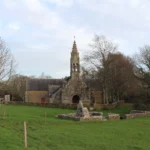
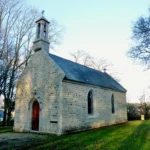
Construite en 1668, la chapelle Saint-Philibert se distingue par son plan en forme de trèfle obtenu par le demi-cercle de l’abside du chœur et ceux des bras du transept. Elle aurait été bâtie sur le plan en croix latine d’une chapelle plus ancienne. Sa charpente, dressée par Noël Salou, est également très originale. Elle rappelle la carène d’un navire retourné. On y admire des entraits et des sablières sculptées formant une corniche. Cet ensemble associé à la porte en plein cintre confère à l’édifice une unité de style particulièrement remarquable.
Les armoiries du seigneur du Leignou et du Diarnelez, Le Rousseau, à qui on attribue la fondation de la chapelle, y figuraient jusqu’à la Révolution. Dans le chœur, la statue en bois polychrome de Saint Philibert date du 17ème siècle. Elle a probablement été commandée en même temps que la construction de la chapelle. Au nord-est de la chapelle, la fontaine Saint-Philibert se compose d’un unique bassin. Son eau avait la réputation de redonner de la vigueur aux enfants fragiles. Jusqu’en 1890, les mères de famille venaient l’été y baigner les enfants rachitiques ou en retard pour marcher, nombreux autrefois à cause de leur mauvaise alimentation.
English
Built in 1668, the Saint-Philibert chapel is distinguished by its cloverleaf plan, created by the semi-circle of the choir apse and transept arms. It is thought to have been built on the Latin cross plan of an earlier chapel. Its roof structure, designed by Noël Salou, is also highly original. It is reminiscent of the hull of an overturned ship. The carved entrails and runners form a cornice. This, combined with the round-arched door, gives the building a particularly remarkable unity of style.
The coat of arms of Le Rousseau, Lord of Le Leignou and Diarnelez, who is credited with founding the chapel, was displayed here until the French Revolution. The polychrome wooden statue of Saint Philibert in the choir dates from the 17th century. It was probably commissioned at the same time as the chapel was built. To the north-east of the chapel, the Saint-Philibert fountain consists of a single basin. Its water was reputed to give strength to fragile children. Until 1890, mothers came here in summer to bathe children who were stunted or slow to walk, many of whom in the past had suffered from poor diet.
Deutsch
Die 1668 erbaute Kapelle Saint-Philibert zeichnet sich durch ihren kleeblattförmigen Grundriss aus, der durch die Halbkreise der Apsis des Chors und der Arme des Querschiffs entsteht. Sie soll auf dem Grundriss eines lateinischen Kreuzes einer älteren Kapelle errichtet worden sein. Auch der von Noël Salou entworfene Dachstuhl ist sehr originell. Es erinnert an den Kiel eines umgedrehten Schiffes. Man kann die geschnitzten Streben und Balken bewundern, die ein Gesims bilden. Zusammen mit der Rundbogentür verleiht dieses Ensemble dem Gebäude eine besonders bemerkenswerte stilistische Einheit.
Das Wappen des Herrn von Leignou und Diarnelez, Le Rousseau, dem die Gründung der Kapelle zugeschrieben wird, befand sich bis zur Revolution in der Kapelle. Die polychrome Holzstatue des Heiligen Philibert im Chor stammt aus dem 17. Jahrhundert. Sie wurde wahrscheinlich zur gleichen Zeit wie der Bau der Kapelle in Auftrag gegeben. Nordöstlich der Kapelle befindet sich der Brunnen Saint-Philibert, der aus einem einzigen Becken besteht. Sein Wasser hatte den Ruf, gebrechlichen Kindern neue Kraft zu verleihen. Bis 1890 kamen Mütter im Sommer hierher, um ihre Kinder zu baden, die aufgrund ihrer schlechten Ernährung oft zu schwach waren oder nicht richtig laufen konnten.
Dutch
Cultureel erfgoed
Español
Construida en 1668, la capilla de Saint-Philibert se distingue por su planta en forma de trébol creada por el semicírculo del ábside del coro y los de los brazos del crucero. Se cree que se construyó sobre la planta en cruz latina de una capilla anterior. La estructura del tejado, diseñada por Noël Salou, también es muy original. Recuerda el casco de un barco volcado. Los travesaños tallados y las correderas forman una cornisa. Combinada con la puerta de arco de medio punto, confiere al edificio una unidad de estilo particularmente notable.
El escudo de armas del señor de Le Leignou y Diarnelez, Le Rousseau, a quien se atribuye la fundación de la capilla, figuró aquí hasta la Revolución Francesa. La estatua de madera policromada de San Filiberto en el coro data del siglo XVII. Probablemente se encargó al mismo tiempo que la construcción de la capilla. Al noreste de la capilla, la fuente de San Filiberto consta de una sola pila. Su agua tenía fama de dar fuerza a los niños frágiles. Hasta 1890, las madres venían aquí en verano para bañar a los niños raquíticos o que tardaban en andar, muchos de los cuales habían sufrido en el pasado una mala alimentación.
Italiano
Costruita nel 1668, la cappella di Saint-Philibert si distingue per la sua pianta a forma di quadrifoglio creata dal semicerchio dell'abside del coro e da quello dei bracci del transetto. Si pensa che sia stata costruita sulla pianta a croce latina di una cappella precedente. Anche la struttura del tetto, progettata da Noël Salou, è molto originale. Ricorda lo scafo di una nave rovesciata. Le traverse e le guide intagliate formano un cornicione. In combinazione con il portale ad arco a tutto sesto, questo conferisce all'edificio un'unità di stile particolarmente notevole.
Lo stemma del signore di Le Leignou e Diarnelez, Le Rousseau, a cui si deve la fondazione della cappella, apparve qui fino alla Rivoluzione francese. La statua lignea policroma di San Filiberto nel coro risale al XVII secolo. Probabilmente è stata commissionata contemporaneamente alla costruzione della cappella. A nord-est della cappella, la fontana di San Filiberto è costituita da un'unica vasca. La sua acqua era ritenuta in grado di dare forza ai bambini fragili. Fino al 1890, le madri si recavano qui in estate per fare il bagno ai bambini stentati o lenti a camminare, molti dei quali in passato avevano sofferto di un'alimentazione scorretta.
Landevec, 56110 Gourin