Stage chant, percussion et danse – 20-08-2025
Description
English
Deutsch
Dutch
Español
Italiano
Description
Programme ibérique
pour musicien.nes confirmé.es
20 stagiaires max
repas du midi inclus CHANT
Nous verrons une tonada (chant ornementé libre), qui est l'équivalent de nos complaintes traditionnelles.
Nous travaillerons en détail l'un des rythmes phares de la culture ibérique : la jota.
Nous aborderons les différents patterns que nous rencontrons en Espagne.
La jota n'aura plus de secret pour vous !
Nous jouerons d'autres rythmes bien pêchus : charro, paso doble, et surtout nous découvrirons quelques rythmes désaxés*/boiteux/asymétriques : ajechao, maragato, charrada…
Le tout est orchestré autour de morceaux arrangés mêlant percu + voix (parfois polyphonies) histoire de jouer une musique vivante et entraînante. PERCUSSION
Côté instruments, nous utiliserons en priorité :
– la pandereta (tambourin ibérique), jouée à la castillane
– le pandero cuadrado de Peñaparda, tambour carré frappé à la baguette
– l'adufe, tambour carré joué à la main
– les mains (palmas)
– panaderas (et nous verrons qu'il est possible de chanter un vaste répertoire sur ce rythme, histoire de changer des mêmes rengaines…)
– et en bonus, tout plein d'instruments issus de la cuisine : almirez, sarten, botella de anis, zambomba, selon notre humeur et le temps disponible… Nous apprendrons aussi à danser quelques figures de jota, qui est une danse emblématique du nord de l'Espagne. Danse athlétique, gracieuse, et super fun ! Sur inscription.
English
Iberian program
for experienced musicians
20 trainees max
lunch included SINGING
We'll take a look at a tonada (free ornamented song), the equivalent of our traditional laments.
We'll work in detail on one of the key rhythms of Iberian culture: the jota.
We'll look at the different patterns we encounter in Spain.
The jota will hold no secrets for you!
We'll also play other peachy rhythms: charro, paso doble, and above all we'll discover some off-axis*/booty/asymmetrical rhythms: ajechao, maragato, charrada…
All of this is orchestrated around arranged pieces combining percussion + vocals (sometimes polyphonic) to create a lively, catchy sound. PERCUSSION
As far as instruments are concerned, we'll give priority to :
– the pandereta (Iberian tambourine), played Castilian-style
– the pandero cuadrado de Peñaparda, a square drum struck with a stick
– the adufe, a square drum played by hand
– the hands (palmas)
– panaderas (and we'll see that it's possible to sing a vast repertoire to this rhythm, for a change from the same old songs…)
– and as a bonus, a whole host of instruments from the kitchen: almirez, sarten, botella de anis, zambomba, depending on our mood and the time available… We'll also learn to dance a few jota figures, an emblematic dance of northern Spain. It's athletic, graceful and great fun! Registration required.
Deutsch
Iberisches Programm
für erfahrene MusikerInnen
max. 20 Praktikanten
mittagessen inbegriffen SINGEN
Wir werden eine Tonada (frei verzierter Gesang) sehen, die unseren traditionellen Klageliedern entspricht.
Wir werden uns ausführlich mit einem der wichtigsten Rhythmen der iberischen Kultur beschäftigen: der Jota.
Wir werden uns mit den verschiedenen Mustern befassen, die uns in Spanien begegnen.
Die Jota wird kein Geheimnis mehr für Sie sein!
Wir werden auch andere feurige Rhythmen spielen: Charro, Paso Doble, und vor allem werden wir einige versetzte*/schleimige/asymmetrische Rhythmen entdecken: Ajechao, Maragato, Charrada…
Das Ganze ist um arrangierte Stücke herum orchestriert, die Percussion und Stimmen (manchmal mehrstimmig) vermischen, um eine lebendige und mitreißende Musik zu spielen. PERCUSSION
An Instrumenten werden wir in erster Linie verwenden:
– die Pandereta (iberisches Tamburin), die auf kastilische Art gespielt wird
– der pandero cuadrado de Peñaparda, eine quadratische Trommel, die mit einem Stock geschlagen wird
– die Adufe, eine quadratische Trommel, die mit der Hand geschlagen wird
– die Hände (palmas)
– panaderas (und wir werden sehen, dass man zu diesem Rhythmus ein breites Repertoire an Liedern singen kann, um Abwechslung in die immer gleichen Lieder zu bringen…)
– und als Bonus alle möglichen Instrumente aus der Küche: Almirez, Sarten, Botella de Anis, Zambomba, je nach Lust und Laune und verfügbarer Zeit… Wir werden auch lernen, einige Jota-Figuren zu tanzen, was ein typischer Tanz aus Nordspanien ist. Ein athletischer, anmutiger Tanz, der super viel Spaß macht! Nach Anmeldung.
Dutch
Iberisch programma
voor ervaren musici
maximaal 20 studenten
lunch inbegrepen ZINGEN
We bekijken een tonada (vrij geornamenteerd lied), het equivalent van onze traditionele klaagzangen.
We zullen in detail werken aan een van de belangrijkste ritmes van de Iberische cultuur: de jota.
We bekijken de verschillende patronen die we in Spanje tegenkomen.
De jota zal geen geheimen voor je hebben!
We spelen ook andere levendige ritmes: charro, paso doble, en vooral ontdekken we enkele ritmes buiten de as*/boomy/asymmetrische ritmes: ajechao, maragato, charrada…
Het geheel is georkestreerd rond gearrangeerde stukken die percussie en zang (soms meerstemmig) combineren tot levendige, aanstekelijke muziek. PERCUSSIE
Wat de instrumenten betreft, geven we voorrang aan :
– de pandereta (Iberische tamboerijn), bespeeld in de Castiliaanse stijl
– de pandero cuadrado de Peñaparda, een vierkante trommel die met een stok wordt aangeslagen
– de adufe, een vierkante trommel die met de hand bespeeld wordt
– de handen (palmas)
– panaderas (en we zullen zien dat het mogelijk is om een uitgebreid repertoire op dit ritme te zingen, ter afwisseling van dezelfde oude liedjes…)
– en als bonus een heleboel instrumenten uit de keuken: almirez, sarten, botella de anis, zambomba, afhankelijk van onze stemming en de beschikbare tijd… We zullen ook een paar jota-figuren leren dansen, een emblematische dans van Noord-Spanje. Het is atletisch, sierlijk en erg leuk! Registratie verplicht.
Español
Programa ibérico
para músicos experimentados
20 estudiantes máximo
almuerzo incluido CANTAR
Estudiaremos una tonada (canción libre ornamentada), que es el equivalente a nuestros tradicionales lamentos.
Trabajaremos en detalle uno de los ritmos clave de la cultura ibérica: la jota.
Veremos los diferentes patrones que encontramos en España.
¡La jota no tendrá secretos para ti!
Tocaremos otros ritmos vivos: charro, pasodoble y, sobre todo, descubriremos algunos ritmos fuera de eje*/boom*/asimétricos: ajechao, maragato, charrada…
Todo ello orquestado en torno a piezas arregladas que combinan percusión y voces (a veces polifónicas) para crear una música viva y pegadiza. PERCUSIÓN
En cuanto a los instrumentos, daremos prioridad a :
– la pandereta (pandero ibérico), tocada al estilo castellano
– el pandero cuadrado de Peñaparda, tambor cuadrado golpeado con un palo
– el adufe, tambor cuadrado que se toca con la mano
– las manos (palmas)
– las panaderas (y veremos que es posible cantar un vasto repertorio a este ritmo, para variar de las mismas canciones de siempre…)
– y como bonus, un montón de instrumentos de la cocina: almirez, sartén, botella de anís, zambomba, según nuestro humor y el tiempo disponible… También aprenderemos a bailar algunas figuras de jota, un baile emblemático del norte de España. Es atlético, elegante y muy divertido Inscripción obligatoria.
Italiano
Programma iberico
per musicisti esperti
20 studenti al massimo
pranzo incluso CANTO
Esamineremo una tonada (canto libero ornato), che è l'equivalente dei nostri lamenti tradizionali.
Lavoreremo in dettaglio su uno dei ritmi chiave della cultura iberica: la jota.
Esamineremo i diversi schemi che si incontrano in Spagna.
La jota non avrà segreti per voi!
Suoneremo altri ritmi vivaci: charro, paso doble, e soprattutto scopriremo alcuni ritmi fuori asse*/boom/asimmetrici: ajechao, maragato, charrada…
Il tutto è orchestrato intorno a brani arrangiati che combinano percussioni e voci (a volte polifoniche) per creare un suono vivace e orecchiabile. PERCUSSIONE
Per quanto riguarda gli strumenti, daremo la priorità a :
– la pandereta (tamburello iberico), suonata in stile castigliano
– il pandero cuadrado de Peñaparda, un tamburo quadrato percosso con una bacchetta
– l'adufe, un tamburo quadrato suonato con le mani
– le mani (palmas)
– le panaderas (e vedremo che è possibile cantare un vasto repertorio a questo ritmo, per cambiare dalle solite canzoni…)
– e come bonus, tutta una serie di strumenti della cucina: almirez, sarten, botella de anis, zambomba, a seconda del nostro umore e del tempo a disposizione… Impareremo anche a ballare qualche figura di jota, una danza emblematica del nord della Spagna. È atletica, aggraziata e molto divertente! Iscrizione obbligatoria.
Salle polyvalente, 46300 Léobard
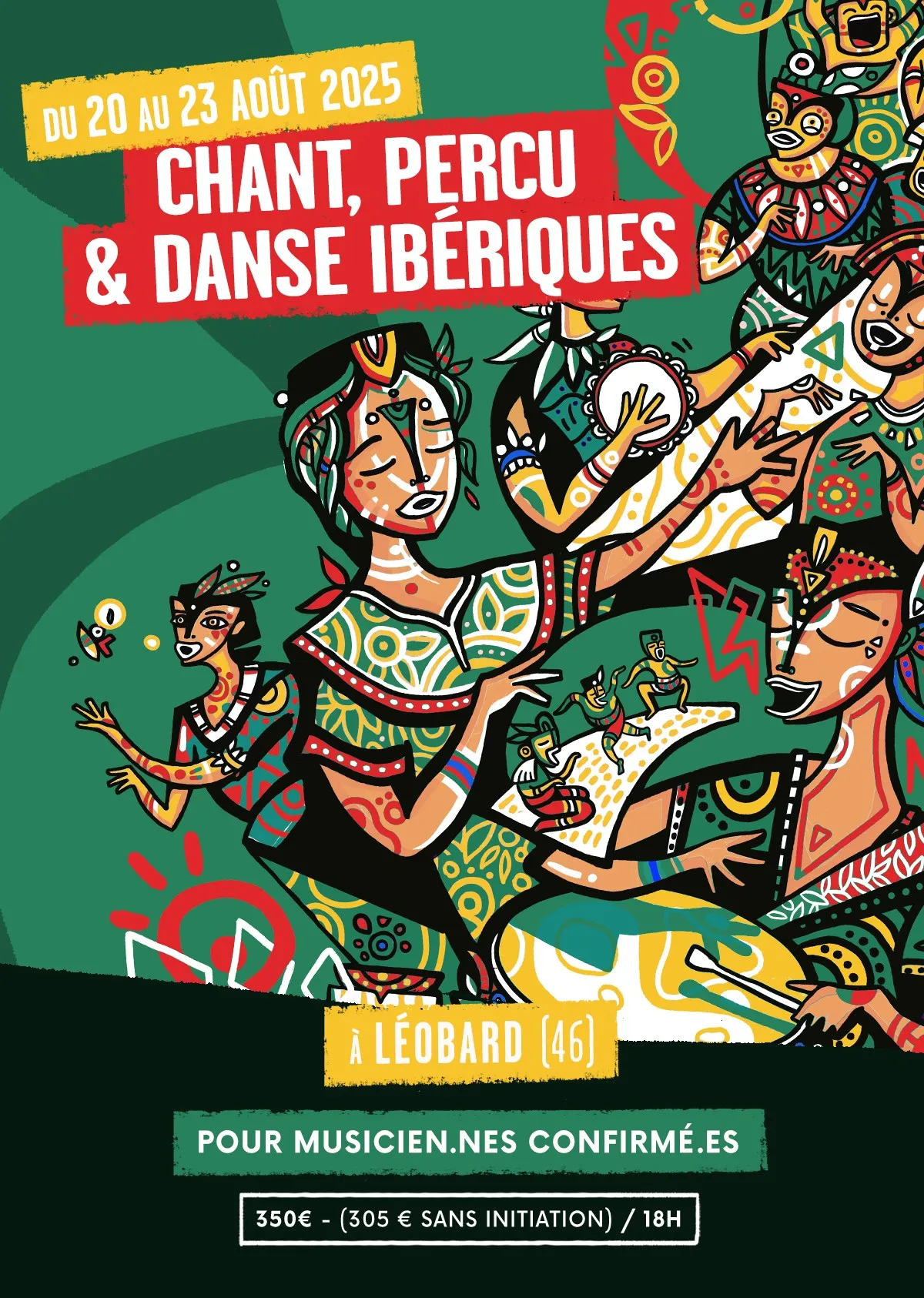
Crédits: ©thomasmarchais.net


