Théâtre d'Anzin – Anzin
Description
English
Deutsch
Dutch
Español
Italiano
Description
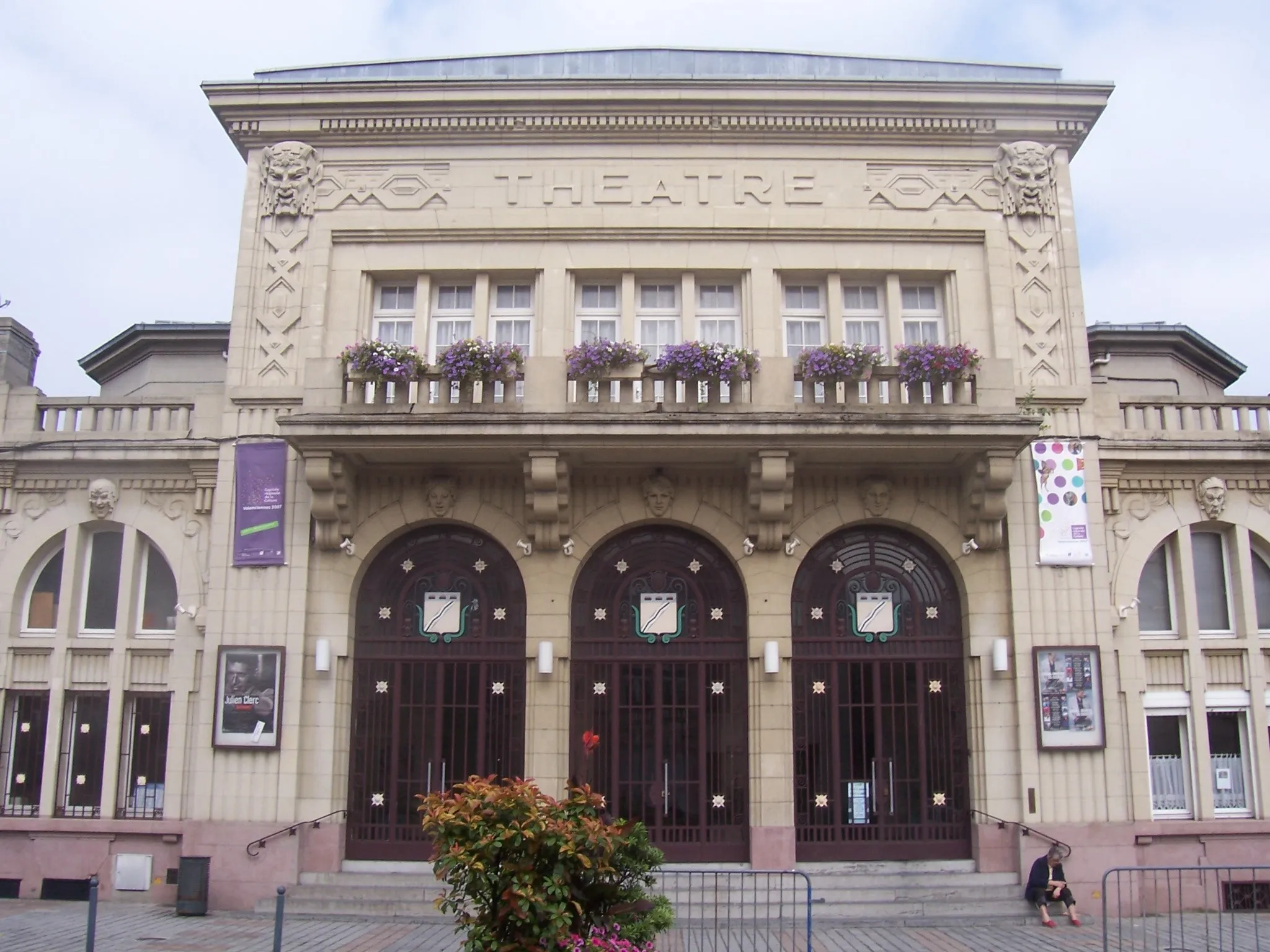
Ce théâtre, érigé à partir de 1932 sous la direction de l’architecte Joseph Foyer, témoigne de l’enrichissement consécutif au développement industriel de la ville pendant la première moitié du XX° siècle liée au développement de l’industrie. Le béton armé est le matériau presque exclusivement employé. Les travaux débutent en 1932 et c’est en 1934 que le théâtre est inauguré. Il ouvre ses portes au public, et devient rapidement une véritable institution culturelle aujourd’hui reconnue pour ses qualités patrimoniales et inscrite dans l’imaginaire collectif pour sa programmation populaire et éclectique. Bientôt centenaire, le théâtre a fermé ses portes en décembre 2020 pour d’importants travaux de rénovation et devrait rouvrir début 2027. Le bâtiment se caractérise par une façade principale "à la Palladienne" de style "art déco" : l'ordonnance se compose d'un corps de bâtiment central établie sur une travée d'entrée principale "tierce" avec balcon encadré de deux pilastres stylisés ayant pour chapiteaux des têtes de personnages rieurs pourvus de cornes, le tout supportant une élégante corniche à "denticules", puis de deux ailes latérales, le tout sur une stricte symétrie située à l'axe de la travée d'entrée centrale. Les deux ailes sont couronnées d'un garde corps à balustres cylindriques dans le prolongement du grand balcon central qu'il poursuit. Chaque baie est découpée en "triptyque" (les éléments de baies étant séparés par un meneau de béton ouvragé). Les baies sont en acier d'une grande finesse ; les trois portes d'accès sont surmontées du blason de la ville, dans une imposte semi-circulaire.
English
This theater, built from 1932 onwards under the direction of architect Joseph Foyer, bears witness to the wealth generated by the city?s industrial development in the first half of the 20th century. Reinforced concrete was used almost exclusively. Work began in 1932, and the theater was inaugurated in 1934. It opened its doors to the public, and quickly became a veritable cultural institution, recognized today for its heritage qualities and inscribed in the collective imagination for its popular and eclectic programming. Almost a hundred years old, the theater closed its doors in December 2020 for major renovation work, and is due to reopen in early 2027. The building features an art deco-style "Palladian" main facade: the layout consists of a central body established on a "tierce" main entrance bay with balcony framed by two stylized pilasters whose capitals feature the heads of laughing figures with horns, all supporting an elegant "denticulated" cornice, then two side wings, all on a strict symmetry located at the axis of the central entrance bay. The two wings are crowned by a cylindrical baluster balustrade in continuation of the large central balcony. Each bay is cut into a "triptych" (the bay elements are separated by an elaborate concrete mullion). The bays are made of highly refined steel; the three access doors are surmounted by the town's coat of arms, in a semi-circular transom.
Deutsch
Dieses Theater, das ab 1932 unter der Leitung des Architekten Joseph Foyer errichtet wurde, zeugt von dem Reichtum, der sich aus der industriellen Entwicklung der Stadt in der ersten Hälfte des 20. Jahrhunderts. Als Baumaterial wurde fast ausschließlich Stahlbeton verwendet. Die Bauarbeiten begannen 1932 und 1934 wurde das Theater eingeweiht. Das Theater öffnete seine Türen für die Öffentlichkeit und entwickelte sich schnell zu einer kulturellen Institution, die heute für ihr kulturelles Erbe bekannt ist und sich durch ihr populäres und eklektisches Programm in die kollektive Vorstellungswelt eingeprägt hat. Das bald 100 Jahre alte Theater wurde im Dezember 2020 für umfangreiche Renovierungsarbeiten geschlossen und soll Anfang 2027 wiedereröffnet werden. Das Gebäude zeichnet sich durch eine Hauptfassade im "Palladio-Stil" aus: Die Anordnung besteht aus einem zentralen Gebäudekörper, der auf einem "dritten" Haupteingangsfeld mit Balkon steht, der von zwei stilisierten Pilastern eingerahmt wird, deren Kapitelle Köpfe lachender Figuren mit Hörnern sind und die ein elegantes Gesims mit "Zacken" tragen, sowie aus zwei Seitenflügeln, alles auf einer strengen Symmetrie in der Achse des zentralen Eingangsfeldes. Die beiden Flügel werden von einer Brüstung mit zylindrischen Balustern gekrönt, die eine Verlängerung des großen zentralen Balkons darstellt, den sie fortsetzt. Jede Öffnung ist als "Triptychon" geschnitten (die Öffnungselemente sind durch eine kunstvoll gearbeitete Betonsprosse getrennt). Die Erker sind aus feinstem Stahl gefertigt; die drei Zugangstüren sind in einem halbrunden Oberlicht mit dem Stadtwappen versehen.
Dutch
Dit theater, gebouwd in 1932 onder leiding van architect Joseph Foyer, getuigt van de rijkdom die de industriële ontwikkeling van de stad in de eerste helft van de 20e eeuw heeft gecreëerd. Gewapend beton is het materiaal dat bijna uitsluitend werd gebruikt. De werkzaamheden begonnen in 1932 en het theater werd ingehuldigd in 1934. Het opende zijn deuren voor het publiek en werd al snel een culturele instelling die vandaag de dag bekend staat om zijn erfgoed en populaire en eclectische programmering. Het theater, bijna een eeuw oud, sloot zijn deuren in december 2020 voor grote renovatiewerkzaamheden en zal begin 2027 heropend worden. Het gebouw wordt gekenmerkt door een hoofdgevel in Palladiaanse art-decostijl: de indeling bestaat uit een centraal gebouw boven een hoofdentree met een balkon omlijst door twee gestileerde pilasters, waarvan de kapitelen de hoofden zijn van lachende figuren met horens, die allemaal een elegante kroonlijst met tandlijsten ondersteunen, gevolgd door twee zijvleugels, allemaal in strikte symmetrie op de as van de centrale entreetravee. De twee vleugels worden bekroond door een balustrade met cilindrische balusters in het verlengde van het grote centrale balkon. Elke travee is opgedeeld in een "drieluik" (de travee-elementen worden gescheiden door een bewerkt betonnen raam). De traveeën zijn gemaakt van uiterst fijn staal; de drie toegangsdeuren zijn bekroond met het stadswapen in een halfronde bovendorpel.
Español
Este teatro, construido a partir de 1932 bajo la dirección del arquitecto Joseph Foyer, es testigo de la riqueza creada por el desarrollo industrial de la ciudad en la primera mitad del siglo XX. El hormigón armado es el material utilizado casi exclusivamente. Las obras comenzaron en 1932 y el teatro se inauguró en 1934. Abrió sus puertas al público y se convirtió rápidamente en una institución cultural, reconocida hoy por su patrimonio y su programación popular y ecléctica. Con casi un siglo de vida, el teatro cerró sus puertas en diciembre de 2020 para someterse a importantes obras de renovación y su reapertura está prevista para principios de 2027. El edificio se caracteriza por una fachada principal de estilo art déco palladiano: la disposición comprende un edificio central situado sobre un vano de entrada principal con un balcón enmarcado por dos pilastras estilizadas, cuyos capiteles son cabezas de figuras risueñas con cuernos, todo ello soportando una elegante cornisa dentilada, seguida de dos alas laterales, todas ellas situadas en estricta simetría sobre el eje del vano de entrada central. Las dos alas están coronadas por una balaustrada con balaustres cilíndricos en la continuación del gran balcón central. Cada crujía está cortada en forma de "tríptico" (los elementos de la crujía están separados por un parteluz de hormigón trabajado). Los vanos son de acero muy fino; las tres puertas de acceso están rematadas con el escudo de la ciudad en un travesaño semicircular.
Italiano
Questo teatro, costruito nel 1932 sotto la direzione dell'architetto Joseph Foyer, testimonia la ricchezza creata dallo sviluppo industriale della città nella prima metà del XX secolo. Il cemento armato è il materiale quasi esclusivamente utilizzato. I lavori iniziarono nel 1932 e il teatro fu inaugurato nel 1934. Il teatro aprì le porte al pubblico e divenne rapidamente un'istituzione culturale, oggi riconosciuta per il suo patrimonio e per la sua programmazione popolare ed eclettica. Con quasi un secolo di vita, il teatro ha chiuso i battenti nel dicembre 2020 per importanti lavori di ristrutturazione e dovrebbe riaprire all'inizio del 2027. L'edificio è caratterizzato da una facciata principale in stile art déco palladiano: la pianta comprende un edificio centrale impostato su una campata d'ingresso principale con una balconata incorniciata da due lesene stilizzate, i cui capitelli sono teste di figure ridenti con corna, che sorreggono un elegante cornicione dentellato, seguito da due ali laterali, tutte impostate in stretta simmetria sull'asse della campata d'ingresso centrale. Le due ali sono coronate da una balaustra con balaustre cilindriche, in continuità con il grande balcone centrale. Ogni campata è tagliata a "trittico" (gli elementi della campata sono separati da un montante in cemento lavorato). Le campate sono realizzate in acciaio finissimo; le tre porte di accesso sono sormontate dallo stemma della città in un traverso semicircolare.
189 Avenue Anatole France, 59410 Anzin