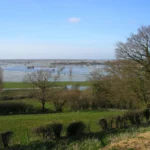
Le marais de Kervijen
Description
English
Deutsch
Dutch
Español
Italiano
Description
Cette zone humide littorale, située au fond de la baie de Douarnenez est composée d'une mosaïque de milieux naturels : roselières hautes et basses, jonchaies, prairies humides, tremblants, eau libre. Elle abrite également une grande diversité d'espèces animales (mammifères semi aquatiques, odonates, reptiles et amphibiens, oiseaux, insectes, poissons, grands mammifères, etc…). Les naturalistes passionnés de l'association Grumpy Nature, soutenus par le Conseil Départemental, s'intéressent, de près à la biodiversité de ce marais et notamment son avifauve, en capturant et baguant chaque année près de 6000 oiseaux d'une soixantaine d'espèces différentes, des plus communes (Phragmite des joncs, Bruant des roseaux…) aux plus rares (Phragmite aquatique, Panure à moustaches…). La station de baguage, au coeur du marais, est ouverte tous les jours de fin juillet à fin août, et aussi tous les week-ends de septembre à mi-décembre. Les oiseaux sont capturés, tout en douceur, au sein de la roselière, pour ensuite être identifiés, bagués, mesurés puis relâchés bien sûr ! Promeneurs et estivants affectionnent ce spectacle !
English
This coastal wetland, located at the bottom of the bay of Douarnenez is composed of a mosaic of natural environments: high and low reed beds, reed beds, wet meadows, trembling, open water. It is also home to a great diversity of animal species (semi-aquatic mammals, odonates, reptiles and amphibians, birds, insects, fish, large mammals, etc…). The passionate naturalists of the Grumpy Nature association, supported by the Departmental Council, take a close interest in the biodiversity of this marsh and in particular its birdlife, by capturing and ringing each year nearly 6000 birds of about sixty different species, from the most common (Reed warbler, Reed sparrow…) to the rarest (Aquatic warbler, Whiskered parsnip…). The ringing station, in the heart of the marsh, is open every day from the end of July to the end of August, and also every weekend from September to mid-December. The birds are captured, very gently, in the reedbed, to be identified, ringed, measured and then released of course! Walkers and summer people love this show!
Deutsch
Dieses Küstenfeuchtgebiet am Ende der Bucht von Douarnenez besteht aus einem Mosaik natürlicher Lebensräume: hohe und niedrige Schilfbestände, Binsengürtel, Feuchtwiesen, Espen, offenes Wasser. Es beherbergt außerdem eine große Vielfalt an Tierarten (halb aquatische Säugetiere, Libellen, Reptilien und Amphibien, Vögel, Insekten, Fische, große Säugetiere usw.). Die passionierten Naturforscher des Vereins Grumpy Nature, die vom Conseil Départemental unterstützt werden, interessieren sich sehr für die Biodiversität dieses Sumpfgebiets und insbesondere für seine Vogelwelt. Sie fangen und beringen jedes Jahr fast 6000 Vögel aus etwa 60 verschiedenen Arten, von den häufigsten (Schilfrohrsänger, Rohrammer…) bis zu den seltensten (Wasserrohrsänger, Schnurrbart-Pfannenstiel…). Die Beringungsstation im Herzen des Sumpfgebiets ist von Ende Juli bis Ende August täglich und von September bis Mitte Dezember auch an den Wochenenden geöffnet. Die Vögel werden sanft im Schilfgürtel eingefangen, identifiziert, beringt, vermessen und natürlich wieder freigelassen! Spaziergänger und Sommergäste lieben dieses Schauspiel!
Dutch
Dit kustwatergebied, gelegen op de bodem van de baai van Douarnenez, bestaat uit een mozaïek van natuurlijke milieus: hoge en lage rietkragen, rietvelden, natte weiden, espen, open water. Het herbergt ook een grote verscheidenheid aan diersoorten (semi-aquatische zoogdieren, odonaten, reptielen en amfibieën, vogels, insecten, vissen, grote zoogdieren, enz.) De gepassioneerde naturalisten van de vereniging Grumpy Nature, gesteund door de Departementsraad, besteden veel aandacht aan de biodiversiteit van dit moeras en in het bijzonder aan de vogelstand, door jaarlijks bijna 6000 vogels van een zestigtal verschillende soorten te vangen en te ringen, van de meest voorkomende (Rietzanger, Rietgors, enz.) tot de zeldzaamste (Waterrietzanger, Fluithoorn, enz.). Het ringstation, in het hart van het moeras, is van eind juli tot eind augustus dagelijks geopend en van september tot half december elk weekend. De vogels worden voorzichtig gevangen in het rietveld en vervolgens geïdentificeerd, geringd, gemeten en vrijgelaten Zowel wandelaars als zomergasten zijn dol op dit spektakel!
Español
Este humedal costero, situado en el fondo de la bahía de Douarnenez, está formado por un mosaico de ambientes naturales: cañaverales altos y bajos, juncales, praderas húmedas, álamos, aguas abiertas. También alberga una gran variedad de especies animales (mamíferos semiacuáticos, odonatos, reptiles y anfibios, aves, insectos, peces, grandes mamíferos, etc.). Los apasionados naturalistas de la asociación Grumpy Nature, apoyados por el Consejo Departamental, se interesan por la biodiversidad de esta marisma, y en particular por su avifauna, capturando y anillando cada año cerca de 6.000 aves de unas sesenta especies diferentes, desde las más comunes (carricerín, escribano palustre, etc.) hasta las más raras (carricerín cejudo, gallina de agua, etc.). La estación de anillamiento, en el corazón de la marisma, está abierta todos los días desde finales de julio hasta finales de agosto, y también todos los fines de semana desde septiembre hasta mediados de diciembre. Las aves se capturan con cuidado en el carrizal y luego se identifican, se anillan, se miden y se liberan Este espectáculo gusta tanto a los senderistas como a los veraneantes
Italiano
Questa zona umida costiera, situata sul fondo della baia di Douarnenez, è costituita da un mosaico di ambienti naturali: canneti alti e bassi, canneti, prati umidi, pioppi, acque libere. Ospita inoltre un'ampia varietà di specie animali (mammiferi semi-acquatici, odonati, rettili e anfibi, uccelli, insetti, pesci, grandi mammiferi, ecc.) Gli appassionati naturalisti dell'associazione Grumpy Nature, sostenuti dal Consiglio dipartimentale, si interessano alla biodiversità di questa palude e in particolare alla sua avifauna, catturando e inanellando ogni anno circa 6.000 uccelli di una sessantina di specie diverse, dalle più comuni (Cannaiola, Zigolo muciatto, ecc.) alle più rare (Cannaiola acquatica, Gallinella d'acqua bavosa, ecc.). La stazione di inanellamento, nel cuore della palude, è aperta tutti i giorni da fine luglio a fine agosto e tutti i fine settimana da settembre a metà dicembre. Gli uccelli vengono catturati delicatamente nel canneto e poi identificati, inanellati, misurati e rilasciati Gli escursionisti e i visitatori estivi amano questo spettacolo!
, 29550 Ploéven