Le Garlaban
Description
English
Deutsch
Dutch
Español
Italiano
Description
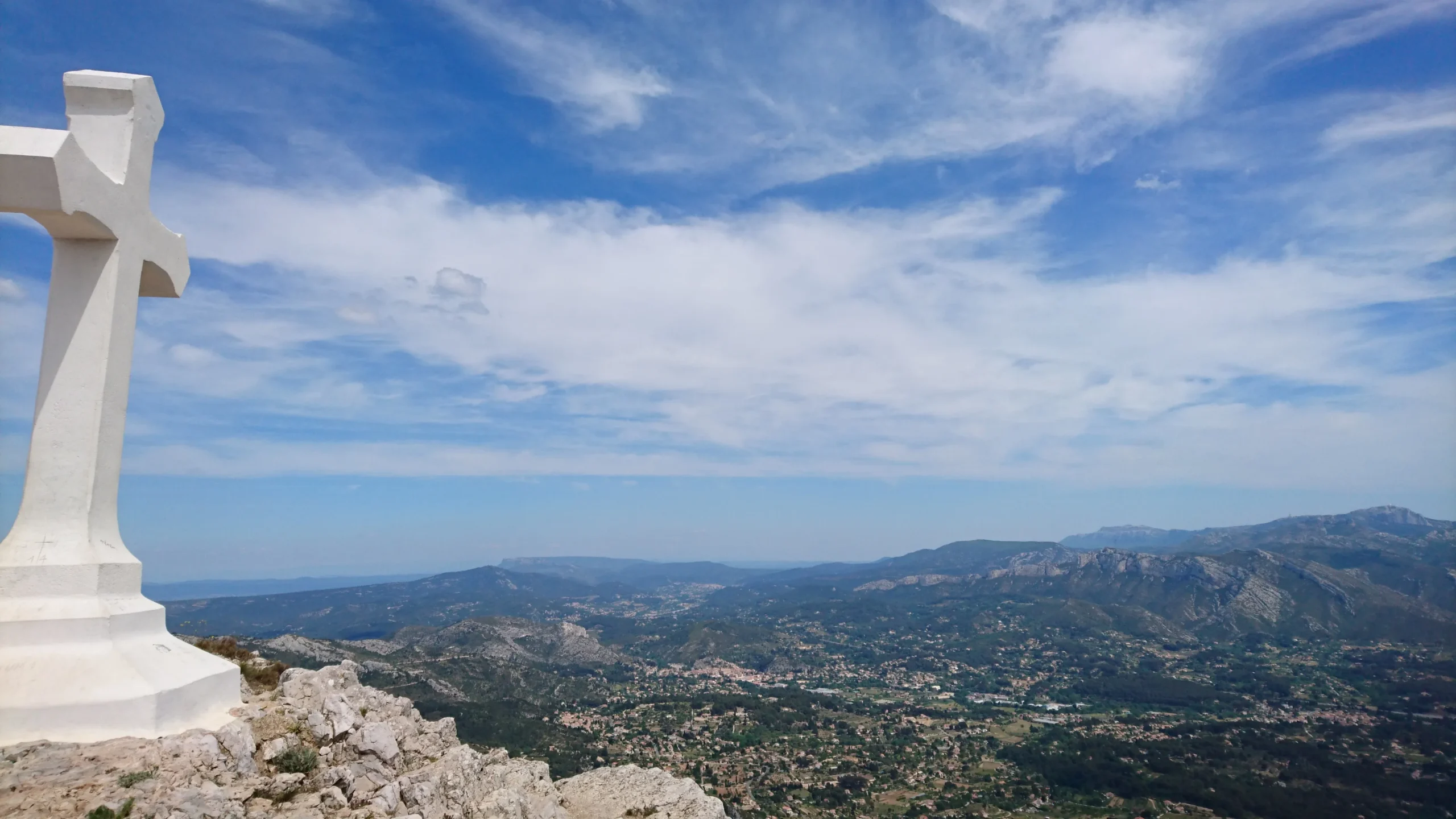
Ils sont bordés au Nord par les massifs de l’Arbois, du Montaiguet, des Collines de Gardanne et du Regagnas, à l’Est par la vallée d’Aubagne et à l’Ouest par l’autoroute A7, le séparant du massif de la Côte Bleue. Ces deux massifs sont séparés par la route départementale D908. De par son relief, et son orientation générale Est-Ouest, l'ensemble formé par les massifs de l’Etoile et du Garlaban est soumis à un fort effet de masque avec un contraste très net entre adret et ubac. Les versants Sud de l’Etoile et du Garlaban sont soumis à un climat méditerranéen typique. Le versant Nord abrite un micro-climat plus frais et plus humide (températures plus faibles, précipitations plus abondantes et sécheresse estivale plus courte). Le vent dominant est le mistral, soufflant de secteur Nord / Nord-Ouest. En versant Sud, les phénomènes aérologiques créés par les nombreux vallons sont complexes. Le vent s’oriente globalement Nord-Ouest sur les crêtes, Sud-Ouest à Sud-Est en remontant les fonds de vallons, avec une accélération générale en versant du fait de la pente. … Le massif du Garlaban présente les mêmes contrastes avec au Nord des stations de chênaie verte avec présence de Chêne pubescent et au Sud des peuplements de Pin d’Alep épars. Le taux de boisement est très faible (7,5 %, soit 554 ha) suite aux nombreux incendies qui ont parcouru le massif. La formation la plus répandue et la garrigue (Chênes kermès, Brachypode rameux, Cistes, Aphyllantes de Montpellier et Ajonc de Provence). La strate arborée est essentiellement constituée de Pin d’Alep (couvert égal ou supérieur à 75%) ces peuplements ne représentent que 350 ha, localisés au Nord-Ouest du massif et en piémont de manière discontinue. Les massifs de l’Etoile et du Garlaban constituent une barrière naturelle entre les agglomérations de Marseille, Aix, Gardanne et Aubagne, ce qui marque fortement la dynamique urbaine des communes qui l’entourent. Les piémonts de ces massifs sont ainsi soumis à une pression foncière très forte du fait de leur position périurbaine. Cette pression fait apparaître très nettement l’absence de zone de transition entre l’urbanisation dense et le milieu naturel. En tant que massif périurbain, poumon vert pour les agglomérations de Marseille et d’Aubagne et les communes qui l’entourent, le massif de l’Etoile et du Garlaban joue un rôle social fort. La fréquentation est estimée à 250 000 visiteurs/an, essentiellement de proximité du fait de la relative confidentialité des accès. … Le massif du Garlaban constitue un massif emblématique et symbolique de la Provence profonde, celle des films de Marcel Pagnol. La fréquentation de ce massif est très marquée et a donné lieu à des aménagements au niveau des sentiers de randonnées. On dénombre par ailleurs plus d’une centaine d’espèces rares ou protégées, dont plusieurs bénéficient d’un statut de protection international (comme l’Aigle de Bonelli, le Hibou Grand duc, le Circaète Jean-le-Blanc). L’ensemble des deux massifs est dans le périmètre Natura 2000 du site Etoile-Garlaban. On soulignera enfin une activité cynégétique importante sur le massif du Garlaban.
English
Located in the southeastern quarter of the Bouches-du-Rhône, the Massif de l’Etoile and Massif du Garlaban encircle a major part of the territories of Marseille and Aubagne, situated to the South. These chains are bordered by the Arbois, Montaiguet, Collines de Gardanne and Regagnas chains to the North, by the Valley of Aubagne to the East and the A7 highway to the West, which forms a barrier between the massif and the Côte Bleue coast. The two massifs are separated by the D908 main road. The relief and general East-West orientation of the Etoile-Garlaban chain provoke a strong masking effect, with striking contrasts between the adret (South-facing) and ubac (North-facing) slopes. The southern slopes of the Etoile and Garlaban are characterized by a typical Mediterranean climate. The northern slopes are characterized by a cooler and wetter micro-climate, with lower temperatures, higher rainfall and shorter summer droughts. The prevailing wind is the Mistral, which blows from the north-northwest. The aerological phenomena created by the numerous valleys crossing the southern slopes are complex. The prevailing winds are northwesterly on the peaks, and southwesterly to southeasterly blowing from the bottom of the valleys upwards, with a general acceleration on the slope due to its steep incline. … The Massif du Garlaban offers the same contrasts, with the presence of evergreen oak woods and durmast oaks to the North, and sparse Aleppo pine populations to the South. Forestation is very low (7.5 %, i.e. 1,370 acres) further to repeated fires in the massif. The predominant formation is garrigue (kermes oaks, spiny Brachypoda, Cistus, Aphyllante of Montpellier and gorse). The arborescent stratum essentially comprises Aleppo pines (75% or more) these populations represent just 865 acres, located in a discontinuous fashion to the northwest of the massif and on the piedmont. The Massif de l'Etoile and Massif du Garlaban comprise a natural barrier between Marseille, Aix, Gardanne and Aubagne, and largely influence the urban dynamics of the surrounding towns. Their peri-urban location means they are the target of extensive development projects moreover, the absence of a transition zone between the highly urbanized and natural areas is extremely apparent. In their role as a peri-urban massif and genuine green lung of Marseille, Aubagne and their neighbouring towns, the Massif de l’Etoile and Massif du Garlaban play a significant social role, with an estimated frequentation of 250,000 visitors per year, most of which are locals due to their somewhat "confidential" access routes. … The Massif du Garlaban is an emblem and symbol of "authentic" Provence, brought to international fame by the films of Marcel Pagnol. The Garlaban attracts many visitors and has now been fitted with numerous footpaths. Moreover, the site is home to over a hundred rare or protected species, many of which are protected by international laws, such as the Bonelli's eagle, eagle owl and short-toed eagle. These two massifs form part of the Etoile-Garlaban Natura 2000 site. The Massif du Garlaban is also a coveted hunting site.
Deutsch
Die im südöstlichen Viertel des Departements gelegenen Bergketten Massif de l’Etoile und Massif du Garlaban umschließen große Teile der im Süden gelegenen Ballungsräume Marseille und Aubagne. Im Norden werden sie durch das Massif de l’Arbois, das Massif du Montaiguet, die Collines de Gardanne und du Regagnas, im Osten durch das Aubagne-Tal und im Westen durch die Autobahn A7 begrenzt, die die Grenze zum Massif de la Côte Bleue darstellt. Die beiden Berggruppen werden durch die Departementstraße D908 voneinander getrennt. Durch die Oberflächengestalt und die generelle Ost-West-Ausrichtung unterliegt die Einheit aus Massif de l’Etoile und Massif du Garlaban einem starken Standorteffekt mit deutlichen Unterschieden zwischen Süd- und Nordlagen. An den Südhängen des Etoile- und Garlaban-Massivs herrscht ein typisches Mittelmeerklima. An der Nordseite findet man ein frischeres und feuchteres Mikroklima (niedrigere Temperaturen, üppigere Niederschläge und kürzere Trockenzeiten im Sommer). Der vorherrschende Wind ist der Mistral, der im Norden und Nordwesten bläst. . Auf den Südhängen kommt es zu zahlreichen, komplexen durch die vielen Talmulden entstehenden höhenwetterkundlichen Phänomenen. Der Wind bläst normalerweise auf den Kämmen in Nordwestrichtung und steigt in südwestlicher bis südöstlicher Richtung durch die Talsohlen empor, am Berghang gewinnt er dabei aufgrund des Gefälles an Geschwindigkeit. Das Massif du Garlaban weist dieselben Unterschiede auf, mit Stein- und Flaumeichewäldern im Norden und dichten Aleppo-Kieferbeständen im Süden. Die Bewaldungsquote ist sehr niedrig (7,5%, also 554 ha) dies ist auf die vielen Brände zurückzuführen, die das Massiv heimgesucht haben. Am verbreitetesten ist die Garrigue (Strauchheide) (Kermeseiche, Brachypodium ramosum (verzweigte Zwencke), Zistrosen, Blaue Binsenlilie und Provence-Ginster). Die Baumschicht besteht vorwiegend aus Aleppo-Kiefern (mindestens 75%) dieser Bestand bedeckt nur 350 ha und findet sich im Nordwesten des Massivs und stellenweise auch an den Bergfüßen. Die Höhenzüge Etoile und Garlaban stellen eine natürliche Barriere zu den Ballungsräumen Marseille, Aix, Gardanne und Aubagne dar, was die Stadtdynamik der sie umgebenden
Gemeinden prägt. Am Fuß der Berggruppen herrscht daher aufgrund ihrer Stadtrandlage eine hohe Grundstücksnachfrage. Diese rückt das Fehlen einer Übergangszone zwischen dichter Stadtbesiedelung und natürlichem Lebensraum deutlich ins Bewusstsein. Als Bergkette am Stadtrand, als grüne Lunge für die Ballungsräume Marseille und Aubagne und die umgebenden Gemeinden spielen das Massif de l’Etoile und das Massif du Garlaban eine wichtige gesellschaftliche Rolle. Die Besucherrate liegt bei geschätzten 250 000 Personen pro Jahr, die vorwiegend aus dem Umland kommen, da die Zugänge in die Berge relativ versteckt liegen Das Massif du Garlaban stellt eine für das Landesinnere der Provence, die Provence der Filme von Marcel Pagnol, typische und symbolische Berggruppe dar. Sie ist sehr stark besucht, und daher wurden zahlreiche Wanderwege angelegt. Außerdem finden sich hier über hundert seltene oder geschützte Arten, darunter manche international geschützte (wie der Habichtsadler, der Uhu, der Schlangenadler). Beide Bergketten sind Teil des Natura 2000 Standorts Etoile-Garlaban. Abschließend sei noch die bedeutende Jagdtätigkeit im Massif du Garlaban erwähnt.
Dutch
Ze worden in het noorden begrensd door de massieven van Arbois, Montaiguet, Collines de Gardanne en Regagnas, in het oosten door het dal van de Aubagne en in het westen door de snelweg A7, die het scheidt van het massief van de Côte Bleue. Deze twee massieven worden gescheiden door de departementale weg D908 Door het reliëf en de algemene oost-west oriëntatie is het ensemble gevormd door het Etoile- en het Garlaban-massief onderhevig aan een sterk maskerende werking met een zeer duidelijk contrast tussen adret en ubac Op de zuidelijke hellingen van Etoile en Garlaban heerst een typisch mediterraan klimaat. De noordelijke hellingen hebben een koeler en vochtiger microklimaat (lagere temperaturen, meer neerslag en kortere zomerdroogte). De overheersende wind is de Mistral, die uit het noorden/noordwesten waait Op de zuidelijke hellingen zijn de luchtverschijnselen die door de talrijke valleien worden veroorzaakt, complex. De wind is over het algemeen noordwest op de bergkammen, zuidwest tot zuidoost als hij de valleibodems optrekt, met een algemene versnelling op de hellingen vanwege de helling.. Het Garlaban-massief vertoont dezelfde contrasten, met stations van steeneiken met schors in het noorden en verspreide opstanden van Aleppo-dennen in het zuiden. Het bebossingspercentage is zeer laag (7,5% of 554 ha) als gevolg van de talrijke branden die het massief hebben geteisterd. De meest voorkomende formatie is het struikgewas (Kermeseik, Brachypodus, Cistus, Aphyllantes de Montpellier en Gorse de Provence). De boomlaag bestaat hoofdzakelijk uit Aleppo-dennen (dekking van 75% of meer). Deze opstanden vertegenwoordigen slechts 350 ha, discontinu gelegen in het noordwesten van het massief en in de uitlopers. Het Etoile- en het Garlaban-massief vormen een natuurlijke barrière tussen de agglomeraties Marseille, Aix, Gardanne en Aubagne, die de stedelijke dynamiek van de omliggende gemeenten sterk beïnvloedt. De uitlopers van deze massieven staan door hun peri-urbane ligging dus onder een zeer sterke gronddruk. Deze druk toont duidelijk het ontbreken van een overgangszone tussen de dichte verstedelijking en de natuurlijke omgeving. Als peri-stedelijk massief, een groene long voor de agglomeraties Marseille en Aubagne en de omliggende gemeenten, speelt het massief van Etoile en Garlaban een sterke sociale rol. Het aantal bezoekers wordt geschat op 250.000 per jaar, voornamelijk lokale bezoekers vanwege de relatieve vertrouwelijkheid van de toegang Het massief van Garlaban is een emblematisch en symbolisch massief van de diepe Provence, dat in de films van Marcel Pagnol voorkomt. Dit massief is zeer populair en er zijn wandelroutes aangelegd. Bovendien zijn er meer dan honderd zeldzame of beschermde soorten, waarvan verschillende een internationale beschermingsstatus hebben (zoals de havikarend, de grote hoornuil, de slangenarend) Het geheel van de twee massieven ligt binnen de Natura 2000-omtrek van het gebied Etoile-Garlaban. Ten slotte is er een aanzienlijke jachtactiviteit op het Garlaban-massief.
Español
They are bordered to the north by the massifs of Arbois, Montaiguet, Collines de Gardanne and Regagnas, to the east by the valley of Aubagne and to the west by the A7 freeway, separating it from the massif of the Côte Bleue. These two massifs are separated by the departmental road D908. Due to its relief and its general east-west orientation, the ensemble formed by the Etoile and Garlaban massifs is subject to a strong masking effect with a very clear contrast between adret and ubac. The southern slopes of Etoile and Garlaban are subject to a typical Mediterranean climate. The northern slopes have a cooler and more humid microclimate (lower temperatures, more rainfall and shorter summer drought). The dominant wind is the Mistral, blowing from the North/Northwest. On the southern slopes, the aerological phenomena created by the numerous valleys are complex. The wind is generally oriented North-West on the ridges, South-West to South-East up the valley bottoms, with a general acceleration on the slopes due to the slope… The Garlaban massif presents the same contrasts with, in the North, stations of holm oak forest with the presence of pubescent oak and, in the South, scattered stands of Aleppo pine. The rate of afforestation is very low (7.5%, or 554 ha) following the numerous fires that have occurred in the massif. The most widespread formation is the scrubland (Kermes oaks, Brachypodus, Cistus, Aphyllantes of Montpellier and Gorse of Provence). The tree stratum is essentially made up of Aleppo pine (75% or more). These stands represent only 350 ha, located in the northwest of the massif and in the foothills in a discontinuous manner. The massifs of Etoile and Garlaban constitute a natural barrier between the agglomerations of Marseille, Aix, Gardanne and Aubagne, which strongly marks the urban dynamics of the surrounding municipalities. The foothills of these massifs are thus subject to very strong land pressure due to their peri-urban position. This pressure clearly shows the absence of a transition zone between the dense urbanization and the natural environment. As a peri-urban massif, a green lung for the agglomerations of Marseille and Aubagne and the surrounding municipalities, the Etoile and Garlaban massif plays a strong social role. The number of visitors is estimated at 250,000 per year, mainly from the local area due to the relative confidentiality of access. The Garlaban massif is an emblematic and symbolic massif of the deep Provence, the one of Marcel Pagnol's movies. The frequentation of this massif is very marked and has led to the development of hiking trails. There are more than a hundred rare or protected species, several of which have international protection status (such as Bonelli's Eagle, the Great Horned Owl, the Short-toed Eagle). The whole of the two massifs is in the Natura 2000 perimeter of the Etoile-Garlaban site. Finally, there is significant hunting activity on the Garlaban massif.
Italiano
Situati nel quarto sud-est del dipartimento, i massicci dell’Etoile e del Garlaban cingono per una gran parte gli agglomerati di Marsiglia e Aubagne, situati a sud. Sono delimitati a nord dai massicci dell’Arbois, del Montaiguet, dalle Colline di Gardanne e del Regagnas, ad est dalla valle d’Aubagne e ad ovest dall’autostrada A7 che li separa dal massiccio della Côte Bleue. Questi due massicci sono separati dalla strada provinciale D908.
Per il suo rilievo e il suo orientamento generale a est-ovest, il complesso formato dai massicci dell’Etoile e del Garlaban è sottoposto ad un forte effetto maschera con un contrasto assai netto tra il versante soleggiato e quello in ombra. I versanti sud dell’Etoile e del Garlaban sono caratterizzati da un tipico clima mediterraneo. Il versante nord accoglie un micro-clima più fresco e più umido (temperature più basse, precipitazioni più abbondanti e periodo di siccità estiva più breve). Il vento dominante è il maestrale, che soffia dal settore nord/nord-ovest. Nel versante sud, i fenomeni aerologici creati dai numerosi valloni sono complessi. Il vento ha, nel complesso, una direzione nord-ovest sulle creste, da sud-ovest a sud-est risalendo il fondo dei valloni, con un’accelerazione generale nel versante a causa della pendenza. … Il massiccio del Garlaban presenta gli stessi contrasti con, a nord, delle zone di querceti verdi, caratterizzate dalla presenza della Quercia pubescente e a sud, una vegetazione sparsa di Pino d'Aleppo. Il tasso d’imboschimento è molto basso (il 7,5%, ovvero 554 ettari) in seguito a numerosi incendi che hanno attraversato il massiccio. La formazione più diffusa è la gariga (Quercia kermès, Brachipodio ramoso, Cisti, Afillante di Montpellier e Ginestrone della Provenza). Lo strato alberato è essenzialmente costituito dal Pino d’Aleppo (copertura in misura pari o superiore al 75%) tali insediamenti rappresentano solo 350 ha, situati a nord-ovest del massiccio e nella zona pedemontana in modo discontinuo. I massicci dell’Etoile e del Garlaban costituiscono una barriera naturale tra gli agglomerati di Marsiglia, Aix, Gardanne e Aubagne e questo influenza in modo decisivo la dinamica urbana dei comuni che li circondano. Le zone pedemontane di tali massicci sono, in tal modo, sottoposte ad una fortissima pressione fondiaria a causa della loro posizione periurbana.Tale pressione rivela in modo netto l’assenza di una zona di transizione tra l’urbanizzazione densa e il contesto naturale. Essendo un massiccio periurbano, polmone verde per gli agglomerati di Marsiglia e di Aubagne e i comuni che lo circondano, il massiccio dell’Etoile e del Garlaban riveste un importante ruolo sociale. La frequentazione è stimata a 250 000 visitatori/anno, essenzialmente di prossimità, vista la relativa riservatezza degli accessi. … Il massiccio del Garlaban costituisce un massiccio emblematico e simbolico della Provenza profonda, quella dei film di Marcel Pagnol. La frequentazione di tale massiccio è molto sostenuta e ha dato luogo a lavori di sistemazione a livello di sentieri di escursione. Si enumerano peraltro oltre un centinaio di specie rare o protette, fra cui diverse vantano lo status di tutela internazionale (come l’Aquila di Bonelli, il gufo Gran duca, il Biancone Jean-le-Blanc). L’insieme dei due massicci si trova nel perimetro Natura 2000 del sito Etoile-Garlaban. Bisogna, infine, porre l’accento su un’importante attività cinegetica sul massiccio del Garlaban.
Classement: Natura 2000
, 13400 Aubagne
Crédits: A. BARTORELLO