Oppidum des Caisses de Jean Jean – Mouriès
Description
English
Deutsch
Dutch
Español
Italiano
Description
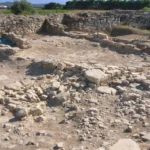
Des fortifications de plusieurs époques y ont été identifiées, attestant du peuplement de cet oppidum du VIe au Ier siècles avant J.-C. Le premier rempart est antérieur à 500 avant JC cependant, il a fait l'objet de reconstructions successives et l'on peut situer la dernière ré-édification – dont les restes sont aujourd'hui visibles – entre 180 et 150 av JC. L'appareil défensif était renforcé à l'ouest par 4 fossés successifs alternant avec des talus de terre et une ligne de roches hérissées faisant office de chevaux de frise.
Dans les fragments de remparts, on trouve des blocs en réemploi (stèles, linteaux…) représentant un seul et même motif : celui d'un cavalier armé d'un javelot. Cet élément laisse à penser que le site aurait abrité aux alentours des VII° ou VI° siècles avant notre ère, un sanctuaire.
L'éperon et son versant sud sont habités jusqu'à la fin du III° siècle ap JC. Les oppida de la région sont en effet progressivement abandonnées à l'époque de la romanisation de la Provence, romanisation qui s'accélère sous le règne d'Auguste (fin du Ier siècle ap JC). Pour certaines, l'abandon sera définitif mais d'autres, comme les Baux ou Castillon (au Paradou), seront récupérées au Moyen-Age.
Le site a été inscrit aux monuments historiques par un arrêté du 2 février 1974. Il est accessible au moyen d'un itinéraire balisé.
English
Fortifications from several periods have been identified here, attesting to the settlement of this oppidum from the 6th to the 1st centuries BC. The first rampart dates back to before 500 BC, but it underwent successive reconstructions, with the last rebuilding – the remains of which are still visible today – taking place between 180 and 150 BC. The defensive structure was reinforced on the west side by four successive ditches alternating with earth embankments and a line of jagged rocks serving as a palisade.
The fragments of the ramparts contain reused blocks (steles, lintels, etc.) bearing a single motif: that of a horseman armed with a javelin. This suggests that the site may have been home to a sanctuary around the 7th or 6th century BC.
The spur and its southern slope were inhabited until the end of the 3rd century AD. The oppida in the region were gradually abandoned during the Romanisation of Provence, a process that accelerated under the reign of Augustus (end of the 1st century AD). Some were abandoned permanently, but others, such as Les Baux and Castillon (in Paradou), were reclaimed in the Middle Ages.
The site was listed as a historic monument by a decree dated 2 February 1974. It is accessible via a marked trail.
Deutsch
Es wurden Befestigungsanlagen aus verschiedenen Epochen identifiziert, die die Besiedlung dieses Oppidums vom 6. bis zum 1. Jahrhundert v. Chr. belegen. Die erste Stadtmauer stammt aus der Zeit vor 500 v. Chr., wurde jedoch mehrfach umgebaut. Der letzte Umbau, dessen Überreste heute noch zu sehen sind, kann auf die Zeit zwischen 180 und 150 v. Chr. datiert werden. Die Verteidigungsanlage wurde im Westen durch vier aufeinanderfolgende Gräben verstärkt, die sich mit Erdwällen und einer Reihe von aufrecht stehenden Felsen abwechselten, die als Frise dienten.
In den Fragmenten der Stadtmauern finden sich wiederverwendete Blöcke (Stelen, Türstürze …), die alle dasselbe Motiv zeigen: einen mit einem Speer bewaffneten Reiter. Dies lässt vermuten, dass sich an dieser Stelle um das 7. oder 6. Jahrhundert v. Chr. ein Heiligtum befand.
Der Felsvorsprung und sein Südhang waren bis zum Ende des 3. Jahrhunderts n. Chr. bewohnt. Die Oppida der Region wurden während der Romanisierung der Provence nach und nach aufgegeben, die sich unter der Herrschaft von Augustus (Ende des 1. Jahrhunderts n. Chr.) beschleunigte. Einige wurden endgültig aufgegeben, andere, wie Les Baux oder Castillon (in Paradou), wurden im Mittelalter wiederbesiedelt.
Die Stätte wurde durch einen Erlass vom 2. Februar 1974 unter Denkmalschutz gestellt. Sie ist über einen markierten Weg erreichbar.
Dutch
Er zijn vestingwerken uit verschillende perioden geïdentificeerd, die getuigen van de bewoning van deze oppidum van de 6e tot de 1e eeuw v.Chr. De eerste wal werd gebouwd vóór 500 v.C., maar hij werd achtereenvolgens herbouwd en de laatste herbouw – waarvan de overblijfselen vandaag zichtbaar zijn – kan gedateerd worden tussen 180 en 150 v.C. Het verdedigingsapparaat werd aan de westkant versterkt door vier opeenvolgende greppels, afgewisseld met aarden wallen en een rij stekelige rotsen die als friezen fungeerden.
In de fragmenten van de vestingmuren vinden we hergebruikte blokken (steles, lateien, enz.) die één enkel motief voorstellen: dat van een ruiter gewapend met een speer. Dit suggereert dat de site rond de 7e of 6e eeuw voor Christus een heiligdom kan hebben gehuisvest.
De uitloper en zijn zuidelijke helling werden bewoond tot het einde van de 3e eeuw na Christus. De oppida van de regio werden geleidelijk verlaten ten tijde van de romanisering van de Provence, die onder het bewind van Augustus (eind 1e eeuw n. Chr.) in een stroomversnelling kwam. Voor sommige was de verlating definitief, maar andere, zoals Les Baux of Castillon (in Paradou), werden in de middeleeuwen hersteld.
De site werd bij besluit van 2 februari 1974 op de lijst van historische monumenten geplaatst. Het is toegankelijk via een bewegwijzerde route.
Español
Se han identificado fortificaciones de varias épocas que atestiguan el asentamiento de este oppidum entre los siglos VI y I a.C. La primera muralla se construyó antes del 500 a.C., pero fue reconstruida sucesivamente y la última reedificación -cuyos restos son visibles hoy en día- puede datarse entre el 180 y el 150 a.C. El aparato defensivo estaba reforzado en el lado oeste por cuatro fosos sucesivos que se alternaban con terraplenes de tierra y una línea de rocas puntiagudas que actuaban como caballos de friso.
En los fragmentos de las murallas, encontramos bloques en reutilización (estelas, dinteles, etc.) que representan un único motivo: el de un jinete armado con una jabalina. Esto sugiere que el sitio puede haber albergado un santuario alrededor del siglo VII o VI antes de Cristo.
El espolón y su ladera sur estuvieron habitados hasta finales del siglo III d.C. Los oppida de la región fueron abandonados progresivamente durante la romanización de la Provenza, proceso que se aceleró bajo el reinado de Augusto (finales del siglo I d.C.). Para algunos, el abandono fue definitivo, pero otros, como Les Baux o Castillon (en Paradou), fueron recuperados en la Edad Media.
El sitio fue declarado monumento histórico por un decreto del 2 de febrero de 1974. Es accesible por medio de una ruta señalizada.
Italiano
Sono state identificate fortificazioni di diversi periodi, che attestano l'insediamento di questo oppidum dal VI al I secolo a.C.. Il primo bastione fu costruito prima del 500 a.C., ma fu successivamente ricostruito e l'ultima riedificazione – i cui resti sono oggi visibili – può essere datata tra il 180 e il 150 a.C.. L'apparato difensivo era rafforzato sul lato ovest da quattro fossati successivi alternati a terrapieni e da una linea di rocce appuntite che fungevano da cavalli di fregio.
Nei frammenti dei bastioni, troviamo blocchi in reimpiego (stele, architravi, ecc.) che rappresentano un unico motivo: quello di un cavaliere armato di giavellotto. Ciò suggerisce che il sito potrebbe aver ospitato un santuario intorno al VII o al VI secolo a.C..
Lo sperone e il suo versante meridionale furono abitati fino alla fine del III secolo d.C.. Gli oppida della regione furono gradualmente abbandonati durante la romanizzazione della Provenza, un processo che si accelerò sotto il regno di Augusto (fine del I secolo d.C.). Per alcuni l'abbandono è stato definitivo, ma altri, come Les Baux o Castillon (a Paradou), sono stati recuperati nel Medioevo.
Il sito è stato classificato come monumento storico con decreto del 2 febbraio 1974. È accessibile attraverso un percorso segnalato.
A la campagne
Equipements: Parking
, 13890 Mouriès