Village Le Moulinet-sur-Solin – Le Moulinet-sur-Solin
Description
English
Deutsch
Dutch
Español
Italiano
Description
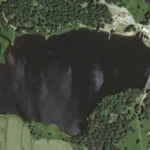
Le Solin autrefois appelé la Vézine, qui y prend sa source dans l’étang de la Bernaudière, faisait tourner quelques moulins qui ont donné son nom au village. Il passe au pied des vestiges d’un château naguère puissamment fortifié, élevé au début du XIIe s. par Blanchard de Lorris, sur cette terre reçue de Louis VI le Gros qui l’avait lui-même acquise de l’abbaye de Fleury (Saint-Benoît-sur-Loire). Un peu plus tard, la terre est retournée au roi Louis VII qui la remet à l’abbé de Saint-Benoît. Ce sont ces religieux qui ont bâti au XIIe s. l’église dédiée à saint Philippe et à saint Loup : ce petit sanctuaire de campagne plein de charme, en partie reconstruit au XIXe s., aujourd’hui remarquablement restauré, a gardé son beau portail roman à arc brisé et pointes de diamant, inscrit aux MH.
English
The Solin, formerly called the Vézine, which has its source in the Bernaudière pond, used to turn some mills that gave its name to the village. It passes at the foot of the vestiges of a formerly strongly fortified castle, built at the beginning of the 12th century by Blanchard de Lorris, on this land received from Louis VI le Gros who had himself acquired it from the abbey of Fleury (Saint-Benoît-sur-Loire). A little later, the land was returned to King Louis VII who gave it to the abbot of Saint-Benoît. In the 12th century, these monks built the church dedicated to Saint Philippe and Saint Loup: this charming little country sanctuary, partly rebuilt in the 19th century, has been remarkably restored and has kept its beautiful Romanesque portal with a pointed arch and diamond points, liste
Deutsch
Der Solin, früher Vézine genannt, entspringt hier im Étang de la Bernaudière und trieb einige Mühlen an, die dem Dorf seinen Namen gaben. Jh. von Blanchard de Lorris auf dem Land errichtet wurde, das er von Ludwig VI. dem Dicken erhalten hatte, der es wiederum von der Abtei Fleury (Saint-Benoît-sur-Loire) erworben hatte. Etwas später fiel das Land wieder an König Ludwig VII. zurück, der es dem Abt von Saint-Benoît übergab. Jh. teilweise wiederaufgebaut und heute bemerkenswert restauriert wurde, hat sein schönes romanisches Portal mit Spitzbogen und Diamantspitzen bewahrt, das in die Liste der Denkmäler aufgenommen wurde.
Dutch
De Solin, vroeger bekend als de Vézine, die ontspringt in de vijver van Bernaudière, liet vroeger verschillende molens draaien waaraan het dorp zijn naam te danken heeft. Hij passeert aan de voet van de overblijfselen van een ooit zwaar versterkt kasteel, gebouwd aan het begin van de 12e eeuw door Blanchard de Lorris, op dit terrein dat hij had gekregen van Lodewijk VI de Dikke, die het zelf had verworven van de abdij van Fleury (Saint-Benoît-sur-Loire). Iets later werd het land teruggegeven aan koning Lodewijk VII, die het aan de abt van Saint-Benoît schonk. In de 12e eeuw bouwden deze monniken de kerk gewijd aan Saint Philippe en Saint Loup: dit charmante kleine plattelandsheiligdom, gedeeltelijk herbouwd in de 19e eeuw en nu opmerkelijk gerestaureerd, heeft zijn prachtige Romaanse porta
Español
El Solin, antiguamente llamado Vézine, que nace en el estanque de Bernaudière, hacía girar varios molinos que dieron nombre al pueblo. Pasa al pie de los restos de un castillo antaño fuertemente fortificado, construido a principios del siglo XII por Blanchard de Lorris, en estas tierras recibidas de Luis VI el Gordo, que a su vez las había adquirido de la abadía de Fleury (Saint-Benoît-sur-Loire). Un poco más tarde, las tierras fueron devueltas al rey Luis VII, quien las entregó al abad de Saint-Benoît. En el siglo XII, estos monjes construyeron la iglesia dedicada a San Felipe y San Loup: este pequeño y encantador santuario rural, parcialmente reconstruido en el siglo XIX y hoy notablemente restaurado, conserva su hermosa portada románica con arco apuntado y puntas de diamante, catalogada
Italiano
Il Solin, anticamente chiamato Vézine, che nasce nello stagno di Bernaudière, faceva girare diversi mulini che hanno dato il nome al villaggio. Passa ai piedi dei resti di un castello un tempo fortemente fortificato, costruito all'inizio del XII secolo da Blanchard de Lorris, su un terreno ricevuto da Luigi VI il Grasso, che lo aveva acquistato dall'abbazia di Fleury (Saint-Benoît-sur-Loire). Poco dopo, il terreno fu restituito al re Luigi VII, che lo donò all'abate di Saint-Benoît. Nel XII secolo, questi monaci costruirono la chiesa dedicata a Saint Philippe e Saint Loup: questo incantevole piccolo santuario di campagna, in parte ricostruito nel XIX secolo e ora notevolmente restaurato, ha conservato il suo bel portale romanico con arco a sesto acuto e punte di diamante, classificato come
, 45290 Le Moulinet-sur-Solin
Crédits: Office de tourisme de Gien