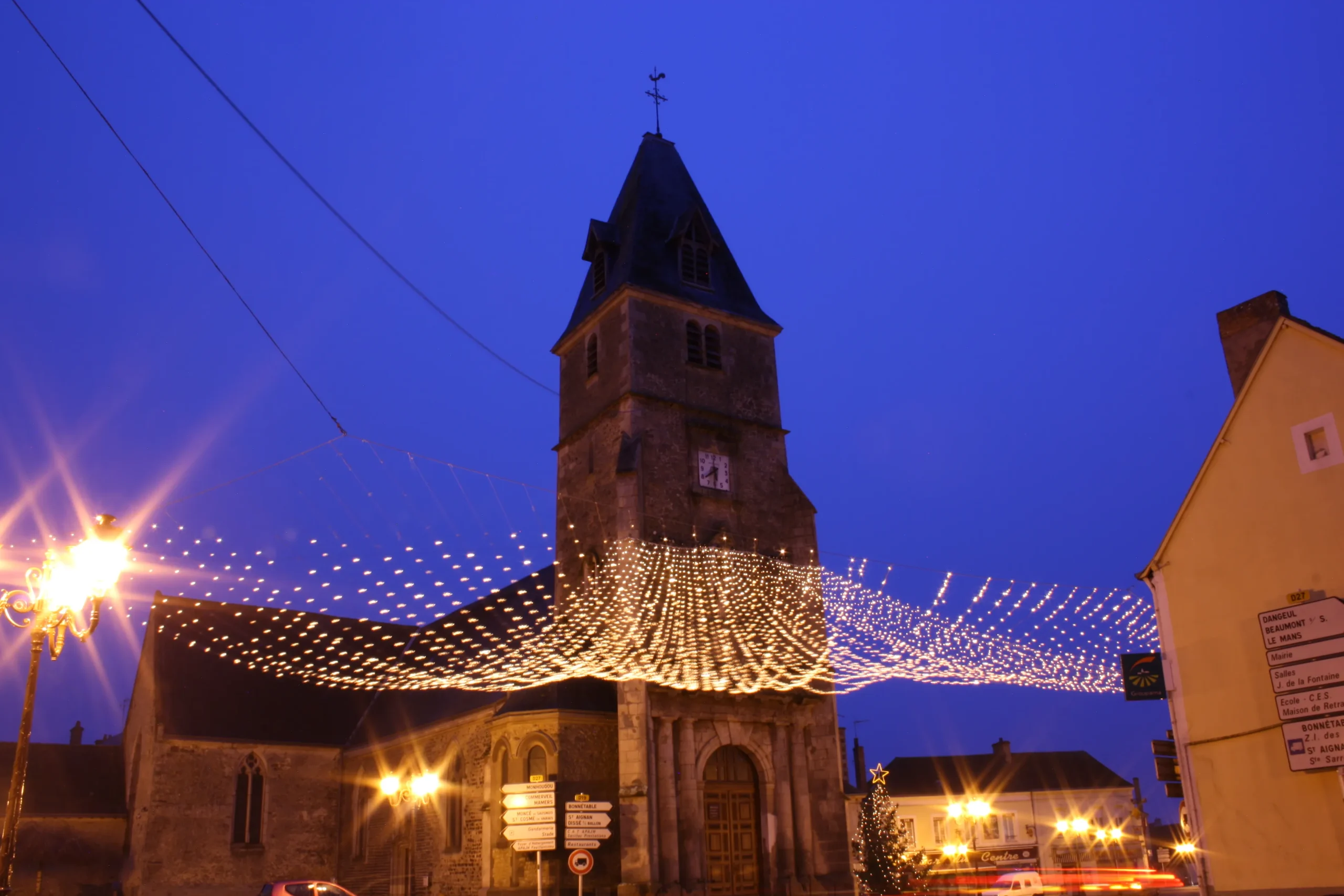
EGLISE SAINT REMY – MAROLLES LES BRAULTS
Description
English
Deutsch
Dutch
Español
Italiano
Description
Construite au XIème siècle, l'église a conservé de cette époque les murs de la nef en appareil de roussard. Les chapelles latérales (XVe) sont percées de fenêtres au remplage flamboyant. Au XVIIe, l'édifice est surélevé par une impressionnante tour clocher. Au XVIIe, grâce à son curé (François Engoulvent), l'église se transforme avec de nombreux travaux et se dote d'un somptueux décor commandé auprès d'artistes réputés. Le curé a financé une partie du mobilier comme le retable du chœur avec la Déploration du Christ (terre cuite du sculpteur manceau Charles Hoyau). Le retable en tuffeau du chœur (classé MH) a, quant à lui, été élevé par l'architecte manceau Henri Guillaune en 1631. Au-dessus, un curieux tableau : le baptême de Clovis (classé MH). On notera également la statue de St François d'Assise en terre cuite et datant de 1635, une statue de St Jean (début XVIIe) et St Rémy (statue en pierre du XVe). Un autre artiste manceau, Josias Crémière est l'auteur des deux retables latéraux en tuffeau.
La Vierge du Rosaire dans la chapelle nord est signée par François Salé, peintre manceau. L'orgue monumental (classé MH) date de 1766, c'est l'abbé Loriot de la Barde qui en a fait don.
English
Built in the 11th century, the church has preserved from this period the walls of the nave as a roussard device. The side chapels (15th century) are pierced by windows with flamboyant fillings. In the 17th century, the building was raised by an impressive bell tower In the 17th century, thanks to its parish priest (François Engoulvent), the church was transformed with numerous works and was given a sumptuous decoration commissioned from famous artists. The parish priest financed part of the furniture such as the altarpiece in the choir with the Deploration of Christ (terracotta by the manceau sculptor Charles Hoyau) The tuffeau altarpiece of the choir (classified MH) was built by the Manceau architect Henri Guillaune in 1631. Above, a curious painting: the baptism of Clovis (listed as a historic monument). Also noteworthy are the terracotta statue of St Francis of Assisi dating from 1635, a statue of St John (early 17th century) and St Remy (15th century stone statue). Another manceau artist, Josias Crémière is the author of the two side altarpieces in tuffeau
The Virgin of the Rosary in the north chapel is signed by François Salé, a manceau painter. The monumental organ (classified MH) dates back to 1766, it was donated by Abbot Loriot de la Barde.
Deutsch
Die Kirche wurde im 11. Jahrhundert erbaut. Aus dieser Zeit stammen noch die Mauern des Kirchenschiffs aus Rousard-Stein. Die Seitenkapellen (15. Jh.) sind von Fenstern mit flamboyanter Füllung durchbrochen. Im 17. Jahrhundert wurde das Gebäude durch einen beeindruckenden Glockenturm erhöht Im 17. Jahrhundert wurde die Kirche dank ihres Pfarrers (François Engoulvent) durch zahlreiche Arbeiten umgestaltet und mit einer prächtigen Ausstattung versehen, die bei berühmten Künstlern in Auftrag gegeben wurde. Der Pfarrer finanzierte einen Teil der Einrichtung wie das Altarbild im Chor mit der Beweinung Christi (Terrakotta des Bildhauers Charles Hoyau aus Manceau) Das Altarbild aus Tuffstein im Chor (als MH klassifiziert) wurde 1631 von dem Architekten Henri Guillaune aus Manceau errichtet. Darüber befindet sich ein kurioses Gemälde: die Taufe von Chlodwig (klassifiziert als MH). Bemerkenswert sind auch die Terrakotta-Statue des Heiligen Franz von Assisi aus dem Jahr 1635, eine Statue des Heiligen Johannes (Anfang 17. Jh.) und des Heiligen Remy (Steinstatue aus dem 15. Jh.). Ein weiterer Künstler aus Manceau, Josias Crémière, ist der Autor der beiden Seitenaltäre aus Tuffstein
Die Rosenkranzmadonna in der Nordkapelle ist von François Salé, einem Maler aus Mance, signiert. Die monumentale Orgel (als MH klassifiziert) stammt aus dem Jahr 1766 und wurde von Abbé Loriot de la Barde gestiftet.
Dutch
De kerk, gebouwd in de 11e eeuw, heeft de muren van het schip, die gemaakt zijn van roussard, behouden. De zijkapellen (15e eeuw) zijn doorboord met flamboyante ramen. In de 17e eeuw werd het gebouw verhoogd met een indrukwekkende klokkentoren In de 17e eeuw werd de kerk, dankzij haar pastoor (François Engoulvent), getransformeerd met talrijke werken en een weelderige decoratie, besteld bij gerenommeerde kunstenaars. De pastoor financierde een deel van het meubilair, zoals het kooraltaarstuk met de Onthulling van Christus (terracotta van de beeldhouwer Charles Hoyau uit Manceau) Het tufstenen altaarstuk in het koor (geklasseerd) werd in 1631 gebouwd door de architect Henri Guillaune uit Mance. Daarboven hangt een merkwaardig schilderij: de doop van Clovis (beschermd als historisch monument). Opmerkelijk zijn ook het terracotta beeld van Sint Franciscus van Assisi uit 1635, een beeld van Sint Jan (begin 17e eeuw) en Sint Remy (stenen beeld uit de 15e eeuw). Een andere kunstenaar uit Mance, Josias Crémière, is de auteur van de twee zijaltaarstukken in tufsteen
De Maagd van de Rozenkrans in de noordelijke kapel is gesigneerd door François Salé, een schilder uit Mance. Het monumentale orgel (dat op de Werelderfgoedlijst staat) dateert uit 1766 en werd geschonken door abt Loriot de la Barde.
Español
Construida en el siglo XI, la iglesia ha conservado los muros de la nave, que son de roussard. Las capillas laterales (siglo XV) están perforadas con ventanas flamígeras. En el siglo XVII, el edificio se elevó con un impresionante campanario En el siglo XVII, gracias a su párroco (François Engoulvent), la iglesia se transformó con numerosas obras y una suntuosa decoración encargada a artistas de renombre. El párroco financió parte del mobiliario, como el retablo del coro con la Deploración de Cristo (terracota del escultor de Manceau Charles Hoyau) El retablo de toba del coro (catalogado como monumento histórico) fue construido por el arquitecto manzano Henri Guillaune en 1631. Encima hay una curiosa pintura: el bautismo de Clodoveo (catalogado como monumento histórico). También destacan la estatua de terracota de San Francisco de Asís, que data de 1635, una estatua de San Juan (principios del siglo XVII) y San Remy (estatua de piedra del siglo XV). Otro artista de Mance, Josias Crémière, es el autor de los dos retablos laterales de toba
La Virgen del Rosario de la capilla norte está firmada por François Salé, pintor de Mance. El órgano monumental (catalogado como Patrimonio de la Humanidad) data de 1766 y fue donado por el abad Loriot de la Barde.
Italiano
Costruita nell'XI secolo, la chiesa ha conservato le pareti della navata centrale, realizzate in roussard. Le cappelle laterali (XV secolo) sono traforate da finestre fiammeggianti. Nel XVII secolo, l'edificio fu sopraelevato con un imponente campanile Nel XVII secolo, grazie al suo parroco (François Engoulvent), la chiesa fu trasformata con numerose opere e una sontuosa decorazione commissionata a rinomati artisti. Il parroco finanziò alcuni arredi, come la pala d'altare del coro con la Deplorazione di Cristo (terracotta dello scultore di Manceau Charles Hoyau) La pala d'altare in tufo del coro (classificata come monumento storico) fu realizzata dall'architetto di Mance Henri Guillaune nel 1631. Sopra di esso si trova un curioso dipinto: il battesimo di Clodoveo (classificato come monumento storico). Da segnalare anche la statua in terracotta di San Francesco d'Assisi del 1635, una statua di San Giovanni (inizio del XVII secolo) e San Remy (statua in pietra del XV secolo). Un altro artista di Mance, Josias Crémière, è l'autore delle due pale laterali in tufo
La Vergine del Rosario nella cappella nord è firmata da François Salé, pittore di Mance. L'organo monumentale (classificato come Patrimonio dell'Umanità) risale al 1766 e fu donato dall'abate Loriot de la Barde.