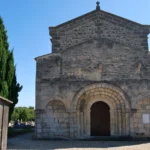
EGLISE SAINT MARTIN – THOIGNÉ
Description
English
Deutsch
Dutch
Español
Italiano
Description
L'église est construite aux XI, XIIeme siècle sur les lieux d'une villa romaine. Son haut mur clocher et son actuelle nef aux remarquables proportions témoignent de l'époque romane. Augmentée à la fin du XVeme de deux chapelles formant un trancept et d'un choeur à chevet plat, elle accueille au XVII-XVIIIeme S trois retables – pierre, terre cuite de style très homogène, signe d'une unité de conception – réalisation.
Bien conservés mais sans émaux, les blasons des seigneurs & dames qui appartiennent aux familles influentes à Thoigné à la fin du XVeme figurent sur l'arc triomphal.
A la fin XIXeme, le choeur est enrichi de deux vitraux en grisaille signalé Fialex et commandés par le marquis Perrochel de Grandchamp dont le blason figure au haut du vitrail.
Dans l'édifice, se trouvent une terre cuite peinte représentant sainte Marguerite et une peinture murale du XVe siècle
English
The church was built in the 11th and 12th centuries on the site of a Roman villa. Its high bell-tower wall and its present nave with remarkable proportions testify to the Romanesque period. Increased at the end of the 15th century by two chapels forming a trancept and a choir with a flat chevet, in the 17th and 18th centuries it housed three altarpieces – stone and terracotta – in a very homogeneous style, a sign of unity of design and execution.
Well preserved but without enamel, the coats of arms of the lords and ladies who belonged to the influential families in Thoigné at the end of the 15th century appear on the triumphal arch.
At the end of the 19th century, the choir was enriched with two stained glass windows in grisaille, signed Fialex and commissioned by the Marquis Perrochel de Grandchamp, whose coat of arms appears at the top of the window.
In the building, there is a painted terracotta representing Saint Marguerite and a 15th century mural painting
Deutsch
Die Kirche wurde im 11. und 12. Jahrhundert auf dem Gelände einer römischen Villa errichtet. Die hohe Glockenturm-Mauer und das heutige Kirchenschiff mit seinen bemerkenswerten Proportionen zeugen von der romanischen Epoche. Jahrhunderts um zwei Kapellen, die ein Triumphbogen bilden, und einen Chor mit flachem Kopfende erweitert. Im 17. und 18. Jahrhundert wurden drei Altarbilder aus Stein und Terrakotta in sehr einheitlichem Stil aufgestellt, was auf eine einheitliche Konzeption und Ausführung hindeutet.
Die Wappen der Herren und Damen, die Ende des 15. Jahrhunderts zu den einflussreichen Familien in Thoigné gehörten, sind auf dem Triumphbogen gut erhalten, aber nicht glasiert.
Ende des 19. Jahrhunderts wurde der Chor mit zwei Grisaille-Fenstern ausgestattet, die von Fialex signalisiert und vom Marquis Perrochel de Grandchamp in Auftrag gegeben wurden, dessen Wappen oben auf dem Fenster zu sehen ist.
Im Gebäude befinden sich ein Terrakottagemälde der heiligen Margarete und ein Wandgemälde aus dem 15
Dutch
De kerk werd in de 11e en 12e eeuw gebouwd op de plaats van een Romeinse villa. De hoge klokkentoren en het huidige schip met zijn opmerkelijke afmetingen getuigen van de romaanse periode. Aan het einde van de 15e eeuw werden twee kapellen toegevoegd om een trancept en een koor met plat chevet te vormen. In de 17e en 18e eeuw werden drie altaarstukken – van steen en terracotta – toegevoegd in een zeer homogene stijl, een teken van eenheid in ontwerp en uitvoering.
De wapens van de heren en dames die behoorden tot de invloedrijke families in Thoigné aan het eind van de 15e eeuw zijn goed bewaard gebleven, maar niet geëmailleerd, en staan op de triomfboog.
Aan het eind van de 19e eeuw werd het koor verrijkt met twee gebrandschilderde ramen in grisaille, gesigneerd Fialex en in opdracht van de markies Perrochel de Grandchamp, wiens wapen bovenaan het raam staat.
In het gebouw bevindt zich een beschilderde terracotta die de heilige Marguerite voorstelt en een muurschildering uit de 15e eeuw
Español
La iglesia fue construida en los siglos XI y XII en el emplazamiento de una villa romana. Su alto muro del campanario y su nave actual, de notables proporciones, son testigos del periodo románico. A finales del siglo XV se añadieron dos capillas para formar un trancepto y un coro con una cabecera plana. En los siglos XVII y XVIII se añadieron tres retablos -de piedra y terracota- de estilo muy homogéneo, signo de unidad en el diseño y la ejecución.
Bien conservados, pero sin esmaltes, los escudos de armas de los señores y damas que pertenecían a las familias influyentes de Thoigné a finales del siglo XV aparecen en el arco del triunfo.
A finales del siglo XIX, el coro se enriqueció con dos vidrieras en grisalla, diseñadas por Fialex y encargadas por el marqués Perrochel de Grandchamp, cuyo escudo aparece en la parte superior de la vidriera.
En el edificio hay una terracota pintada que representa a Santa Margarita y una pintura mural del siglo XV
Italiano
La chiesa fu costruita nei secoli XI e XII sul sito di una villa romana. L'alto muro del campanile e l'attuale navata, con le sue notevoli proporzioni, testimoniano il periodo romanico. Alla fine del XV secolo, furono aggiunte due cappelle per formare un transetto e un coro con un chevet piatto. Nel XVII e XVIII secolo, furono aggiunte tre pale d'altare – in pietra e in terracotta – in uno stile molto omogeneo, segno di unità progettuale ed esecutiva.
Ben conservati ma privi di smalti, gli stemmi dei signori e delle signore che appartenevano alle famiglie influenti di Thoigné alla fine del XV secolo compaiono sull'arco trionfale.
Alla fine del XIX secolo, il coro fu arricchito da due vetrate a grisaglia, disegnate da Fialex e commissionate dal marchese Perrochel de Grandchamp, il cui stemma compare nella parte superiore della finestra.
Nell'edificio si trovano una terracotta dipinta raffigurante Santa Margherita e una pittura murale del XV secolo