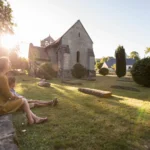
Eglise Saint-Martial de Lestards – Lestards
Description
English
Deutsch
Dutch
Español
Italiano
Description
Au début du 14e siècle, Lestards était sous le patronage de la commanderie de Saint-Antoine de Viennois. L'église a des supports romans et des voûtes en berceau de la fin 12e-début 13e siècle. La voûte en croisée d'ogives au carré du transept date du 15e ou du 16e siècle. La façade ouest d'entrée est un clocher mur-pignon, flanqué de quatre contreforts sur les angles. L' édifice est couvert par un toit de chaume (unique en France). Son décor intérieur (chapiteaux sculptés) a été remis en valeur par une restauration récente. Accès libre, de 8h à 19h.
Visite pour les groupes sur réservation toute l'année.
English
In the early 14th century, Lestards was under the patronage of the Commandery of Saint-Antoine de Viennois. The church has Romanesque supports and barrel vaults dating from the late 12th-early 13th centuries. The cross vault in the transept square dates from the 15th or 16th century. The west entrance facade is a wall-gabled bell tower, flanked by four corner buttresses. The building has a thatched roof (unique in France). Its interior decoration (sculpted capitals) has been enhanced by recent restoration work. Free admission, 8am to 7pm.
Group visits by prior arrangement all year round.
Deutsch
Zu Beginn des 14. Jahrhunderts stand Lestards unter der Schirmherrschaft der Komturei von Saint-Antoine de Viennois. Die Kirche hat romanische Stützen und ein Tonnengewölbe aus dem späten 12. bis frühen 13. Das Kreuzrippengewölbe im Viereck des Querschiffs stammt aus dem 15. oder 16. Die westliche Eingangsfassade ist ein Glockenturm mit Giebelwand, der an den Ecken von vier Strebepfeilern flankiert wird. Das Gebäude ist mit einem Strohdach gedeckt (einzigartig in Frankreich). Die Innenausstattung (geschnitzte Kapitelle) wurde bei einer kürzlich durchgeführten Restaurierung wieder zur Geltung gebracht. Freier Zugang von 8 bis 19 Uhr.
Gruppen können das ganze Jahr über nach vorheriger Anmeldung das Gebäude besichtigen.
Dutch
In het begin van de 14e eeuw viel Lestards onder het beschermheerschap van de commanderij Saint-Antoine de Viennois. De kerk heeft romaanse steunberen en tongewelven uit de late 12e en vroege 13e eeuw. Het geribde gewelf in het vierkant van het dwarsschip dateert uit de 15e of 16e eeuw. De gevel van de westelijke ingang bestaat uit een klokkentoren met een muur, geflankeerd door vier steunberen op de hoeken. Het gebouw heeft een rieten dak (uniek in Frankrijk). De binnendecoratie (gebeeldhouwde kapitelen) is verbeterd door recente restauratiewerkzaamheden. Gratis toegang van 8.00 tot 19.00 uur.
Groepsbezoeken op afspraak het hele jaar door.
Español
A principios del siglo XIV, Lestards estaba bajo el patronato de la encomienda de Saint-Antoine de Viennois. La iglesia tiene soportes románicos y bóvedas de cañón que datan de finales del siglo XII y principios del XIII. La bóveda de crucería de la plaza del crucero data del siglo XV o XVI. La fachada de la entrada oeste es un campanario a dos aguas, flanqueado por cuatro contrafuertes en las esquinas. El edificio tiene un tejado de paja (único en Francia). Su decoración interior (capiteles esculpidos) ha sido realzada por recientes obras de restauración. Entrada gratuita, de 8.00 a 19.00 h.
Visitas de grupos concertadas todo el año.
Italiano
All'inizio del XIV secolo, Lestards era sotto il patronato della Commenda di Saint-Antoine de Viennois. La chiesa presenta sostegni romanici e volte a botte risalenti alla fine del XII e all'inizio del XIII secolo. La volta a crociera nella piazza del transetto risale al XV o XVI secolo. La facciata dell'ingresso occidentale è costituita da un campanile a vela, affiancato da quattro contrafforti agli angoli. L'edificio ha un tetto di paglia (unico in Francia). La decorazione interna (capitelli scolpiti) è stata valorizzata da recenti lavori di restauro. Ingresso libero, dalle 8.00 alle 19.00.
Visite di gruppo su prenotazione tutto l'anno.