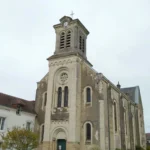
Eglise Saint-Gervais – Saint-Gervais-en-Vallière
Description
English
Deutsch
Dutch
Español
Italiano
Description
L'église est placée sous le patronage de saint Gervais (de Chalon), un diacre assassiné dans la forêt environnante, alors qu'il retournait dans son pays, la ville du Mans, au retour d'un pèlerinage à Rome. L'évêque de Chalon fit construire dès le VIIème siècle une chapelle sur le lieu de son supplice. L'église actuelle date du XIVème.
English
The church is placed under the patronage of Saint Gervais (of Chalon), a deacon who was murdered in the surrounding forest, while returning to his country, the city of Le Mans, after a pilgrimage to Rome. The bishop of Chalon had a chapel built in the 7th century on the site of his torture. The present church dates from the 14th century.
Deutsch
Die Kirche steht unter dem Patronat des heiligen Gervasius (von Chalon), eines Diakons, der im umliegenden Wald ermordet wurde, als er auf dem Rückweg von einer Pilgerreise nach Rom in seine Heimat, die Stadt Le Mans, zurückkehrte. Der Bischof von Chalon ließ bereits im 7. Jahrhundert eine Kapelle an der Stelle errichten, an der er gefoltert wurde. Die heutige Kirche stammt aus dem 14.
Dutch
De kerk staat onder de bescherming van de heilige Gervais (van Chalon), een diaken die in het omringende bos werd vermoord toen hij van een pelgrimstocht naar Rome terugkeerde naar zijn land, de stad Le Mans. De bisschop van Chalon liet in de 7e eeuw een kapel bouwen op de plaats van zijn executie. De huidige kerk dateert uit de 14e eeuw.
Español
La iglesia está bajo la advocación de San Gervais (de Chalon), un diácono que fue asesinado en el bosque circundante cuando regresaba a su país, la ciudad de Le Mans, de una peregrinación a Roma. El obispo de Chalon hizo construir una capilla en el siglo VII en el lugar de su tortura. La iglesia actual data del siglo XIV.
Italiano
La chiesa è posta sotto il patronato di San Gervais (di Chalon), un diacono che fu assassinato nella foresta circostante mentre tornava al suo paese, la città di Le Mans, da un pellegrinaggio a Roma. Il vescovo di Chalon fece costruire una cappella nel VII secolo sul luogo del suo supplizio. La chiesa attuale risale al XIV secolo.
Equipements: Parking
Place de l'Église, 71350 Saint-Gervais-en-Vallière