Eglise Saint-Denis-de-Jouhet – Saint-Denis-de-Jouhet
Description
English
Deutsch
Dutch
Español
Italiano
Description
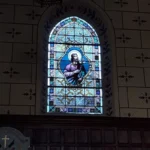
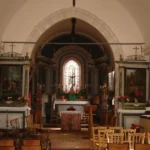
A la fin du XIIe s, elle connaît une phase de reconstruction et possède alors 2 travées de nef romane, prolongées d'un chœur droit et terminées par un chevet plat. Le clocher octogonal est érigé postérieurement sur la 1ère travée de la nef, augmentée de 3 travées au XIIIe s. Le portail en arc brisé ouvert au sud est dépourvu de tympan. A l'intérieur de l'édifice, où se ressentent les influences limousines, se trouvent des vitraux des XIIe-XIIIe s. Ceux-ci mettent en scène dans des médaillons divers épisodes de la légende de Saint-Denis. L'évêque est identifié par des inscriptions qui accompagnent les représentations de sa prédication et de son martyre. Ces lancettes sont couronnées d'une grande rosace de Lucien-Léopold Lobin d'une belle réussite chromatique.
English
At the end of the 12th century, it underwent a reconstruction phase and then had two bays in the Romanesque nave, extended by a straight choir and ending with a flat apse. The octagonal bell tower was erected later on the first bay of the nave, increased to three bays in the 13th century. The south-opening pointed arch portal lacks a tympanum. Inside the building, where Limousin influences can be felt, there are 12th-13th century stained glass windows. These stage the different episodes of the legend of St. Denis in the medallions. The bishop is identified by inscriptions accompanying the representations of his preaching and martyrdom. These lancets are crowned with Lucien-Leopold Lobin's large rose window, a great success in terms of colours.
Deutsch
Jh. wurde die Kirche umgebaut und besaß nun ein romanisches Kirchenschiff mit zwei Jochen, einem geraden Chor und einem flachen Kopfende. Der achteckige Glockenturm wurde später über dem ersten Joch des Kirchenschiffs errichtet, das im 13. Jahrhundert um drei Joch erweitert wurde. Das nach Süden offene Spitzbogenportal hat kein Tympanon. Im Inneren des Gebäudes, das von limousinischen Einflüssen geprägt ist, befinden sich Glasmalereien aus dem 12. bis 13. Jahrhundert. Diese stellen in Medaillons verschiedene Episoden aus der Legende von Saint-Denis dar. Der Bischof wird durch Inschriften identifiziert, die die Darstellungen seiner Predigt und seines Martyriums begleiten. Die Lanzettfenster werden von einer großen Rosette von Lucien-Léopold Lobin gekrönt, deren Farbgebung sehr gelungen ist.
Dutch
Aan het eind van de 12e eeuw onderging het een verbouwingsfase en had toen twee traveeën met een romaans schip, uitgebreid met een recht koor en eindigend met een plat chevet. De achthoekige klokkentoren werd later gebouwd op de eerste travee van het schip, dat in de 13e eeuw met drie traveeën werd uitgebreid. Het naar het zuiden geopende spitsboogportaal heeft geen timpaan. In het gebouw, waar de Limousin-invloeden voelbaar zijn, bevinden zich glas-in-loodramen uit de 12e-13e eeuw. Deze tonen verschillende episodes uit de legende van Saint-Denis in medaillons. De bisschop wordt geïdentificeerd door inscripties bij de afbeeldingen van zijn prediking en martelaarschap. Deze lancetten worden bekroond door een groot roosvenster van Lucien-Léopold Lobin, dat qua kleur een groot succes is.
Español
A finales del siglo XII, se sometió a una fase de reconstrucción y pasó a tener dos tramos de nave románica, prolongada por un coro recto y terminada con una cabecera plana. El campanario octogonal se erigió posteriormente en la primera nave, que se amplió en tres tramos en el siglo XIII. El portal de arco apuntado abierto al sur no tiene tímpano. En el interior del edificio, donde se notan las influencias lemosinas, hay vidrieras de los siglos XII-XIII. Estos muestran varios episodios de la leyenda de Saint-Denis en medallones. El obispo está identificado por las inscripciones que acompañan a las representaciones de su predicación y martirio. Estas lancetas están coronadas por un gran rosetón de Lucien-Léopold Lobin, que es un gran éxito de color.
Italiano
Alla fine del XII secolo, subì una fase di ricostruzione e si presentò con due campate di navata romanica, prolungate da un coro rettilineo e terminanti con un chevet piatto. Il campanile ottagonale fu eretto più tardi sulla prima campata della navata, che fu ampliata di tre campate nel XIII secolo. Il portale a sesto acuto aperto a sud è privo di timpano. All'interno dell'edificio, dove si avvertono le influenze del Limousin, si trovano vetrate del XII-XIII secolo. Questi mostrano vari episodi della leggenda di Saint-Denis in medaglioni. Il vescovo è identificato da iscrizioni che accompagnano le raffigurazioni della sua predicazione e del suo martirio. Queste monofore sono coronate da un grande rosone di Lucien-Léopold Lobin, che riscuote un grande successo in termini di colore.
Roman
Equipements: Bar
4 place de l'église, 36230 Saint-Denis-de-Jouhet

Crédits: G. Trible