Eglise Saint Austrégésile – Berry Roman – Saint-Outrille
Description
English
Deutsch
Dutch
Español
Italiano
Description
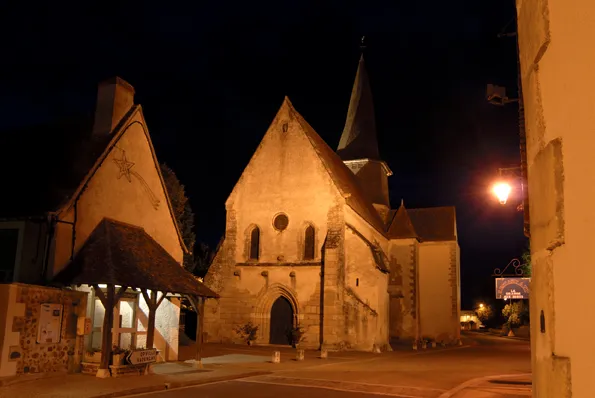
Il présente un chevet remarquable bien visible depuis l'espace vert à l’est. Il se conforme au plan bénédictin dominant en Berry datant de la fin du XIe siècle. L’abside, percée de larges fenêtres, offre un décor assez archaïque d’arcatures aveugles reposant sur des pilastres plats ornés d’entrelacs. Seule la partie inférieure du mur est épaulée de contreforts. À l’intérieur, les chapiteaux des arcades du chœur s’inspirent librement des motifs corinthiens et reposent sur des colonnes galbées monolithes. L’affaissement accidentel de l’arc triomphal est sans doute contemporain de l’écroulement de la nef primitive, reconstruite au XVe siècle, ainsi que la façade. Depuis 1999 l'édifice a subi des travaux de consolidation et de restauration des maçonneries.
English
It also boasts a remarkable chevet which can be admired from the grassy area to the East. It follows the Benedictine layout common in Berry in the late 11th century. The apse has large windows is decorated in a rather archaic style with blind arcades resting on flat pilasters decorated with interlacing. Only the lower part of the wall is supported by buttresses. Inside, the capitals of the arcades in the choir are loosely inspired by the Corinthian style and rest on rounded monolithic columns. The unfortunate subsidence of the triumphal arch occurred no doubt at the same time as the collapse of the early nave, which was rebuilt in the 15th century alongside the facade. Since 1999 the building has been undergoing structural reinforcement and restoration work.
Deutsch
Sie hat einen bemerkenswerten Kopfteil, der von der Grünfläche im Osten aus gut sichtbar ist. Er entspricht dem in Berry vorherrschenden Benediktinerplan aus dem späten 11. Die von großen Fenstern durchbrochene Apsis weist eine recht archaische Dekoration mit Blendbögen auf, die auf flachen, mit Flechtwerk verzierten Pilastern ruhen. Nur der untere Teil der Mauer ist mit Strebepfeilern versehen. Im Inneren sind die Kapitelle der Arkaden des Chors frei von korinthischen Motiven und ruhen auf monolithischen, geschwungenen Säulen. Das versehentliche Absinken des Triumphbogens war wahrscheinlich zeitgleich mit dem Einsturz des ursprünglichen Kirchenschiffs, das im 15. Jahrhundert zusammen mit der Fassade wieder aufgebaut wurde. Seit 1999 wurde das Gebäude konsolidiert und das Mauerwerk restaur
Dutch
Het heeft een opmerkelijke chevet die duidelijk zichtbaar is vanaf de groene ruimte in het oosten. Het is in overeenstemming met het dominante benedictijnse plan in Berry dat dateert van het einde van de 11e eeuw. De apsis, doorboord door grote ramen, heeft een nogal archaïsche decoratie van blinde arcaturen die rusten op platte pilasters versierd met vlechtwerk. Alleen het onderste deel van de muur wordt ondersteund door steunberen. Binnen zijn de kapitelen van de koorbogen vrij geïnspireerd op Korinthische motieven en rusten ze op monolithische gebogen zuilen. De toevallige instorting van de triomfboog valt waarschijnlijk samen met de instorting van het oorspronkelijke schip, dat in de 15e eeuw werd herbouwd, en van de voorgevel. Sinds 1999 heeft het gebouw consolidatie- en restauratiewe
Español
Cuenta con un notable chevet que es claramente visible desde el espacio verde al este. Se ajusta al plan benedictino dominante en Berry que data de finales del siglo XI. El ábside, perforado por grandes ventanales, presenta una decoración bastante arcaica de arcadas ciegas que descansan sobre pilastras planas decoradas con entrelazos. Sólo la parte inferior del muro está sostenida por contrafuertes. En el interior, los capiteles de las arcadas del coro se inspiran libremente en motivos corintios y descansan sobre columnas curvas monolíticas. El derrumbe accidental del arco de triunfo es probablemente contemporáneo del derrumbe de la nave original, reconstruida en el siglo XV, así como de la fachada. Desde 1999, el edificio ha sido objeto de trabajos de consolidación y restauración de la ma
Italiano
Ha un chevet notevole, ben visibile dallo spazio verde a est. È conforme alla pianta benedettina dominante nel Berry, risalente alla fine dell'XI secolo. L'abside, traforata da grandi finestre, presenta una decorazione piuttosto arcaica di arcatelle cieche che poggiano su lesene piatte decorate a intreccio. Solo la parte inferiore del muro è sostenuta da contrafforti. All'interno, i capitelli delle arcate del coro sono liberamente ispirati a motivi corinzi e poggiano su colonne monolitiche ricurve. Il crollo accidentale dell'arco trionfale è probabilmente contemporaneo al crollo della navata originaria, ricostruita nel XV secolo, e della facciata. Dal 1999 l'edificio è stato sottoposto a lavori di consolidamento e restauro delle murature.
Roman
Equipements: Parking
Rue de l'Eglise, 18310 Saint-Outrille
Crédits: © Mairie Saint-Outrille
