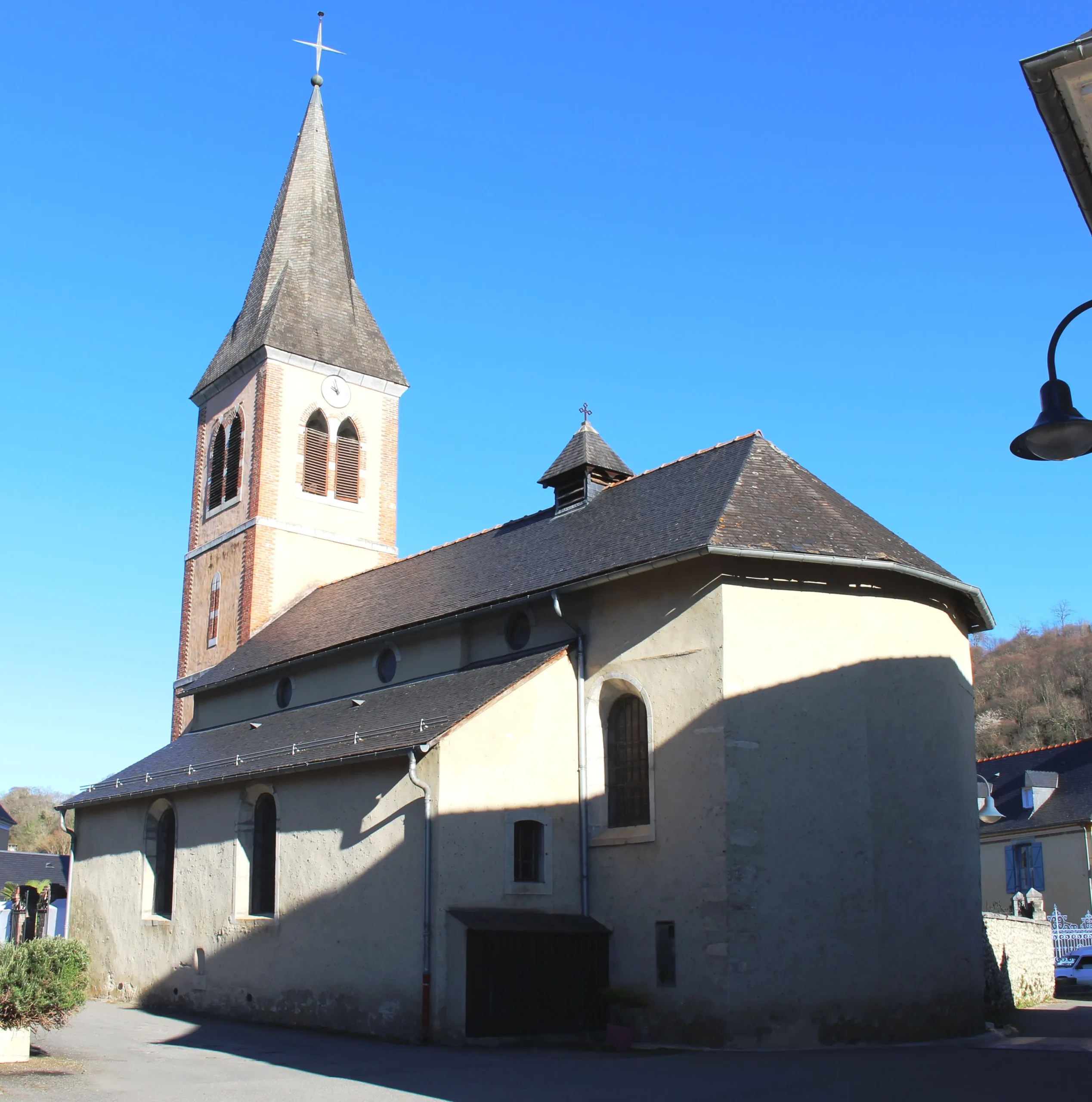
ÉGLISE DE LEZIGNAN
Description
English
Deutsch
Dutch
Español
Italiano
Description
Église de la Toussaint au clocher-porche. Construite fin XVIIe siècle, elle a été largement remaniée, surtout le clocher, au XIXe siècle. On accède à l'intérieur par un porche classique de la fin du XVIIe siècle, en marchant sur des dalles tombales.
Très beau retable. Si le panneau central d'origine inconnue est daté de 1690, date mentionnée sur le panneau d'information, les panneaux latéraux sont attribués à Jean Ferrère : colonnes torses, rinceaux et grappes très baroques. Le superbe panneau central et le tabernacle, eux, seraient de Dominique Ferrère (donc plus tardif). Ce panneau représente l’Assomption de la Vierge. Il est encadré d’un évêque et de Saint-Jean. Armoire baptismale.
English
Church of All Saints' Day with bell-tower-porch. Built at the end of the 17th century, it was largely rebuilt, especially the bell tower, in the 19th century. The interior is accessed through a classical porch from the late 17th century, walking on tombstones.
Beautiful altarpiece. While the central panel of unknown origin is dated 1690, the date mentioned on the information panel, the side panels are attributed to Jean Ferrère: torsos columns, scrolls and very baroque clusters. The superb central panel and the tabernacle, on the other hand, are said to be by Dominique Ferrère (thus later). This panel represents the Assumption of the Virgin. It is framed by a bishop and Saint John. Baptismal cupboard.
Deutsch
Allerheiligenkirche mit Glockenturm und Portal. Die Ende des 17. Jahrhunderts erbaute Kirche wurde im 19. Jahrhundert stark umgebaut, vor allem der Glockenturm. Das Innere erreicht man durch eine klassische Vorhalle aus dem späten 17. Jahrhundert, wobei man über Grabplatten läuft.
Sehr schönes Altarbild. Während die Mitteltafel unbekannter Herkunft auf das Jahr 1690 datiert ist, ein Datum, das auf der Informationstafel erwähnt wird, werden die Seitentafeln Jean Ferrère zugeschrieben: sehr barocke gedrehte Säulen, Ranken und Trauben. Die wunderschöne Mitteltafel und der Tabernakel hingegen sollen von Dominique Ferrère stammen (also später). Die Tafel stellt die Himmelfahrt der Jungfrau Maria dar. Es wird von einem Bischof und dem Heiligen Johannes eingerahmt. Taufschrank.
Dutch
Kerk van Allerheiligen met klokkentoren en portiek. Gebouwd aan het eind van de 17e eeuw, werd het in de 19e eeuw ingrijpend verbouwd, met name de klokkentoren. Het interieur is toegankelijk via een klassiek portaal uit het einde van de 17e eeuw, door over grafstenen te lopen.
Het altaarstuk is erg mooi. Terwijl het centrale paneel van onbekende oorsprong is gedateerd op 1690, de datum die op het informatiepaneel wordt vermeld, worden de zijpanelen toegeschreven aan Jean Ferrère: gedraaide zuilen, gebladerte en zeer barokke druiven. Het prachtige centrale paneel en het tabernakel daarentegen zouden van Dominique Ferrère zijn (dus later). Dit paneel stelt de Maria Hemelvaart voor. Het is ingelijst door een bisschop en St John. Doopkast.
Español
Iglesia de Todos los Santos con campanario y pórtico. Construido a finales del siglo XVII, fue ampliamente remodelado, especialmente el campanario, en el siglo XIX. Se accede al interior a través de un pórtico clásico de finales del siglo XVII, caminando sobre las lápidas.
El retablo es muy hermoso. Mientras que el panel central de origen desconocido está fechado en 1690, fecha mencionada en el panel informativo, los paneles laterales se atribuyen a Jean Ferrère: columnas retorcidas, follaje y uvas muy barrocas. El magnífico panel central y el tabernáculo, en cambio, son obra de Dominique Ferrère (por tanto, posterior). Este panel representa la Asunción de la Virgen. Está enmarcada por un obispo y San Juan. Gabinete de bautismo.
Italiano
Chiesa di Ognissanti con campanile e portico. Costruita alla fine del XVII secolo, è stata ampiamente ristrutturata, soprattutto il campanile, nel XIX secolo. All'interno si accede attraverso un portico classico della fine del XVII secolo, camminando sulle lapidi.
La pala d'altare è molto bella. Mentre il pannello centrale di origine sconosciuta è datato 1690, data riportata sul pannello informativo, i pannelli laterali sono attribuiti a Jean Ferrère: colonne tortili, fogliame e uva molto barocca. Il superbo pannello centrale e il tabernacolo, invece, sarebbero opera di Dominique Ferrère (quindi più tardi). Questo pannello rappresenta l'Assunzione della Vergine. È incorniciato da un vescovo e da San Giovanni. Armadio battesimale.