Eglise abbatiale de La Trinité Porhoët – La Trinité-Porhoët
Description
English
Deutsch
Dutch
Español
Italiano
Description
Patrimoine culturel
English
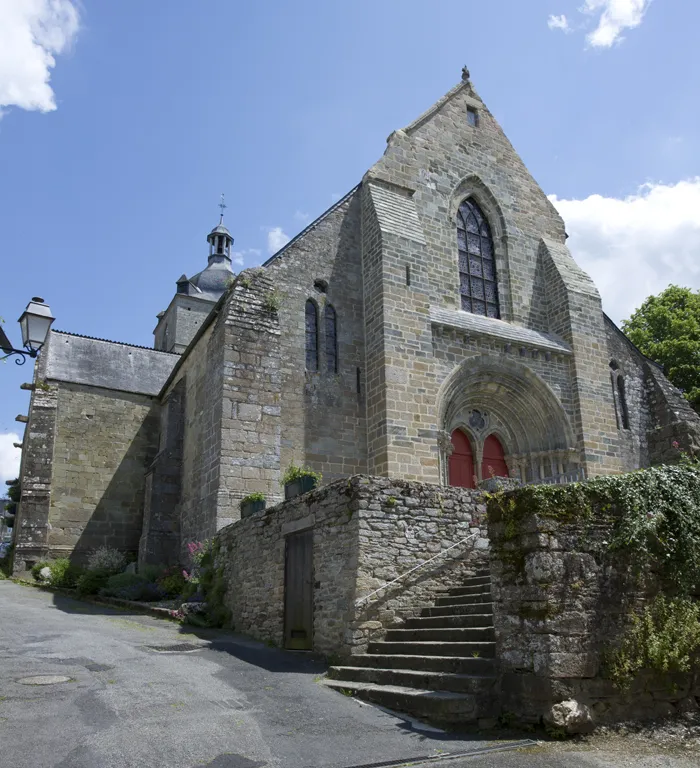
Church dating from the year 1000, with a nave in Gothic and Romanesque styles.
A vast edifice built on a steep slope: the climb to the choir is surprising.
Superb tree of Jesse, with shimmering colors. With its imposing western portal, the church has been listed as a Monument Historique since 1914.
Altered several times over the centuries, it retains its original Romanesque structure: a large nave with two aisles, a transept with two crosses and a rectangular choir with a flat chevet.
Its interior dimensions are imposing: 45m long, 16m wide, 11m50 to 14m50 high. Inside, Romanesque (north side) and Gothic (south side) styles coexist. The imposing edifice leans to the south, and we literally have to climb up to the choir, as the slope is so steep.
The most admired part is the Tree of Jesse, dating from 1675. Located in the choir, the Baroque-style tree was carved in wood and terracotta by Italian sculptors. It symbolizes the family tree of Jesus. At the foot of the tree is Jesse, Christ?s most ancient ancestor, and at the top, Jesus emerging in glory from his tomb.
At the base of the tree is a gilded wooden altarpiece. It comes from the Château de Bodegat in Mohon. It was donated to the church of La Trinité-Porhoët by the Marquise Madame de Sévigné, when she decided to abandon her château, which was in a very poor state of repair. Free admission and guided tours for groups. Open daily, 9am-6pm, by local residents.
Deutsch
Kirche aus dem Jahr 1000, deren Schiff im gotischen und romanischen Stil erbaut wurde.
Großes Gebäude, das auf einem starken Höhenunterschied errichtet wurde: Der Aufstieg zum Chor ist überraschend.
Wunderschöner, farbenprächtiger Jessebaum. Aufgrund ihres imposanten Westportals ist die Kirche seit 1914 als historisches Monument klassifiziert.
Die Kirche wurde im Laufe der Jahrhunderte mehrmals umgebaut, hat jedoch ihre ursprüngliche romanische Struktur bewahrt: ein großes Kirchenschiff mit zwei Seitenschiffen, ein Querschiff mit zwei Kreuzungen und ein rechteckiger Chor mit flachem Kopfende.
Die Innenmaße sind beeindruckend: 45 m lang, 16 m breit und zwischen 11,50 und 14,50 m hoch. Im Inneren finden sich romanische (Nordseite) und gotische (Südseite) Stilelemente nebeneinander. Das imposante Gebäude neigt sich nach Süden und wir müssen buchstäblich zum Chor hinaufsteigen, da die Steigung so groß ist.
Der am meisten bewunderte Teil ist der Baum Jesse aus dem Jahr 1675. Er befindet sich im Chorraum und wurde von italienischen Bildhauern im Barockstil aus Holz und Terrakotta gefertigt. Er symbolisiert den Stammbaum Jesu. An seinem Fuß befindet sich Jesse, der älteste Vorfahre Christi, und an seiner Spitze Jesus, der in Herrlichkeit aus seinem Grab steigt.
Am Fuß des Jesse-Baums befindet sich ein Altaraufsatz aus vergoldetem Holz. Dieser stammt aus dem Schloss Bodegat in Mohon. Es wurde der Kirche von La Trinité-Porhoët von der Marquise Madame de Sévigné geschenkt, als sie beschloss, ihr Schloss zu verlassen, das sich in einem sehr schlechten Zustand befand. Freie und kostenlose Besichtigung und Möglichkeit von kostenpflichtigen Führungen für Gruppen. Täglich von 9 bis 18 Uhr von den Einwohnern geöffnet.
Dutch
Cultureel erfgoed
Español
Iglesia del año 1000, con una nave de estilos gótico y románico.
Un vasto edificio construido en una pendiente pronunciada: la subida al coro es sorprendente.
Soberbio árbol de Jesé, de colores resplandecientes. Con su imponente portal occidental, la iglesia está clasificada como Monumento Histórico desde 1914.
Aunque ha sufrido varias modificaciones a lo largo de los siglos, conserva su estructura románica original: una gran nave con dos tramos, un crucero con dos cruces y un coro rectangular con cabecera plana.
Sus dimensiones interiores son imponentes: 45 m de largo, 16 m de ancho, 11,5 m a 14,5 m de alto. En el interior se mezclan los estilos románico (lado norte) y gótico (lado sur). El imponente edificio se inclina hacia el sur y hay que subir literalmente hasta el coro, ya que la pendiente es muy pronunciada.
La parte más admirada es el Árbol de Jesé, que data de 1675. Situado en el coro, fue realizado en madera y terracota por escultores italianos de estilo barroco. Simboliza el árbol genealógico de Jesús. A los pies del árbol está Jesé, el antepasado más antiguo de Cristo, y en la cima está Jesús emergiendo glorioso de su tumba.
En la base del árbol de Jesé hay un retablo de madera dorada. Procede del castillo de Bodegat, en Mohon. Fue regalado a la iglesia de la Trinité-Porhoët por la marquesa Madame de Sévigné cuando decidió abandonar su castillo en muy mal estado. Visita gratuita y posibilidad de pagar visitas guiadas para grupos. Abierto todos los días de 9 a 18 h, por los habitantes.
Italiano
Chiesa risalente all'anno 1000, a navata unica in stile gotico e romanico.
Un vasto edificio costruito su un ripido pendio: la salita al coro è sorprendente.
Superbo l'albero di Jesse, dai colori scintillanti. Con il suo imponente portale occidentale, la chiesa è classificata come Monumento Storico dal 1914.
Sebbene sia stata più volte modificata nel corso dei secoli, conserva ancora la sua struttura romanica originale: un'ampia navata con due navate laterali, un transetto con due croci e un coro rettangolare con un chevet piatto.
Le dimensioni interne sono imponenti: 45 m di lunghezza, 16 m di larghezza, 11,5-14,5 m di altezza. All'interno si mescolano gli stili romanico (lato nord) e gotico (lato sud). L'imponente edificio è inclinato verso sud e bisogna letteralmente arrampicarsi per raggiungere il coro, dato che il pendio è molto ripido.
La parte più ammirata è l'Albero di Jesse, risalente al 1675. Situato nel coro, è stato realizzato in legno e terracotta da scultori italiani in stile barocco. Simboleggia l'albero genealogico di Gesù. Ai piedi dell'albero c'è Jesse, il più antico antenato di Cristo, e in cima c'è Gesù che emerge in gloria dalla sua tomba.
Alla base dell'albero di Jesse si trova una pala d'altare in legno dorato. Proviene dal castello di Bodegat, a Mohon. Fu donata alla chiesa di La Trinité-Porhoët dalla marchesa Madame de Sévigné quando decise di abbandonare il suo castello in pessimo stato. Visita gratuita e possibilità di visite guidate a pagamento per gruppi. Aperto tutti i giorni dalle 9 alle 18, a cura degli abitanti.
Place du Martray, 56490 La Trinité-Porhoët
Crédits: CCPorhoet
CC BY-SA 3.0
CC BY-SA 3.0