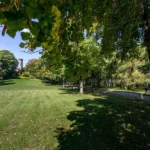
Château du Schlossberg – Forbach
Description
English
Deutsch
Dutch
Español
Italiano
Description
Première mention en 1257, dans un acte de donation en faveur de la collégiale de Hombourg-Haut. Il comportait un donjon carré, une enceinte et un palais, agrandi et fortifié au fil des siècles. Au XIVe s. il se présente comme une forteresse-palais de style Renaissance. La tour ronde « Saareck » fut élevée en 1437, l’actuelle tour octogonale en 1891. Jusqu’au XVIIe siècle, le château fut transformé et complété par des bastions. Suite au pillage de la tour ronde en 1591, il fut réaménagé, puis définitivement rasé en 1634 par le Maréchal de la Force, sur ordre de Richelieu et du roi Louis XIII.
English
First mention in 1257, in a deed of donation to the collegiate church of Hombourg-Haut. It consisted of a square keep, an enclosure and a palace, enlarged and fortified over the centuries. In the 14th c. it is presented as a fortress-palace in Renaissance style. The round "Saareck" tower was erected in 1437, the current octagonal tower in 1891. Until the 17th century, the castle was transformed and completed with bastions. Following the looting of the round tower in 1591, it was refurbished, then definitively razed to the ground in 1634 by the Marshal of the Force, on the orders of Richelieu and King Louis XIII.
Deutsch
Erste Erwähnung 1257 in einer Schenkungsurkunde zugunsten der Stiftskirche von Hombourg-Haut. Sie bestand aus einem quadratischen Bergfried, einer Ringmauer und einem Palast, der im Laufe der Jahrhunderte erweitert und befestigt wurde. Im 14. Jh. präsentierte er sich als Festung-Palast im Renaissance-Stil. Der runde Turm "Saareck" wurde 1437 errichtet, der heutige achteckige Turm 1891. Bis zum 17. Jahrhundert wurde die Burg umgebaut und durch Bastionen ergänzt. Nach der Plünderung des runden Turms im Jahr 1591 wurde sie umgebaut und 1634 vom Marschall de la Force auf Befehl von Richelieu und König Ludwig XIII. endgültig abgerissen.
Dutch
Voor het eerst vermeld in 1257, in een akte van schenking aan de collegiale kerk van Hombourg-Haut. Het omvatte een vierkante donjon, een muur en een paleis, dat in de loop der eeuwen werd uitgebreid en versterkt. In de 14e eeuw was het een fort-paleis in renaissancestijl. De ronde toren "Saareck" werd gebouwd in 1437, de huidige achthoekige toren in 1891. Tot in de 17e eeuw werd het kasteel omgebouwd en aangevuld met bastions. Na de plundering van de ronde toren in 1591 werd hij opgeknapt en vervolgens in 1634 met de grond gelijk gemaakt door de maarschalk de la Force, in opdracht van Richelieu en koning Lodewijk XIII.
Español
Se menciona por primera vez en 1257, en una escritura de donación a la colegiata de Hombourg-Haut. Incluía una torre del homenaje cuadrada, una muralla y un palacio, que fue ampliado y fortificado a lo largo de los siglos. En el siglo XIV era una fortaleza-palacio de estilo renacentista. La torre redonda "Saareck" fue construida en 1437, la actual torre octogonal en 1891. Hasta el siglo XVII, el castillo fue transformado y complementado con baluartes. Tras el saqueo de la torre redonda en 1591, fue reconstruida y finalmente arrasada en 1634 por el mariscal de la Force, por orden de Richelieu y del rey Luis XIII.
Italiano
Menzionato per la prima volta nel 1257, in un atto di donazione alla collegiata di Hombourg-Haut. Comprendeva un mastio quadrato, una cinta muraria e un palazzo, che fu ampliato e fortificato nel corso dei secoli. Nel XIV secolo era un palazzo-fortezza in stile rinascimentale. La torre rotonda "Saareck" fu costruita nel 1437, l'attuale torre ottagonale nel 1891. Fino al XVII secolo, il castello fu trasformato e integrato con bastioni. Dopo il saccheggio della torre rotonda nel 1591, fu ricostruita e infine rasa al suolo nel 1634 dal maresciallo de la Force, su ordine di Richelieu e del re Luigi XIII.
Médiéval
Langues: Deutsch - English
Clientèle: Tout public - Groupes
Classement: Monument Historique
rue du Parc, 57600 Forbach

Crédits: Original téléversé par <a href="https://en.wikipedia.org/wiki/fr:User:InXtremis" class="extiw" title="w:fr:User:InXtremis">InXtremis</a> sur <a href="https://en.wikipedia.org/wiki/fr:" class="extiw" title="w:fr:">Wikipédia français</a>.
CC BY-SA 1.0
CC BY-SA 1.0