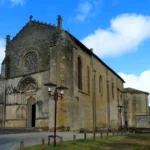
Chapelle Notre-Dame – Saint-Macaire
Description
English
Deutsch
Dutch
Español
Italiano
Description
Les ursulines se sont installées auprès de la chapelle Saint-Michel, attestée dès le XIVe siècle, qui accompagnait un cimetière hors les murs, face à la porte principale d’accès à la cité. Pillé par les huguenots, le sanctuaire a été remodelé et agrandi par les ursulines dès leur arrivée en conservant le chevet plat et en ajoutant une voûte de bois. Le décor en trompe l’œil a été retouché à la Révolution puisque l’édifice est devenu le siège du club des Jacobins, mais le portail d’entrée conserve les armes de François de Sourdis. La configuration intérieure actuelle date de 1861, époque de la reconquête catholique portée en Bordelais par le Cardinal Donnet.
English
The Ursulines settled near the Saint-Michel chapel, attested as early as the 14th century, which accompanied a cemetery outside the walls, facing the main gate to the city. Looted by the Huguenots, the sanctuary was remodelled and enlarged by the Ursulines as soon as they arrived, keeping the flat chevet and adding a wooden vault. The trompe l'oeil decoration was retouched during the Revolution as the building became the headquarters of the Jacobins' club, but the entrance portal retains the arms of François de Sourdis. The present interior configuration dates from 1861, the time of the Catholic reconquest brought to Bordeaux by Cardinal Donnet.
Deutsch
Die Ursulinen ließen sich bei der Kapelle Saint-Michel nieder, die bereits im 14. Jahrhundert nachgewiesen wurde und einen Friedhof außerhalb der Stadtmauern gegenüber dem Haupttor zur Stadt begleitete. Das von den Hugenotten geplünderte Heiligtum wurde von den Ursulinen nach ihrer Ankunft umgestaltet und vergrößert, wobei das flache Kopfende beibehalten und ein Holzgewölbe hinzugefügt wurde. Die Trompe-l'œil-Dekoration wurde während der Revolution retuschiert, da das Gebäude zum Sitz des Jakobinerklubs wurde, doch das Eingangsportal trägt noch immer das Wappen von François de Sourdis. Die heutige Inneneinrichtung stammt aus dem Jahr 1861, der Zeit der katholischen Rückeroberung, die von Kardinal Donnet in die Region Bordeaux getragen wurde.
Dutch
De zusters Ursulinen vestigden zich bij de kapel Saint-Michel, waarvan al in de 14e eeuw getuigenis wordt afgelegd en die een begraafplaats buiten de muren begeleidde, tegenover de hoofdpoort van de stad. Het door de Hugenoten geplunderde heiligdom werd door de zusters Ursulinen na hun aankomst verbouwd en vergroot, waarbij het platte chevet werd behouden en een houten gewelf werd toegevoegd. De trompe l'oeil decoratie werd gewijzigd tijdens de Revolutie toen het gebouw het hoofdkwartier werd van de Jacobijnse club, maar het ingangsportaal draagt nog steeds het wapen van François de Sourdis. De huidige inrichting dateert uit 1861, de tijd van de katholieke herovering in Bordeaux door kardinaal Donnet.
Español
Las monjas ursulinas se instalaron cerca de la capilla de Saint-Michel, atestiguada ya en el siglo XIV, que acompañaba a un cementerio extramuros, frente a la puerta principal de la ciudad. Saqueado por los hugonotes, el santuario fue remodelado y ampliado por las monjas ursulinas nada más llegar, conservando la cabecera plana y añadiendo una bóveda de madera. La decoración en trampantojo fue modificada durante la Revolución, cuando el edificio se convirtió en la sede del club jacobino, pero el portal de entrada sigue llevando las armas de François de Sourdis. La configuración interior actual data de 1861, época de la reconquista católica llevada a cabo en Burdeos por el cardenal Donnet.
Italiano
Le suore Orsoline si stabilirono nei pressi della cappella Saint-Michel, attestata già nel XIV secolo, che accompagnava un cimitero fuori dalle mura, di fronte alla porta principale della città. Saccheggiato dagli ugonotti, il santuario fu ristrutturato e ampliato dalle suore Orsoline appena arrivate, mantenendo il chevet piatto e aggiungendo una volta in legno. La decorazione a trompe l'oeil fu alterata durante la Rivoluzione, quando l'edificio divenne la sede del club giacobino, ma il portale d'ingresso reca ancora le armi di François de Sourdis. L'attuale configurazione interna risale al 1861, all'epoca della riconquista cattolica operata a Bordeaux dal cardinale Donnet.
Cours de Verdun, 33490 Saint-Macaire