Visiter l'Hôtel de ville – 21-09-2025 – Comines
Description
English
Deutsch
Dutch
Español
Italiano
Description
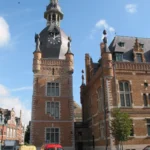
### **A découvrir en intérieur (au rez-de-chaussée et au premier étage) :** Le vestibule, l'escalier et les salons d'honneur, leur décoration architecturale de briques, leurs vitraux thématiques (grandes familles seigneuriales, légendes, savoir-faire textile…), le médaillon de la cheminée à l'éffigie de Philippe de Commynes, ainsi qu'un plan relief de Comines au XVIIème siècle et un métier à tisser datant du XIXème siècle. ### **A observer à l'extérieur :** L'architecture mélant les styles "régionalisme – renaissance néoflamande" et "art-déco", oeuvre du célèbre architecte Louis-Marie Cordonnier qui s'est inspiré du "vocabulaire" de l'ancien beffroi (détruit en 1918), pour uniformiser l'architecture de l'ensemble de l'Hôtel de ville (la Mairie et son beffroi).
_**A noter que le beffroi (partie du bien sériel "Beffrois de Belgique et de France" reconnu Patrimoine mondial par l'UNESCO) n'est pas accessible à l'occasion de cette ouverture exceptionnelle de l'Hôtel de ville.**_
_Les visiteurs sont invités à découvrir son architecture seingulière, en particulier son bulbe et sa flèche, depuis la Grand place, en notant leur "symétrie" avec divers éléments architecturaux de la toiture de l'Hôtel de ville._
English
### **To discover indoors (first floor and second floor):** The vestibule, staircase and lounges of honor, their brick architectural decoration, their thematic stained glass windows (great seigneurial families, legends, textile know-how…), the fireplace medallion bearing the effigy of Philippe de Commynes, as well as a 17th-century relief plan of Comines and a 19th-century weaving loom. ### To be seen outside:** The architecture, a blend of "regionalism – neo-Flemish renaissance" and "art-deco" styles, is the work of renowned architect Louis-Marie Cordonnier, who drew inspiration from the "vocabulary" of the old belfry (destroyed in 1918), to unify the architecture of the entire Town Hall (the Town Hall and its belfry).
please note that the belfry (part of the UNESCO World Heritage Site "Belfries of Belgium and France") is not accessible during this exceptional opening of the Town Hall
visitors are invited to discover the belfry's distinctive architecture, in particular its bulb and spire, from the Grand Place, noting their "symmetry" with various architectural elements of the Town Hall's roof.**_
Deutsch
### **In Innenräumen zu entdecken (im Erdgeschoss und im ersten Stock) :** Das Vestibül, die Treppe und die Ehrensalons, ihre architektonische Dekoration aus Ziegelsteinen, ihre thematischen Glasfenster (große Herrscherfamilien, Legenden, textiles Know-how…), das Medaillon im Kamin mit dem Bildnis von Philippe de Commynes sowie ein Reliefplan von Comines im 17. Jahrhundert und ein Webstuhl aus dem 19. ### **Außenansicht:** Die Architektur, die die Stile "Regionalismus – Neo-Flämische Renaissance" und "Art-Deco" mischt, ist ein Werk des berühmten Architekten Louis-Marie Cordonnier, der sich vom "Vokabular" des alten Belfrieds (1918 zerstört) inspirieren ließ, um die Architektur des gesamten Rathauses (das Rathaus und sein Belfried) zu vereinheitlichen.
_**Anmerkung: Der Belfried (Teil des von der UNESCO als Weltkulturerbe anerkannten seriellen Gutes "Belfriede von Belgien und Frankreich") ist anlässlich dieser außergewöhnlichen Öffnung des Rathauses nicht zugänglich.**__
Dutch
### Binnen (begane grond en eerste verdieping):** De vestibule, het trappenhuis en de salons van eer, hun bakstenen architecturale decoratie, hun thematische glasramen (grote adellijke families, legendes, textielkennis, enz.), het medaillon in de schouw met het portret van Philippe de Commynes, evenals een reliëfplattegrond van Comines in de 17e eeuw en een weefgetouw uit de 19e eeuw. ### Buiten te zien:** De architectuur, een mix van "regionalisme – neo-Vlaamse renaissance" en "art-deco" stijlen, is het werk van de beroemde architect Louis-Marie Cordonnier, die zich liet inspireren door de "woordenschat" van het oude belfort (vernield in 1918) om de architectuur van het hele stadhuis (het stadhuis en zijn belfort) te verenigen.
let op: het belfort (dat deel uitmaakt van het UNESCO Werelderfgoed "Belforten van België en Frankrijk") is niet toegankelijk tijdens deze speciale opening van het Stadhuis
bezoekers worden uitgenodigd om de unieke architectuur, in het bijzonder de bol en de torenspits, vanaf de Grote Markt te ontdekken en hun "symmetrie" met verschillende architecturale elementen op het dak van het Stadhuis op te merken
Español
### Interior (planta baja y primer piso):** El vestíbulo, la escalera y los salones de honor, su decoración arquitectónica de ladrillo, sus vidrieras temáticas (grandes familias nobles, leyendas, pericia textil, etc.), el medallón de la chimenea con el retrato de Philippe de Commynes, así como un plano en relieve de Comines en el siglo XVII y un telar del siglo XIX. ### Para ver en el exterior:** La arquitectura, mezcla de estilos "regionalismo – renacimiento neoflamenco" y "art-deco", es obra del célebre arquitecto Louis-Marie Cordonnier, que se inspiró en el "vocabulario" del antiguo campanario (destruido en 1918) para unificar la arquitectura de todo el Ayuntamiento (la Casa Consistorial y su campanario).
tenga en cuenta que el campanario (parte del Patrimonio Mundial de la UNESCO "Campanarios de Bélgica y Francia") no es accesible durante esta apertura especial del Ayuntamiento
se invita a los visitantes a descubrir su arquitectura única, en particular su bulbo y su aguja, desde la Grand Place, observando su "simetría" con diversos elementos arquitectónicos del tejado del Ayuntamiento
Italiano
### All'interno (piano terra e primo piano):** Il vestibolo, lo scalone e i saloni d'onore, la loro decorazione architettonica in mattoni, le vetrate tematiche (grandi famiglie nobili, leggende, competenze tessili, ecc.), il medaglione del camino con il ritratto di Philippe de Commynes, nonché una pianta in rilievo di Comines nel XVII secolo e un telaio del XIX secolo. ### Da vedere all'esterno:** L'architettura, un mix di "regionalismo – rinascimento neofiammingo" e "art-deco", è opera del famoso architetto Louis-Marie Cordonnier, che si è ispirato al "vocabolario" del vecchio campanile (distrutto nel 1918) per unificare l'architettura dell'intero municipio (il municipio e il suo campanile).
si prega di notare che il campanile (parte del patrimonio mondiale dell'UNESCO "Campanili del Belgio e della Francia") non è accessibile durante questa apertura straordinaria del Municipio
i visitatori sono invitati a scoprire la sua architettura unica, in particolare il bulbo e la guglia, dalla Grand Place, notando la loro "simmetria" con i vari elementi architettonici sul tetto del Municipio
grand' place, 59560 Comines