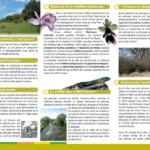
Pelouse calcaire au lieu-dit grauve – Ottange
Description
English
Deutsch
Dutch
Español
Italiano
Description
Insectes, oiseaux, végétaux rares, ils prennent délicatement leur place et s'installent au creux des pelouses marneuses de la Grauve. On y découvre l'anémone pulsatille qui, le saviez-vous, servait de teinture pour les œufs de Pâques. Orchidée, trèfle rouge ou thym font également partie de ces rubans de couleurs fragiles et protégés. Si l'on ferme les yeux on entend le doux et harmonieux chant des oiseaux : bruant jaune, espèce rare, pouillot, fauvette grise, mésange bleue. Ils se cachent et se nourrissent dans les nombreux arbustes et buissons qui baignent la pelouse. D'autres petits insectes rampant et papillons sont au rendez-vous. De quoi se rappeler que la nature est riche, belle et mérite qu'on la (re)découvre.
English
Insects, birds, rare plants, they delicately take their place and settle in the hollows of the Grauve's marly lawns. You'll discover the pulsatilla anemone, which you may have heard was used to dye Easter eggs. Orchids, red clover and thyme are also part of these fragile, protected ribbons of color. If you close your eyes, you can hear the sweet, harmonious song of birds: rare yellowhammer, warbler, gray warbler, blue tit. They hide and feed in the many shrubs and bushes that line the lawn. Other small creeping insects and butterflies are also present. A reminder that nature is rich, beautiful and worth (re)discovering.
Deutsch
Insekten, Vögel, seltene Pflanzen – sie alle nehmen behutsam ihren Platz ein und lassen sich in den Mergelrasen der Grauve nieder. Hier findet man die Anemone pulsatille, die früher zum Färben von Ostereiern verwendet wurde. Auch Orchideen, Rotklee und Thymian gehören zu den empfindlichen und geschützten Farbbändern. Wenn man die Augen schließt, hört man den sanften und harmonischen Gesang der Vögel: die seltene Goldammer, den Teichrohrsänger, die Mönchsgrasmücke und die Blaumeise. Sie verstecken und ernähren sich in den zahlreichen Sträuchern und Büschen, die den Rasen umspülen. Auch andere kleine Krabbeltiere und Schmetterlinge sind hier anzutreffen. So wird man daran erinnert, dass die Natur reich und schön ist und es verdient, dass man sie (wieder) entdeckt.
Dutch
Insecten, vogels en zeldzame planten nemen subtiel hun plaats in in de holtes van de gazons van mergel van Grauve. Hier vind je de pulsatilla anemoon, waarvan je misschien hebt gehoord dat hij werd gebruikt om paaseieren te verven. Orchideeën, rode klaver en tijm maken ook deel uit van deze fragiele en beschermde linten van kleur. Als je je ogen sluit, kun je het zachte, harmonieuze gezang van de vogels horen: de zeldzame gele gors, de grasmus, de grauwe klauwier en de pimpelmees. Ze verstoppen zich en voeden zich in de vele struiken en bosjes die langs het gazon staan. Andere kleine kruipende insecten en vlinders zijn ook aanwezig. Het is een mooie herinnering dat de natuur rijk en mooi is en het (her)ontdekken waard.
Español
Insectos, aves y plantas raras ocupan delicadamente su lugar en los huecos de los prados de marga de Grauve. Aquí encontrará la anémona pulsatilla, de la que habrá oído que se utilizaba para teñir los huevos de Pascua. Orquídeas, trébol rojo y tomillo también forman parte de estas frágiles y protegidas cintas de color. Si cierras los ojos, podrás oír el suave y armonioso canto de los pájaros: el raro escribano amarillo, la curruca mosquitera, la curruca mosquitera y el herrerillo común. Se esconden y alimentan en los numerosos arbustos y matas que bordean el césped. También hay otros pequeños insectos rastreros y mariposas. Es un gran recordatorio de que la naturaleza es rica, hermosa y merece la pena (re)descubrirla.
Italiano
Insetti, uccelli e piante rare prendono delicatamente posto nelle cavità dei prati di marna Grauve. Qui si trova l'anemone pulsatilla, che forse avete sentito dire che veniva usata per tingere le uova di Pasqua. Anche le orchidee, il trifoglio rosso e il timo fanno parte di questi fragili e protetti nastri di colore. Se si chiudono gli occhi, si può sentire il canto dolce e armonioso degli uccelli: il raro zigolo giallo, lo svergognatore, la cinciallegra e la cinciarella. Si nascondono e si nutrono nei numerosi arbusti e cespugli che costeggiano il prato. Sono presenti anche piccoli insetti striscianti e farfalle. È un ottimo promemoria per ricordare che la natura è ricca, bella e vale la pena di essere (ri)scoperta.
Clientèle: Tout public - Groupes
Cité Sainte-Barbe, 57840 Ottange