ÉGLISE DE GEU
Description
English
Deutsch
Dutch
Español
Italiano
Description
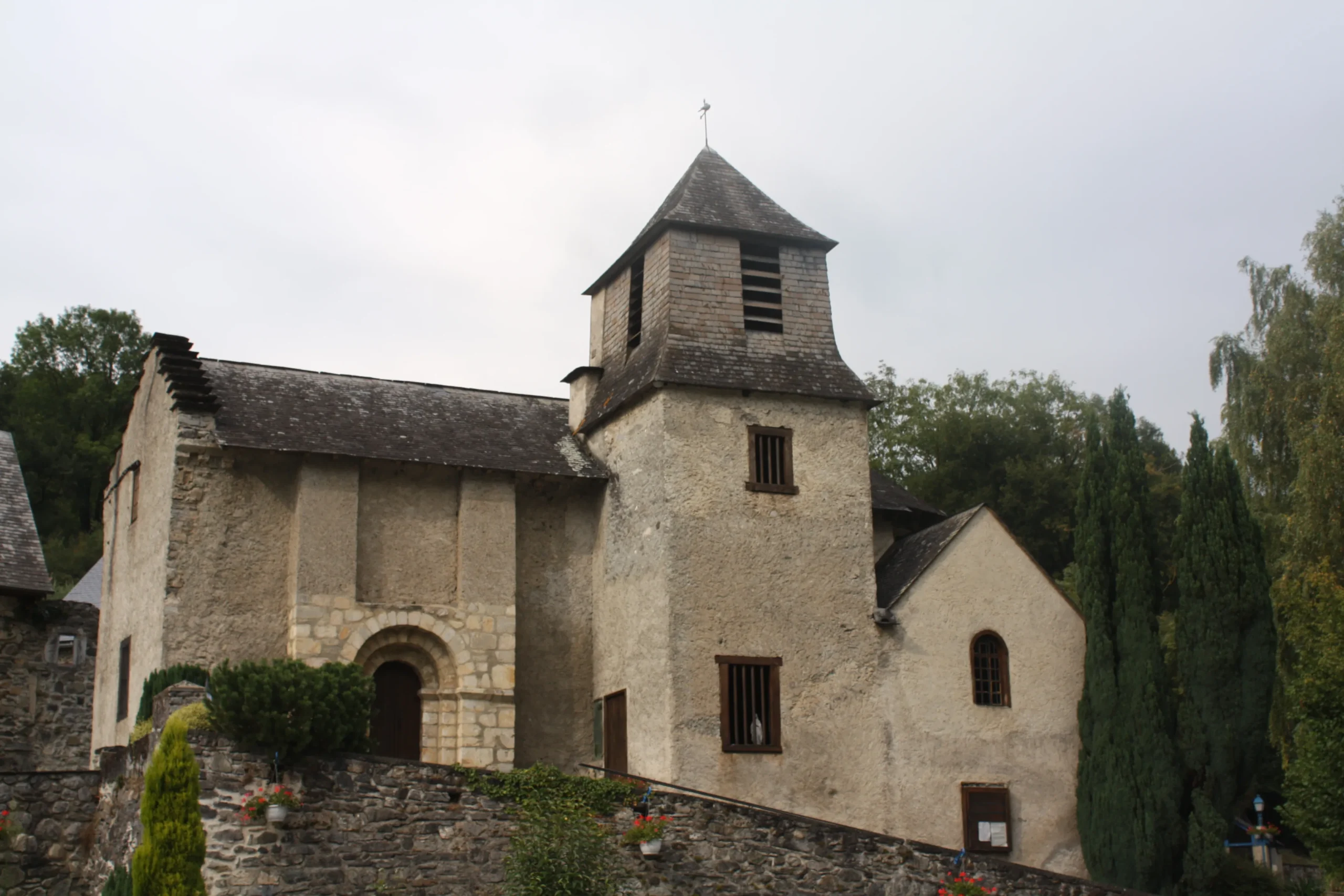
L’église de Saint-Martin, avec son pignon à penàus (redents) et son clocher-tour est de style roman (XIIIe siècle). D’une grande simplicité, cet édifice à nef unique, sans transept et à chevet semi-circulaire à pilastres (contreforts) et à modillons frustres, mérite un détour. Deux des quatre contreforts sur la façade nord ont été supprimés pour réaliser deux grandes ouvertures. Et certains modillons côté sud, paraissent sculptés. Son entrée à 3 voussures, dont la première a été réalisée dans 2 contreforts plats, est surmontée du plus petit chrisme du Lavedan. À l'ouest, le bâtiment se termine par un mur pignon à redents protégés par de larges dalles de schiste. Le clocher est plus tardif.
English
The church of Saint-Martin, with its penàus (toothed) gable and its bell-tower is in Romanesque style (13th century). Of great simplicity, this building with a single nave, no transept and a semi-circular chevet with pilasters (buttresses) and frusto modillions, is worth a detour. Two of the four buttresses on the north façade have been removed to make two large openings. And some of the modillions on the south side appear to be sculpted. Its entrance with 3 arches, the first of which was made in 2 flat buttresses, is surmounted by the smallest Lavedan chrism. To the west, the building ends in a gable wall with teeth protected by large schist slabs. The bell tower is later.
Deutsch
Die Kirche Saint-Martin mit ihrem Giebel mit Penàus (Schrägen) und ihrem Glockenturm ist im romanischen Stil (13. Jh.) erbaut. Dieses schlichte Gebäude mit einem einzigen Schiff, ohne Querschiff und einem halbrunden Kopfende mit Pilastern (Strebepfeilern) und frustrierten Modillons ist einen Umweg wert. Zwei der vier Strebepfeiler an der Nordfassade wurden entfernt, um zwei große Öffnungen zu schaffen. Einige Modillons an der Südseite wirken wie geschnitzt. Der Eingang mit drei Gewölben, von denen das erste in zwei flache Strebepfeiler eingearbeitet wurde, wird vom kleinsten Chrisam in Lavedan gekrönt. Im Westen endet das Gebäude mit einer Giebelwand mit Stufen, die von breiten Schieferplatten geschützt werden. Der Glockenturm stammt aus späterer Zeit.
Dutch
De kerk van Saint-Martin, met zijn gevel met penàus (redenten) en zijn klokkentoren is in romaanse stijl (13e eeuw). Dit zeer eenvoudige gebouw met een enkel schip, geen dwarsschip en een halfrond chevet met pilasters (steunberen) en gefrustreerde modillions is een bezoek waard. Twee van de vier steunberen aan de noordgevel zijn verwijderd om twee grote openingen te creëren. Sommige van de modillions aan de zuidkant lijken gebeeldhouwd. De ingang met 3 bogen, waarvan de eerste is uitgevoerd in 2 platte steunberen, wordt bekroond door het kleinste Chrisma in Lavedan. In het westen eindigt het gebouw met een gevel die beschermd wordt door grote platen schist. De klokkentoren is later.
Español
La iglesia de Saint-Martin, con su frontón con penàus (redentes) y su campanario es de estilo románico (siglo XIII). Este edificio, muy sencillo, de una sola nave, sin crucero y con una cabecera semicircular con pilastras (contrafuertes) y modillones frustrados, merece una visita. Dos de los cuatro contrafuertes de la fachada norte se han eliminado para crear dos grandes aberturas. Algunos de los modillones del lado sur parecen estar esculpidos. Su entrada con 3 arcos, el primero de ellos realizado en 2 contrafuertes planos, está coronada por el crismón más pequeño de Lavedan. Al oeste, el edificio termina con un muro a dos aguas protegido por grandes losas de esquisto. El campanario es posterior.
Italiano
La chiesa di Saint-Martin, con il suo timpano con penàus e il suo campanile, è in stile romanico (XIII secolo). Vale la pena di visitare questo edificio molto semplice, a navata unica, senza transetto e con un chevet semicircolare con pilastri (contrafforti) e modiglioni frustrati. Due dei quattro contrafforti della facciata nord sono stati rimossi per creare due grandi aperture. Alcuni dei modiglioni sul lato sud sembrano scolpiti. Il suo ingresso a 3 archi, il primo dei quali realizzato in 2 contrafforti piatti, è sormontato dal più piccolo crisma di Lavedan. A ovest, l'edificio termina con un muro a timpano protetto da grandi lastre di scisto. Il campanile è successivo.