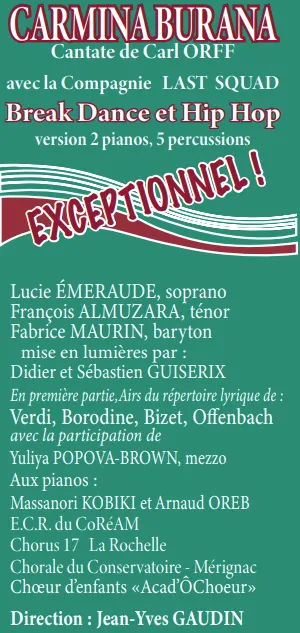
Les Coréades 2025 – Carmina Burana, Cantate de Carl ORFF à Niort – 11-10-2025 – Niort
My Tourisme > Evénements > Evénements Culturels > Les Coréades 2025 – Carmina Burana, Cantate de Carl ORFF à Niort – 11-10-2025 – Niort
Description
English
Deutsch
Dutch
Español
Italiano
Description
Qui n’a jamais entendu le célèbre « O Fortuna » ouvrant et concluant Carmina Burana ? Ses rythmes puissants marquent l’auditeur. En 1934, Carl Orff découvre un recueil de 200 poèmes médiévaux en bas-latin, moyen-haut allemand et vieux français. Séduit, il compose un an plus tard sa cantate scénique, célébrant l’amour, le vin et la danse. Le titre, « Chants de Beuren », fait référence à l’abbaye bavaroise de Benediktbeuern. L’œuvre se divise en 25 tableaux, autour du printemps, de la taverne et de l’amour. Riche et théâtrale, elle mêle chant grégorien, folklore, polyphonie allemande et accents orientalistes. Elle sera ici accompagnée par la compagnie de break dance bordelaise Last Squad. Renseignements et réservations via www.coream.org ou [email protected] ou au 05.49.09.03.11
English
Who hasn?t heard the famous "O Fortuna" that opens and closes Carmina Burana? Its powerful rhythms leave a lasting impression on the listener. In 1934, Carl Orff discovered a collection of 200 medieval poems in Low Latin, Middle High German and Old French. Seduced, he composed his scenic cantata a year later, celebrating love, wine and dance. The title, "Chants de Beuren", refers to the Bavarian abbey of Benediktbeuern. The work is divided into 25 tableaux, revolving around springtime, the tavern and love. Rich and theatrical, it blends Gregorian chant, folklore, German polyphony and oriental accents. She will be accompanied here by the Bordeaux break-dance company Last Squad. Information and bookings via www.coream.org or [email protected] or 05.49.09.03.11
Deutsch
Wer kennt es nicht, das berühmte "O Fortuna", das Carmina Burana eröffnet und abschließt? Die kraftvollen Rhythmen prägen den Zuhörer. 1934 entdeckte Carl Orff eine Sammlung von 200 mittelalterlichen Gedichten in Niederlatein, Mittelhochdeutsch und Altfranzösisch. Ein Jahr später komponierte er seine szenische Kantate, in der er die Liebe, den Wein und den Tanz feierte. Der Titel "?Lieder von Beuren?" bezieht sich auf die bayerische Abtei Benediktbeuern. Das Werk ist in 25 Bilder unterteilt, die sich um den Frühling, die Taverne und die Liebe drehen. Es ist ein reiches, theatralisches Werk, das gregorianische Gesänge, Folklore, deutsche Polyphonie und orientalische Akzente miteinander verbindet. Begleitet wird sie hier von der Bordeaux-Break-Dance-Company Last Squad. Informationen und Reservierungen über www.coream.org oder [email protected] oder unter 05.49.09.03.11
Dutch
Wie kent niet het beroemde "O Fortuna" waarmee Carmina Burana opent en sluit? De krachtige ritmes laten een blijvende indruk achter op de luisteraar. In 1934 ontdekte Carl Orff een verzameling van 200 middeleeuwse gedichten in het Nederlatijn, Middelhoogduits en Oudfrans. Verleid door deze gedichten componeerde hij een jaar later zijn podiumcantate, waarin liefde, wijn en dans worden gevierd. De titel, "Liederen uit Beuren", verwijst naar de Beierse abdij Benediktbeuern. Het werk is onderverdeeld in 25 tableaus, waarin de lente, de taveerne en de liefde centraal staan. Het is rijk en theatraal en mengt gregoriaans, folklore, Duitse polyfonie en oosterse accenten. Ze wordt hier begeleid door het breakdancegezelschap Last Squad uit Bordeaux. Informatie en boekingen via www.coream.org of [email protected] of 05.49.09.03.11
Español
¿Quién no ha escuchado alguna vez el famoso "O Fortuna" que abre y cierra Carmina Burana? Sus poderosos ritmos dejan una huella imborrable en el oyente. En 1934, Carl Orff descubrió una colección de 200 poemas medievales en bajo latín, alto alemán medio y francés antiguo. Seducido por ella, un año después compuso su cantata escénica, que celebra el amor, el vino y la danza. El título, "Canciones de Beuren", hace referencia a la abadía bávara de Benediktbeuern. La obra se divide en 25 cuadros, centrados en la primavera, la taberna y el amor. Rica y teatral, mezcla canto gregoriano, folclore, polifonía alemana y acentos orientales. Aquí estará acompañada por la compañía bordelesa de break dance Last Squad. Información y reservas en www.coream.org o [email protected] o 05.49.09.03.11
Italiano
Chi non ha mai sentito il famoso "O Fortuna" che apre e chiude i Carmina Burana? I suoi ritmi potenti lasciano un'impressione duratura sull'ascoltatore. Nel 1934, Carl Orff scoprì una raccolta di 200 poesie medievali in basso latino, medio-alto tedesco e francese antico. Sedotto da essa, un anno dopo compose la sua cantata scenica, che celebrava l'amore, il vino e la danza. Il titolo, "Canti di Beuren", si riferisce all'abbazia bavarese di Benediktbeuern. L'opera è suddivisa in 25 tableaux, incentrati sulla primavera, sulla taverna e sull'amore. Ricca e teatrale, fonde canto gregoriano, folclore, polifonia tedesca e accenti orientali. Sarà accompagnata dalla compagnia di break dance di Bordeaux Last Squad. Informazioni e prenotazioni su www.coream.org o [email protected] o 05.49.09.03.11